Tourism and recreation pressure on the coast
Tourism is of major economic significance in Australia and is overwhelmingly the major employer in coastal towns and cities outside the metropolitan areas. About three-quarters of economic activity in this sector can be attributed to domestic tourism, and one quarter to international tourism. This activity accounts for about 6% of the Australian economy: in terms of employment, tourism is dominant throughout coastal areas.
The coastal zone is the principal focus for tourism in Australia:
'In terms of accommodation nights, 47% of all tourism activity (international and domestic, 1990-91) in Australia takes place in the non-metropolitan coastal zone, 30% takes place in the capital cities, and the remainder is spread over the rest of Australia.'
Source: RAC (1993b), p. 56
A great deal of this activity is on the east coast; in fact, nearly three- quarters of accommodation nights spent within the non-metropolitan coastal zone are in New South Wales and Queensland. The Gold Coast (2.3 million visitors per year on visits of more than one day) and the Sunshine Coast are the two most important regions.
Over 3 million international tourists come to Australia each year (Commonwealth of Australia 1997), the great majority include a visit to coastal locations. About half of the international tourists engage in activities in coastal waters, including swimming, surfing, scuba diving and snorkelling. Foreign exchange from international tourism earned $16 billion per year in the mid 1990s, and was Australia's most important export industry.
For nearly all Australians the coast is where the annual holiday is taken, and it is the most frequented location for recreation. The numbers of participants generate significant industries for some activities; for example, recreational fishing (estimated at 1.5 million annually), water sports (2 million) and boating activities (80 000 boat owners). Overwhelmingly, the weight of numbers is near the capital cities and along the length of the east coast of the continent.
The description by Bird and Cullen (1990) of the recreational uses of Port Phillip Bay and the management problems is one that might be applied to the coast near many Australian cities. Of the water-based activities, swimming is the most popular, undertaken by approximately a third of a million people. Many ramps, harbours, marinas, and moorings around the Bay serve the tens of thousands involved in fishing, power boating and water skiing. The conditions of the Bay are excellent for sailing, sailboarding and canoeing. Land-based activities are facilitated by the Crown coastal reserves, which back about half the total length of the Bay's foreshore. This ensures general public access to the shore as well as providing the space for sports facilities, showers, barbecue sites, designated camping areas, car parking and club facilities.
Management of the recreational activities and the impacts of the activities of the four million people who live around Port Phillip Bay is a challenge to the large range of state and local agencies who manage the coast. Coastal erosion of the recreational beaches is widespread around the bay, mainly due to the hard protection of the eroding cliffs, which formerly supplied sand to the beaches. Eighteen beaches have required sand nourishment by dredging and bulldozing sand from the Bay floor. Water quality has been a concern to all bay users. Sediment run-off from expanding suburbs as well as farmland has elevated turbidity levels after rainstorms. Raised nutrient levels and signs of eutrophication occur near sewage outlets. Concerns have been raised over heavy metal concentrations (mercury, lead and cadmium) as well as reports of pesticide and hydrocarbon levels. Water pollution has been regulated and in many cases reduced by state government intervention, but the benthic biota of the Bay itself appears to have assimilated raised nitrogen levels (see page 131). It could be argued that coastal recreation, as well as contributing to the degradation of the Port Philip Bay environment, has also been important in raising public awareness of change and deterioration. This awareness has been significant in motivating public responses to manage the problems.
Growth of tourism and recreational activities has continued around the Australian coast throughout the 1980s and 1990s. Not all of this has been near the centres of population; it has occurred in all but the most remote locations. Road improvement and the very rapid rise in ownership of off-road recreational vehicles means that significant numbers of people can spend the long weekend or the holiday camping at the elusive 'untouched' beach. As a result, on the remote beaches as well as near the towns there has been a rising demand for infrastructure, which increases pressure on the coastal environment. State and local governments are called upon to provide water, sewerage, waste disposal, power, roads, parking, landscaping, signs, rest rooms, camp grounds, lookouts, interpretation, barbecue, and picnic facilities. Remote beaches and estuaries, where few facilities are needed for most of the year, may see the regular influx of hundreds in January, and a failure to provide basic facilities can lead to gross environmental impacts. Frequently, local community groups are involved in the provision and maintenance of facilities within coastal reserves, thereby improving tourism's basic resource.
The Mecca for Australian off-road vehicle owners is Fraser Island, voted the nation's favourite 'Place of the Heart' in an Australian Heritage poll. A brief survey of the giant sand island by John Sinclair for FIDO (Fraser Island Defenders Organisation) in 1999 showed gross impacts on the bird numbers of the eastern beach, which has become a heavily used 4WD road, with a fatal impact on nesting sites (Sinclair 2000). Sand tracks and camping sites within the rainforest are reported to be causing sediment run-off into creeks and perched lakes, famous for their natural clarity. Sinclair ascribes much of the current damage to the island to poor management and lack of state government financial commitment, despite the National Park and World Heritage status of the island.
Around the Australian coast the off-road vehicle has not replaced, but added to, the impact of the holiday home. The impact of vehicles and homes depends on how the use of the coast is managed, rather than the nature of the use in itself, as the following case of South Australia's beach shacks illustrates.
Box 3.2 Holiday homes in South Australia: The beach shack
'If there is one thing that symbolises the Australian way of life it is leisure time in a weekend house, preferably near the sea.'
Source: Harry Seidler: introduction to Beach Houses of Australia and New Zealand
by Stephen Crafti
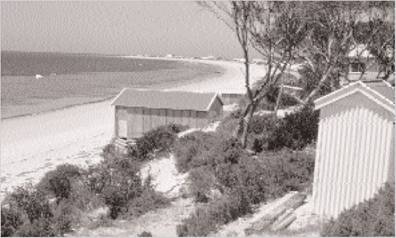
Figure 3.5 Yorke Peninsula beach shacks
(photography Ken Bardsley)
South Australia is well endowed with beaches, and many of them have groups of holiday homes established as dwellings on leasehold allotments on Crown land: the holiday shacks. Many of the shack sites were leased by the state government (and a few by local councils) in the 1950s and 1960s, and by 1970 a state review found that there were approximately 7000 beach shack dwellings of varied quality: many were of fibro and tin, others were of more substantial construction. These groups of shacks constituted a series of small, unplanned summer settlements around the state's coast. The shacks also constituted significant places in the lives of several tens of thousands of South Australians: places of family memories, places visited at times of personal decisions and, for some, places to which to retire.
Concern over the impacts of these settlements and the difficulties of infrastructure provision led to a series of government reviews, and as a result there were some improvements in services, freeholding of many sites, and the removal of a few dwellings. By the time of the last state-wide review, in 1991, some 1600 leasehold coastal shack sites remained: the shacks with problems unresolved by previous review. The 1991 review was termed an 'Assessment of Crown Lease Coastal Shack Sites in Accordance with Environmental Sustainability Criteria' (PPK 1991). The criteria were applied to groups of shack sites and stated that sites:
• should have safe legal access
• should not inhibit public access and use of the foreshore
• should meet reasonable planning and health standards, such as those relating to the site acceptability for septic disposal
• should allow reasonable dune and beach management
• should not be threatened by coastal flooding or erosion
• the shack area should be visually acceptable and the structures sound. These criteria are valuable in pointing up the common impacts of this form of coastal recreational land use. The 1991 assessment found that the great majority of shacks did not meet the criteria: only 5% did so, although some had the potential to meet the criteria.
This careful effort by agencies did not inhibit the newly elected state government of 1994, which decided to freehold all shacks (as a declared policy, which attracted no discussion before the election). As well as ignoring the 1991 review, the policy was a radical approach to coastal planning. The free- holding of sites contravened the objectives and principles within development plans for most coastal councils; in many cases it also contravened the state policy on flooding and erosion (with specific allowance for sea level rise) placed in the development plan the previous year. The radical nature of this approach was acknowledged in the planning instrument (PAR) to implement the shack freeholding (SA Department of Planning 1997, p. x): 'The PAR will, in effect, create a two tiered level of policies along the coastline ... New development generally will have to comply with the current planning criteria. On the other hand, the land division and upgrading of existing lawfully erected shacks on Crown land along the coastline will have to meet the criteria of this PAR.' Thus, in an unintended way, the emotional regard for a traditional recreational use of the Crown coastal reserve completely undermined the credibility of a state's coastal planning policy. The significance of recreational use of coastal lands in Australia should not be underestimated.
Box 3.3 Managed tourism in a protected area: Great Barrier Reef
The Great Barrier Reef (is one of Australia's top tourist destinations for international visitors. Tourist numbers have grown most markedly since the Reef gained World Heritage status in 1981. Tourist numbers have continued to increase through the 1990s, notably the number of international visitors. The pattern of visitation is to stay at one of a number of coastal towns, or at one of the resort islands, and to visit the reef by boat to fish, dive, snorkel and swim. Major cruise companies often include the Reef in the itinerary of liners in the region.
Table 3.12 Total nights spent by tourists in Far North Queensland
|
Domestic visitors |
International visitors |
||
|
1989-90 |
5 486 000 |
1989 |
2 702 000 |
|
1991-92 |
6 482 000 |
1991 |
3 284 000 |
|
1993-94 |
6 177 000 |
1993 |
3 326 000 |
Source: Bureau of Tourism Research, cited in ABS 1996
Table 3.13 Recreational activities permitted in the zones of the Great Barrier Reef Marine Park
|
Activity |
General use |
Marine National Park |
|||||
|
Zone A |
Zone B |
A Zone |
Buffer |
B Zone |
Scientific |
Preservation |
|
|
research |
Zone |
||||||
|
zone |
|||||||
|
Boating |
Yes |
Yes |
Yes |
Yes |
Yes |
No |
No |
|
Collecting (e.g. fish, shells) |
Permit |
Permit |
No |
No |
No |
No |
No |
|
Dive, swim, snorkel |
Yes |
Yes |
Yes |
Yes |
Yes |
No |
No |
|
Line fishing (by hand) |
Yes |
Yes |
Yes |
No |
No |
No |
No |
|
Netting |
Yes |
Yes |
Permit |
No |
No |
No |
No |
|
Trolling |
Yes |
Yes |
Yes |
Yes |
No |
No |
No |
|
Spear-fishing (without scuba) |
Yes |
Yes |
No |
No |
No |
No |
No |
|
Traditional fishing |
Yes |
Yes |
Yes |
Permit |
Permit |
Permit |
No |
Source: Coveney 1993
Kelleher and Dinesan (1993) noted a number of potential and actual impacts of tourism on the reef, including:
• damage to coral from reef walking and intensive diving, and from anchors
• development involving land reclamation or mangrove destruction
• excavation and dredging leading to habitat destruction and raised turbidity levels
• the effects of fixed or moored structures on reefs and fish populations
• waste and litter from vessels
• the effects of fish-feeding on fish populations.
The impact on fish stocks from fishing is a significant management issue and a matter of ongoing revie w.
Kelleher and Dinesan (1993) stated that the major impact of visitors to the area is through raised water nutrient levels from the towns catering for the tourists.
The impact of visitor activities to the Reef itself is actively managed through interpretation, guidelines for visitors, codes of practice for tour operators, and regulation of some activities, including zoning of the reef. A range of monitoring, principally by the Great Barrier Reef Marine Park Authority, the James Cook University, and the Australian InstiUite of Marine Science, informs this process.
Research by the Great Barrier Reef Marine Park Authority lias confirmed die economic significance of the Reef to the region; the small contribution of users to die management budget raises important questions about the appropriate responsibility for management costs (see chapter 4).
Table 3.14 Economic valuation of the Great Barrier Reef, 1991-92
|
Value of tourism and recreation |
$776 million |
|
Other uses of the Reef |
$147 million |
|
Total measured value |
$923 million |
|
Management budget |
$18.1 million |
|
Revenue from users |
$0.8 million |
Source: Driml 1994

