Cumulative Prospect Theory (CPT)
Tversky and Kahneman (1992) have later developed a new version of PT that employs cumulative rather than separable decision weights. This version, called CPT, applies to uncertain as well as to risky prospects with any number of outcomes. CPT applies the cumulative functional separately to gains and to losses. An uncertain prospect f is a function from a finite set of states of nature S into a set of outcomes X, that assign each state an outcome. To define the cumulative functional, the outcomes of each prospect are arranged in increasing order of their values. A prospect f is then represented as a sequence of pairs  , which yields
 if
 occurs, where
 iff
 and
 is a partition of S. Positive subscripts are used to denote positive outcomes, negative subscripts to denote negative outcomes, and the zero subscript to index neutral outcome. The positive part of f, denoted
 , is obtained by letting
 , and
 . The negative part of f denoted
 , is defined equivalently. CPT asserts that there exist a strictly increasing value function v :
 , satisfying
 , and decision weights functions
 and
 , such that for
 ,
 (11.3)
 (11.4)
 (11.5)
where  is the prospect gains value,
 is the prospect losses value,

 are the decision weights of the gains, and
 are the decision weights of the losses.
If the prospect  is given by a probability distribution
 , it can be viewed as a probabilistic or risky prospect
 . In this case, decision weights are defined by:
 (11.6)
 (11.7)
 (11.8)
 (11.9)
where  and
 are strictly increasing functions from the unit interval into itself satisfying:
 (11.10)
 (11.11)
The following functional form for the value function (Tversky & Kahneman, 1992) fits the CPT assumptions:
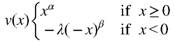 (11.12)
The parameter  describes the degree of loss aversion and the parameters
 measure the degree of diminishing sensitivity.
 represents the case of pure loss aversion.
The weighting functions proposed by Tversky and Kahneman (1992) for gains and losses are, respectively:
 (11.13)
 (11.14)
The curvature of the weighting function, as well as the point where it crosses the 45° line, are defined by the parametric values of and
 :. Decreasing
 and
 causes the weighting function to become more curved and to cross the 45° line farther to the right.
Alternative functional forms for the decision weight function, that captures the same behavioural assumptions, were suggested by Goldstein and Einhorn (1987), Prelec (1998) and others (for an overview, see Rasouli & Timmermans, in press).
Tversky and Kahneman (1992) estimated the parameters  and
 . The values which best fit their experimental results are:
 ;
 and
 as median values. Although similar estimations were found in different data sets from different decision-making tasks (Benartzi & Thaler, 1995; Camerer & Ho, 1994; Wu & Gonzalez, 1996), and even in route-choice modelling (Avineri & Prashker, 2004), these values should not be treated as universal and should be estimated empirically for specific applied contexts of CPT (for a discussion of this issue see Avineri, 2006; Avineri & Bovy, 2008). In specific, Avineri (2006) argues that it is not trivial to assume that the parameter values estimated by Tversky and Kahneman (1992), or in other studies of economic choices under risk, might be transferable to decision problems in the travel behaviour domain. These estimations have been derived from gambles that incorporated money outcomes, and any attempt to draw conclusions related to travel choice based on these values should be questioned.
One may wonder if there is a reason to assume that the violations of EUT will occur also in the context of travel choice. Such an assumption is not trivial due to two main reasons (Avineri & Prashker, 2004). First, there is a significant difference between travel choice decision-making which is commonly associated with expected travel time, and the gambling problems based on monetary values studied by Kahneman and Tversky (1979). One of Kahneman and Tversky's findings was that people are often much more sensitive to the difference between an outcome and the reference level than about the absolute value of the measured outcome. Unlike monetary outcomes associated with economic and financial decisions, travel time cannot be stored or pooled; therefore, the observation regarding sensitivity to a reference point might be of more relevance and importance in the context of travel choice problems rather than for problems dealing with selection of risky monetary assets.
Another characterisation of the route-choice problem, which makes it different from monetary-based problems, is that homogeneity of reference point values in the mind of individual travellers is not very likely. When dealing with monetary gains and losses, $0 may be a common value of the reference point. Dealing with traveller's experienced travel time, the framing of the resulted travel time as a gain or a loss is based on an individual reference point, which may be based on the traveller's past experience and expectations. Such a reference point may differ from one traveller to another.
To illustrate the relevance of PT to travel choice modelling, a route-choice experiment, inspired by Kahneman and Tversky's (1979) work, was conducted by Avineri and Prashker (2004). The participants were asked to make stated-choice preferences (SP) in response to route-choice situations. They showed that the preferences revealed in sets of route-choice problems violate EUT assumptions (regardless of the utility function shape) and on the other hand can be explained and predicted by PT. Their findings illustrated the so-called certainty effect, or Allais' Paradox (Allais, 1953, 1979), captured by the shape of the weighting function: an extreme underweighting of high probabilities, which fall short of certain outcomes, make positive certain outcomes very attractive. Another violation of EUT, the inflation of small probabilities, was also illustrated in Avineri and Prashker (2004).

