The problem with party autonomy
This book reflects on limits on party autonomy regarding dispute resolution clauses incorporated into a charterparty by the shipowner and the charterer and any B/L issued pursuant to a charterparty, and the related challenges faced by the parties.
What are the limits on party autonomy regarding jurisdiction and arbitration clauses?
Party autonomy is an acknowledged principle that allows parties the freedom to choose methods of dispute resolution and the applicable law. It is present in domestic legislation worldwide and noticeably present in EU legislation, such as the Brussels I Regulation (recast). The procedural, substantive and conflictual party autonomy to select a certain court or an arbitral tribunal, as well as the choice of applicable law, is limited by different normative frameworks due to a partial and sectorial harmonisation, preventing sufficient predictability and legal certainty in contractual relationships concerning parties’ rights and obligations with regard to disputes.
The potential limitations on the three types of party autonomy (procedural, material or substantial and conflictual) will be examined through a hypothetical cargo claim.

Figure 3 Contractual claim for loss or damage to the goods.
In the example shown in Figure 3, a charterer (C) and a shipowner (SO) sign a voyage charterparty under which SO agrees to perform the carriage of grain in return for freight. There are no intermediaries and a single contractual relationship between the parties is established. The carried grain is damaged, resulting in a cargo claim, and C will seek compensation for damages from SO under the contractual terms.
A contract for the carriage of goods between a shipowner employing its vessel in the liner trade and anyone interested in shipping goods is usually evidenced by a B/L. A charterparty and B/L are not mutually exclusive, since a party operating as a general carrier frequently charters the ship for a concrete period of time.[1]
Problems may arise if the quality and quantity of the goods described in the B/L do not coincide with what was agreed in the contract for the sale of goods and a dispute arises. Contracts of affreightment normally include a dispute resolution clause to provide legal certainty. The charterparty and B/L may contain the same or different express jurisdiction (prorogatio fori)10 or alternative dispute resolution (ADR) clauses (usually arbitration).
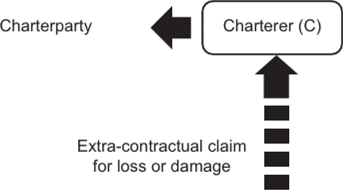
In the example shown in Figure 4, a receiver (the buyer and B/L holder) may seek compensation from C after receiving the damaged grain cargo. This amounts to an extra-contractual claim. The seller has already received payment under the contract for the sale of goods from the buyer and only holds a B/L as the receipt and proof of the contract for the carriage of goods between S (shipper) and C. The extra-contractual responsibility of C for the damaged cargo shall not be dependent on the dispute resolution terms included in the B/L binding SO and S.

Ship owner (SO) k___________________
Bill of
Lading
(B/L) ■
r~~ I X

Cargo interest
B/L holder
Figure 4 Extra-contractual claim for loss or damage to the goods.
A contract between C and S for the carriage of goods may have contained a dispute resolution clause similar to or from the one included in the charterparty between SO and C. Such a contract may have had its terms superseded by those included in the B/L. If an agent signed a B/L on behalf of C, the contractual responsibility of C for any loss or damage to the cargo would depend on the dispute resolution clause included in the B/L.
When the cargo claim is filed, the judge will first analyse the court’s competence to hear it, by analysing the relevant law and jurisdiction or ADR clauses. This will be more problematic if the cargo claimant starts proceedings in a country other than the one included in the contracts of affreightment and the judge in that country does not recognise the dispute resolution clause or its incorporation into the relevant contract based on procedural, substantive or conflict of laws grounds. Third parties to a contract, such as S, may not be bound by incorporated dispute resolution clauses. The dispute resolution terms may be between the charterparty and B/L, leading to potential conflicts of interests due to erroneous incorporation of the charterparty dispute resolution clauses into the B/L. The question here is in what circumstances a prorogatio fori agreement is valid in case of a cargo claim by S against SO or C.
Party autonomy can be disregarded or limited in certain situations, leading to a different outcome in each case. A charterparty allows greater party autonomy to SO and C to decide the conditions for the use of the vessel. The simation may be different in relation to claims in tort or bailment, but these are outside the scope of this work.
- [1] cf Wilson (n 24). 2 Some B/Ls (e g. CONGENBILL 2007 and CONLINEBILL 2000) provide solutions to incorporate jurisdiction clauses.

