Activism as a Discursive Formation
To understand the cultural construction of the categories of speech and action in grassroots activism, we need to contextualize the notion of activism in relation to the distinctive legacy of twentieth-century social movements in which it gained its meaning. I propose to view activism as a distinctive discursive formation (Foucault, 1973), that is, as a system of ideas, attitudes, beliefs, and practices that systematically constitute a field of action, subjects, regimes of truth, and power-imbued social relations. Notably, dictionary definitions of the term “activism” do not address the ambivalence implicit in the speech-action dualism discussed earlier. The Merriam-Webster Dictionary defines activism as “a doctrine or practice that emphasizes direct vigorous action especially in support of or opposition to one side of a controversial issue.”10 It dates this lexeme’s first known use to 1915, a temporal trajectory that is supported by the Google NGram graph for activism (which currently goes up to 2012), in which the term “activism” is seen to have emerged in the early twentieth century, peaked in the late 60s, and has steadily risen to peak again in the early 2000s.11
Other dictionaries speak of activism as “campaigning,” or “noticeable action to achieve a result,” or “direct, often confrontational action.”12 They also differentiate between activist domains, such as environmental activism or peace activism, and provide examples of activist practices - such as demonstrations, sit-ins, strikes, and letter-campaigns. These practices are
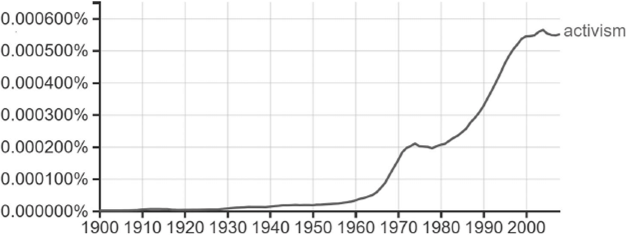
Figure I Ngram for activism.
extensively described in both scholarly and popular writings about activism (e.g., Downing, 2010; Sharp, 1973).
Notably, the English loan words “activism” and “activist” have been borrowed and integrated into Hebrew vernacular usage. The Hebrew term for “activist” - pa’il (maie)lpe’ila (female) - is used both as a noun to refer to a person identified (by him/herself or others) through his or her engagement in struggles for social or political change, and as an adjective that describes the practices involved in such struggles. The shape of the Google NGram for Hebrew “activism” is somewhat different from the English one, but follows a generally similar trajectory (it peaks in the 1980s). In Hebrew, the locution “activist action” [pe’ula activistit] does not sound as tautological as it does in English, and I will use it to refer to the kinds of actions locally considered to be part of activists’ distinctive repertoires. These action repertoires, in turn, construct the field-specific notion of action within the semantics of activism. As a first approximation, then, we can say that as a distinctive cultural-discursive formation associated with twentieth-century nonviolent social movements, activism defines the social experience and public engagement of people who claim an activist identity by participating in a range of vigorous and demonstrative grassroots activities that respond to participants’ deeply felt moral imperative to act and that are considered part of their field-specific action repertoire. In so doing, they engage in a double act of rejection - they reject the use of violence as a mode of resistance, and at the same time they also reject the position of social indifference that is signaled by inaction and epitomized by the possibility of maintaining silence. As grassroots political players, activists collectively enact their dissent through symbolic means that include both embodied and discursive practices by using strategies of nonviolence (Sharp, 1973). Activist action often entails some degree of disruption of the social order, or even civil disobedience, as when demonstrations block the traffic (under police regulation) or when strikers (regulated by state laws) affect public services. Such activities may be controversial or even condemned and criminalized from a law-and-order perspective. In activists’ own self-reflexive discourse, however, the use of the term “activism” carries decidedly positive connotations and stands in contrast to a state of indifference or to actual complicity with objectionable social and political regimes.
In the past half-century, the scholarly literature on social movements has grown exponentially and has become a recognized field of social science research. It is obviously far too expansive, rich, and diverse to be surveyed here, but I will point to some concepts and approaches proposed by social movement scholars that can help me address the nature, possibilities, and limits of defiant discourse as a form of activist action. In their integrative introduction to the study of social movements, della Porta and Diani (1999, p. 16) propose the following characterization of social movements that distinguishes them from other, more conventional political formations, saying:
We will consider social movements - and, in particular, their political component - as (1) informal networks, based (2) on shared beliefs and solidarity, which mobilize about (3) conflictual issues, through (4) the frequent use of various forms of protest. These elements will enable us to distinguish social movements from various forms of parties, interest groups or religious sects, as well as single protest events or ad hoc political coalitions.
This set of characteristics fits the Israeli anti-occupation movement, which consists of an informal network of individuals and group, who share a highly controversial belief in the futility and hopelessness of the occupation as a political arrangement, and are prepared to struggle toward ending it by employing a variety of protest forms as political action. These forms of action, and beliefs about them, will be at the heart of my analysis in this book. Therefore, I will not address the structural dimensions of social movements as informal networks but will limit my attention to the ways in which scholars have addressed the modes of action specifically associated with social movement activism. In this context, the category of action serves as a pivotal cultural concept, that is a key symbol (Ortner, 1973), in terms of which activists’ practices and identities, and the social field as a whole, are organized. Tracing the cultural construction of the categories of speech and action in Israeli grassroots activism must therefore attend to their field-specific coding in activist arenas before their rootedness in the Israeli action-centered Zionist ethos is addressed (and to which I turn in the next chapter). As sociologists have pointed out, what counts as action in activist arenas is a function of the development of open-ended, yet recognizable, action repertoires (e.g., Tilly, 1986). Activist repertoires can be said to delimit what practices are considered as action in the context of organized dissent. Speech performances are central components of such repertoires, alongside visual images and embodied actions. Oppositional activist performances are comprised of more or less creative combinations of loosely coded practices that are included in such open-ended repertoires. The skepticism that sometimes attends the use of words as a tool for change, as represented by the “deeds not words” slogan, is not actually restricted to verbal resistance; it may also accompany embodied forms of dissent such as demonstrations, vigils, and marches. At the same time, the value of action in activist contexts is not determined only with reference to its pragmatic outcomes but also with reference to its symbolic meanings. In other words, social movement action repertoires may collapse the notions of action and speech, underscoring the performative action-like quality of speech as well as the meaning-making, speech-like quality of action.

