A Melanesian ontology of face-to-face networks
We start with Melanesian ethnography, and particularly the work of Marilyn Strathern on the notion of the ‘dividual’ (Strathern 1988). A dividual is made from the various relations in which he or she participates - this ‘relational’ definition of personhood is typically set against the supposedly Western notion of the individual. The matter of creating face-to-face networks at the micro-scale is less fraught if one can connect separable ‘individuals’ -whereas dividuals present a bigger problem. How can one justifiably isolate a dividual as a node in a network? Some of the issues faced when one tries to do this have actually been addressed in a fascinating paper by Alfred Gell (Gell 1999) on Marilyn Strathern’s writings, and specifically The Gender of the Gift (Strathern 1988). Not only is personhood distributed among relations, but this distribution typically occurs during exchange relations in which goods are exchanged. The particular expression of this is pig exchange: when one person gives a pig to another, they are not simply exchanging an alienable product, but are giving away part of themselves too. This kind of micro-scale, face-to-face social interaction mediated by things is captured in the sketch in Figure 2.1, from Gell’s 1999 paper (Gell 1999,39):

Figure 2.1 Sketch of a face-to-face pig exchange. After Gell 1999, 39.
But matters quickly become more complicated because typically there is not just a single exchange of this kind. The donor may ‘give’ part of himself when exchanging the pig. That same pig may then be further exchanged, however; and when this happens, prior exchange relationships are implicated. The web that may quickly form is not shown diagrammatic-ally by Strathern. Yet, Gell insists that Strathern herself told him she used a ‘series of diagrams as schemata in the process of writing’ (Gell 1999,31). So what he does in his paper is ‘supply the missing graphic channel of expression to the argument of GG’ (GG = The Gender of the Gift; Gell 1999, 31). And the way Gell does this is fascinating because he uses graphs, or networks, essentially. This is why he calls his paper ‘Strathernograms’, to reveal some of this diagrammatic thinking, and to attempt a more formal network depiction of this Melanesian conception of the person, whereby a series of relations are somehow encapsulated in object and person. What he does is really quite similar to how we are advised in network analysis to abstract nodes and links from observable phenomena (see Brandes et al. 2013). We might choose, for example, to think of both people and pigs as nodes, connected in bipartite networks such that people only connect to one another via pigs. But doesn’t this rely on an ontology that sees people and pigs as alienable, quite separate, connected by relations of exteriority? What if, in a Melanesian ontology, with its relations of inferiority, one cannot really separate pigs and persons, because persons are in pigs, and pigs are brought into being by inter-personal relations? Is it possible to make a network abstraction that is consistent with this ontology - an ontology of ‘intra-action’ rather than inter-action? This is the problem, in essence, that Gell finds himself grappling with in diagramming Strathernograms.
Gell starts by laying out Strathern’s theoretical stance as idealist - i.e. describing a world in which the real is a system of ideas, rather than a collection of objects. For Strathern, Gell says, idealism is an interpretative heuristic. She conceives of a system of ideas made up of terms and their reification in matter, which she calls appearances. In her scheme, the ultimate constituents of the world are relations (not things or persons). She never specifies what a relation actually is, but Gell interprets it as a connection between two terms. For example, in the formulation 5>4, the > is the relation. 5 and 4 are terms, not things; and they are not self-sufficient (there is no 4 without 5, etc). Similarly, the term ‘mother’ makes little sense without the term ‘child’.
The idea we have to grasp is that relationships in the social world are not between visible entities, such as mothers and children, but between terms within the code.
(Gell 1999,35)
The idea is very general thus far. Strathern adds two constraints: 1) all relations between terms are exchange relations, and 2) all are gendered.
To capture the character of terms, relations, and appearance in Strathern’s system, Gell devises the following graphic scheme:
- • Terms are in rectangular boxes.
- • Relations in circles/ovals.
- • But these are ideal types, and only palpable through APPEARANCES... for which he uses a lozenge.
One of the most basic diagrams he employs is that shown in Figure 2.2, which simply shows how terms are connected (Gell 1999, 36).
Then, from this most basic formulation, Gell adds appearances into the mix (Gell 1999, 38), which he shows as objectifying a relation (see Figure 2.3).
The next step is to apply these graphic conventions to Melanesian ethnography - i.e. the ceremonial exchange of pigs between exchange partners (the kind of phenomenon sketched in Figure 2.1). Gell gives an account of why this sketch is insufficient - because the donor gives part of himself, and no sketch captures this. So, an abstract representation is the only way to capture the relations involved. Let’s now use this system. If we start with the pig, it objectifies more than one relationship. How does Strathern deal with this? Gell says:
the principle adopted is that a unique objectification (a particular pig) objectifies a cluster of relationships, which are themselves related.
(Gell 1999,40)

Relation
Figure 2.2 Diagram showing how terms are connected. After Gell 1999, 36.

Figure 2.3 Diagram showing how an appearance objectifies a relation. After Gell 1999,36.

Figure 2.4 Diagram showing hierarchical nesting of relations. After Gell 1999,41.
So, if pig X objectifies two separate sets of relations, those relations will themselves be related. But, as Gell understands it, Strathern reacts to this by nesting relations of a more subordinate order within relations of a more encompassing order (i.e. the principle governing the relations between relations is one of hierarchy). Gell says Strathern is not altogether clear on this, but he sees the only way to conceive of such relations is as we see depicted in Figure 2.4 - such that the C-D relationship is embedded within A (Gell 1999, 41, fig. 1.8).
An important consequence of this decision to nest relations is that the subordinate relation C-D is only accessible through A-B (or only through A?) - and that in consequence C-D is occluded or, to use Strathern’s term, eclipsed by A-B. This idea of eclipsing is very close to Roy Wagner’s obviation, though the latter is stronger (Wagner 1978). The former implies relations are still implicit, if latent.
To flesh out the argument, consider how the pig is produced by an exchange of reproductive capacities between boar and sow. Thus, the pig(let) is objectifying this relationship (Gell 1999, 42) - as diagrammed in Figure 2.5.
However, a pig used in ceremonial exchange is seen as a human rather than a porcine product. It is fed and nurtured in a domestic setting. Therefore, the pig comes to objectify the exchange of domestic services between man and wife (see Figure 2.6). As Gell says:
Thus the biological reproduction of pigs is symbolically eclipsed by the pig-nurture provided by their human producers.
(Gell 1999, 44; original italics)
These cross-sex unmediated exchanges produce objects (pigs) that are then the exchange mediators in single-sex exchanges (male donor giving a pig to a male recipient) (Figure 2.7), and this mediated exchange produces relations. Gell states that:

Figure 2.5 Diagram indicating how a piglet is the objectification of the boar-sow relation. After Gell 1999, 42.
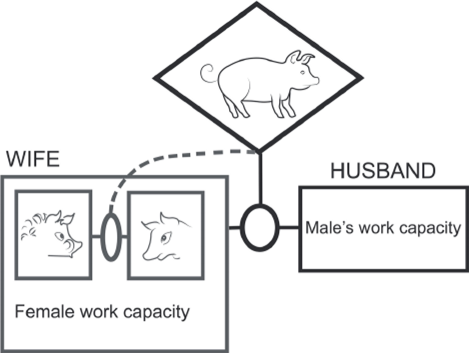
Figure 2.6 Diagram in which piglet now objectifies exchange of domestic services between man and wife. After Gell 1999,46.
the relationship-producing exchange has to be logically distinguished from the object-producing exchange...
(Gell 1999,47)
Strathern describes the relations brought into being through single-sex mediated exchange as replicated (rather than substituted). And there is no

Figure 2.7 Diagram showing further objectification of pig in mediated exchange relation. Previous relations are eclipsed. After Gell 1999,47.
limit to this replication. The same pig can go on being exchanged, as in the graph here in Figure 2.8 (Gell 1999, 48):
Except, Gell says, all relations objectified by a single pig should themselves be related - so there should somehow be a link between the A-B relation and the B-C relation. So Gell produces another graph (Gell 1999, 49) which he thinks better expresses these relations - especially the eclipsing of prior relations in each subsequent exchange (Figure 2.9).
D, the donor, in his person, encompasses all the prior donor-recipient relations which the pig has objectified. It is these he hands over when he gives the pig to E (thereby replicating the existing relations). D in this figure displays a fractal structure (because of the rule of eclipsing which decrees hierarchical relations).
An intriguing set of ideas are in play here. And we can look at them through the model seen in Brandes et al. 2013 (see also Collar et al. 2015) - such that every network perspective tackles a phenomenon under study first through a process of abstraction, and then a process of representation (Figure 2.10).
We can see here that Strathern (as interpreted by Gell) introduces a few key abstractions:
- 1 Terms and appearances
- 2 Hierarchy
- 3 Eclipsing

Figure 2.8 Replication of mediated exchange relations. After Gell 1999, 48.

Figure 2.9 Graph showing the nesting of eclipsed exchange relations. After Gell 1999,49.

Figure 2.10 A network model - from phenomenon, to abstraction, to representation. After Brandes et al. 2013.
Strathern may not go on to make network representations, but Gell takes this step for her. However, he has his own idiosyncratic diagrams, which resemble networks, but differ in some respects. Perhaps the most awkward in terms of ‘translating’ into network analysis is his use of a node to represent a link - so rather than just draw a link between two terms, he has two links connecting to an intervening node (see previous graphs). Another difference lies in how the various nodes are related. In network analysis one might typically use two-mode (bipartite) networks when seeking to link up two different kinds of entities such as, in this case, people and pigs. In a bipartite network, then, people would only link to one another via pigs. But in Gell’s scheme, persons link to one another, and pigs link to ‘relations’ (which are nodes). I have not tried to unpick these complexities to depict what Gell shows in more classic network terms - though in this volume the chapter by Aline Deicke shows how one might go about translating some aspects of these relations into network terms. Deicke suggests that attributing features to either nodes or their links could help, though the decision as to which attribute or value to assign would largely depend on the research question (and perhaps we would need to be clearer in this case quite what questions we might have about the relations manifested in pig exchange). Nevertheless, the point I wish to make is this: while the Strathern/Gell scheme could benefit from the tools of SNA, is it not also the case that this ethnographic ‘model’ refracts network issues back onto SNA, obliging those using network models to think twice about the abstractions used? Is the Melanesian ontology presented here compatible with a network ontology?

