Health and Nutrition Related Claims
The FDA’s regulations related to health and nutrition-related claims have been subject to scrutiny, but the agency is not planning to address these regulations directly. A Government Accountability Office 2011 report found that 86.9% of the claims on food packages are express or implied nutrient content claims, 5.5% are structure-function claims, 4.3% are health claims, and 0.4% are qualified health claims.[1] Each of these will be explained in turn.
Health claims characterize the relationship of a substance to a disease or health-related condition and must be based on a “significant scientific agreement” standard.[2] The FDA has a guidance document for industry explaining
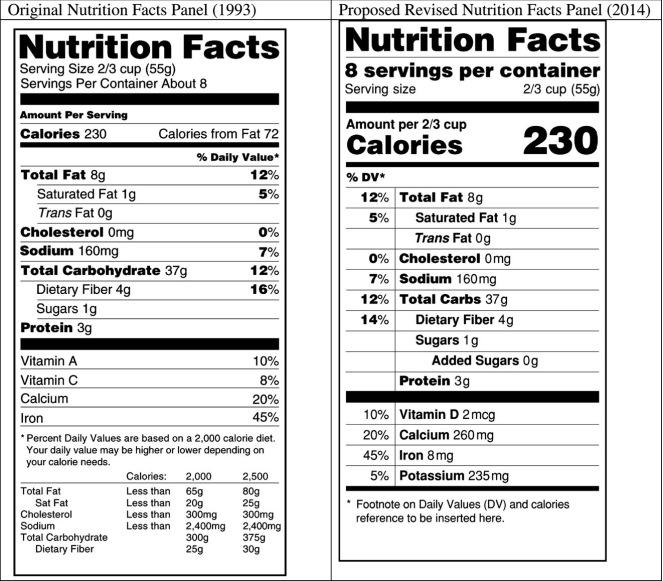
figure 6.1 Original Nutrition Facts Panel and Proposed Revised Nutrition Facts Panel.8
aFDA. Proposed Changes to the Nutrition Facts Label http://www.fda.gov/food/guidanceregulation/ guidancedocumentsregulatoryinformation/labelingnutrition/ucm385663.htm
the agency’s current thinking on the significant scientific agreement standard.45 The FDA relies on an “evidence-based review system,” which it defines as the systematic science-based evaluation of the strength of the evidence, to determine if in totality, the scientific evidence supports the determination that there is significant scientific agreement to support a claim.46 Health claims may be express, such as “healthful diets with adequate folate may reduce a woman’s risk of having a child with a brain or spinal cord defect,”47 or implied, such as through a heart symbol.48 A product may not bear a health claim if it contains “disqualifying nutrient levels” of total fat (13 grams), saturated fat (4 grams),
- 45 Food and Drug Administration. Guidance for Industry: Evidence-Based Review System for the Scientific Evaluation of Health Claims—Final (January 2009). http://www.fda.gov/food/guidan- ceregulation/guidancedocumentsregulatoryinformation/labelingnutrition/ucmo73332.htm.
- 46 Food and Drug Administration. Guidance for Industry: Evidence-Based Review System for the Scientific Evaluation of Health Claims—Final (January 2009). http://www.fda.gov/food/guidan- ceregulation/guidancedocumentsregulatoryinformation/labelingnutrition/ucm073332.htm.
- 47 21 CFR 101.79.
- 48 21 CFR 101.14.
BOX 6.1
Proposed Changes to the Nutrition Facts Panel (2014)
Update Nutrition Information
- ? Require information about “added sugars” because consumers should reduce the amount of added sugar in their diets.
- ? Update daily values for nutrients like sodium, dietary fiber, and Vitamin D because they are used to calculate the Percent Daily Value, which is supposed to help consumers understand this information in the context of a total daily diet.
- ? Require manufacturers to declare on the label the amount of potassium and Vitamin D; calcium and iron would continue to be disclosed, and the disclosure of Vitamins A and Vitamin C would be voluntary.
- ? Remove the “Calories from Fat” entry; the type of fat is more important than the amount.
Updated Serving Size Requirements and New Labeling Requirements
for Certain Package Sizes
- ? Update the Reference Amounts Customarily Consumed (RACCs) for both children younger than four years of age, and for persons four years and older to reflect current consumption patterns.
- ? Require that packaged foods customarily consumed in one sitting be labeled a single serving (e.g., a 20ounce bottle of soft drink).
- ? Require large packages that might be consumed in one or more sittings (e.g., a pint of ice cream) to provide dual column labels disclosing the calorie and nutrient information “per serving” and “per package.” The proposed dual-column Nutrition Facts Panel to reflect per serving and per package information is in Figure 6.2.
Refresh the Design
- ? Emphasize important parts of the label relevant to the public health concerns of obesity, diabetes, and cardiovascular disease.
- ? Emphasize the Percent Daily Value.
- ? Edit the footnote to explain the meaning of the Percent Daily Value information.
Source: FDA. Proposed Changes to the Nutrition Facts Label http://www.fda.gov/food/
guidanceregulation/guidancedocumentsregulatoryinformation/labelingnutrition/ucm385663.htm
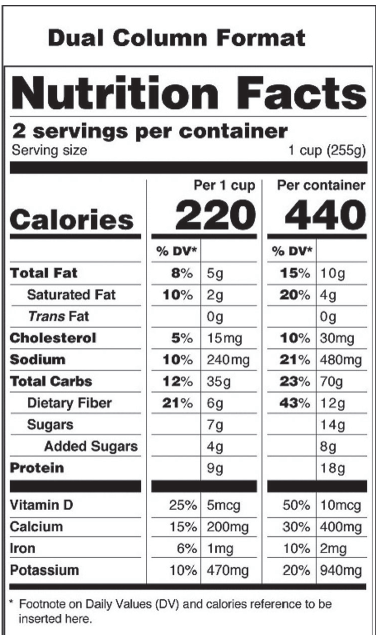
figure 6.2 Proposed Dual Column Nutrition Facts Panel.3
aFDA. Proposed Changes to the Nutrition Facts Label. Dual Column Format of the Nutrition Facts Label. http://www.fda.gov/downloads/Food/GuidanceRegulation/GuidanceDocumentsRegulatoryInformation/ LabelingNutrition/UCM387440.jpg
notation that the “FDA concludes that there is little scientific evidence supporting this claim.”50 An example of such a claim is: “Very limited and preliminary scientific research suggests that eating one-half to one cup of tomatoes and/or tomato sauce a week may reduce the risk of prostate cancer. FDA concludes that there is little scientific evidence supporting this claim.”51 For this example, the FDA only permits the claim on cooked, raw, dried, canned tomatoes or tomato sauce that contains at least 8.37% salt-free tomato solids.52
Food and Drug Administration. Summary of Qualified Health Claims Subject to Enforcement Discretion. http://www.fda.gov/food/ingredientspackaginglabeling/labelingnutri- tion/ucm073992.htm
Food and Drug Administration. Summary of Qualified Health Claims Subject to Enforcement Discretion. http://www.fda.gov/food/ingredientspackaginglabeling/labelingnutri- tion/ucm073992.htm
Food and Drug Administration. Summary of Qualified Health Claims Subject to Enforcement Discretion. http://www.fda.gov/food/ingredientspackaginglabeling/labelingnutri- tion/ucm073992.htm
Note that when the FDA promulgated the original regulations to carry out the NLEA, it did not allow qualified health claims. In comments to the proposed rules, dietary supplement manufacturers (who are subject to some of the same labeling requirements as manufacturers of conventional food) argued that the regulations only permitting health claims based on significant scientific agreement violated their First Amendment rights to communicate the science about weaker health connections related to their products. The FDA disagreed and responded that the First Amendment does not require “a more lenient standard of scientific validity” because the “FDA has a strong interest in ensuring that the information that appears on the food label is scientifically valid and believes that the standard it has adopted best furthers that interest.”[3] The FDA adopted the final regulations requiring that health claims be supported by the significant scientific agreement standard. Marketers of dietary supplements sued the FDA, again arguing that the final rules violated their First Amendment rights. A federal appellate court agreed with the marketers and held that the proposed speech was only potentially misleading and thus the FDA could not ban health claims that failed to meet the more robust scientific standard.[4] Rather, the agency must allow a modified health claim or one with a clarifying disclaimer.[5] The FDA has since applied this rationale to food products.
Nutrient content claims characterize the level of a nutrient of the type required to be disclosed in nutrition labeling. There are several types of nutrient content claims and they all must be made in accordance with Reference Amounts Customarily Consumed or the Recommended Daily Value of the food or nutrient. Nutrient content claims may be express, such as “low sodium,” or implied, which is when the claim about a food or ingredient suggests that a nutrient or ingredient is absent or present, such as “good source of oat bran.”[6] They may also compare the level of a nutrient in the food with the level of a nutrient in a designated similar reference food or the same food type. These are called “relative claims.”[6] For example, pretzels have “less sodium” than potato chips, or the claim, “reduced fat potato chips,” implies that they are reduced fat as compared to standard potato chips. Other types of nutrient content claims are common terms such as “healthy” and “fortified.”[8] These all must be made according to specific regulatory requirements. However, if the food contains more than the “disqualifying nutrient levels” of total fat, saturated fat, cholesterol, or sodium, it must also bear a statement related to the nutrient exceeding the specified level present in the food; for example, if the nutrient exceeding the specified level is fat, the statement must say: “See nutrition information for fat content.”[6]
The final category of claims has the least amount of FDA regulation. Structure- function claims describe the role of a nutrient or ingredient intended to affect or maintain normal structure or function in the body; for example, “calcium builds strong bones,” or “fiber maintains bowel regularity.”[10] Structure-function claims do not need preapproval and there are no specific requirements for their use on conventional foods, so the manufacturer alone is responsible for their accuracy.[10]
The result of this lenient permission for food manufacturers to use structure- function claims is that the FDA has less recourse against a questionable claim.[12] The penultimate example occurred when Kellogg’s placed the claim on its Rice and Cocoa Krispies cereals, “Now Helps Support Your Child’s IMMUNITY.”[13] The FDA did not issue a warning letter or bring other action against Kellogg’s for this questionable claim because it is considered a structure-function claim and also the FDA could not require Kellogg’s to turn over its substantiation documents. The FTC, however, does not have similar restraints on its authority. It did investigate the claim and admonished Kellogg’s to refrain from making misleading representations in the future.
The inclusion of high fructose corn syrup in food products has resulted in interesting and controversial labeling issues. These are described in Box 6.2.
- [1] U.S. Government Accountability Office. GAO-11-102. Food Labeling: FDA Needs to ReassessIts Approach to Protecting Consumers From False or Misleading Claims. 2011.
- [2] 21 CFR 101.14.
- [3] 59 FR 395, 421 (1994).
- [4] Pearson v. Shalala, 164 F.3d 650, 655-656 (D.C. Cir. 1999).
- [5] Pearson v. Shalala, 164 F.3d 650, 657-658 (D.C. Cir. 1999).
- [6] 21 CFR 101.13.
- [7] 21 CFR 101.13.
- [8] Food and Drug Administration. Guidance for Industry: A Food Labeling Guide (10.Appendix B: Additional Requirements for Nutrient Content Claims). January 2013. http://www.fda.gov/food/guidanceregulation/guidancedocumentsregulatoryinformation/labelingnutrition/ucm064916.htm
- [9] 21 CFR 101.13.
- [10] Food and Drug Administration. Label Claims for Conventional Foods and DietarySupplements. December 2013. http://www.fda.gov/food/ingredientspackaginglabeling/labelingnu-trition/ucm111447.htm
- [11] Food and Drug Administration. Label Claims for Conventional Foods and DietarySupplements. December 2013. http://www.fda.gov/food/ingredientspackaginglabeling/labelingnu-trition/ucm111447.htm
- [12] J. L. Pomeranz. A Comprehensive Strategy to Overhaul FDA Authority for Misleading FoodLabels. American Journal of Law & Medicine. 2013;39(4):617-647.
- [13] Bruce Horovitz. Critics Blast Kellogg’s Claim that Cereals Can Boost Immunity. USA Today.November 6, 2009. http://www.usatoday.com/money/industries/food/2009-11-02-cereal-immu-nity-claim_N.htm.

