Range restoration
Researchers in East Africa claimed that in some areas ‘overgrazing and destruction of vegetation has gone beyond the possibility of restoration.”3 This is precisely what the environmental crisis hypothesis would predict. But what does the statement actually mean? We will examine the issue from the perspectives of range rehabilitation and restoration methods: rangeland reseeding and bush clearing. In the 1950s, major land rehabilitation programs were implemented across the Karamojong district in Uganda14 and the Kamba reserve in eastern Kenya. Some experiments compared bush cleared paddocks with those that remained under traditional grazing and those that had been ploughed and re-seeded (Table 5.2). The ploughed and
114 Ecological and social research
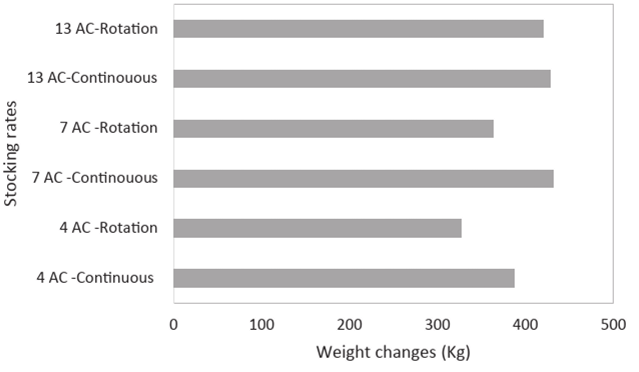
Figure 5.7 Rotational grazing experiments stocked at 4 acres per steer, 7 acres per steer and 13 acres per steer compared to continuous grazing.
Data source: A.D. McKay, “Range management research at E.A.A.F.R.O." East African Agricultural and Forestry Journal XXXV.4 (1970): 346-349.
reseeded treatments did not show superior productivity. Accordingly, Pereira55 concluded that there was no economic rationale for breaking the soil to reseed in order to improve pastures. Again, it should have been acknowledged that the success of reseeding experiments was dependent on rainfall.’6 Moreover, this is another fallacy of imperial science, considering that there was no evidence of any lack of a soil seedbank in the first place.
In second reseeding experiments in the Baringo area, researchers assumed that the potential for the growth of grass cover had been lost,’' based on reports of nineteenth-century European travelers. The soil surfaces were ploughed to create micro-environments where the grass seeds would be embedded to avoid being blown by wind or washed away by surface runoff water (Table 5.2). The first series of experiments failed to demonstrate any establishment of grass. David Pratt’8 made the following remarks:
In view of the great influence of seasonal chance on reseeding, it is dangerous to place too much importance on the precise quantitative results obtained from a reseeding experiment— [T]he most striking feature of the experiment is the extent of the differences between sites ... the results ranged from virtual failure to reasonable successes.
The performance of the reseeded sites—when compared with those stocked at 8.4 acres per head of animal unit—showed that the latter treatment exhibited better plant growth. The paradox may be explained by the role played by livestock in assisting natural reseeding—through trampling and breaking the soil crust, thereby improving water infiltration through the soil. This is an evolutionary role that ungulate herbivores have played in the establishment of savanna grasslands in Africa.59
In third reseeding experiments, the methods and seasons of reseeding were influenced by climate variability and site potentials.60 That experiment required time for proper recovery of the grass cover. The main challenge was bush regeneration after one-time bush clearing. The trials failed for a variety of reasons, including attacks by army worms, locusts and harvester ants;61 range restoration projects were therefore required, to focus on this multiplicity of issues.
Environmental restoration
Several restoration experiments were concerned with testing methods of bush clearing to deal with bush encroachment. Aerial photographs taken in 1947 through to the 1950s show that vast areas of the East African savannas were covered by bushy plants.62 In the three East African territories, an estimated 241,402 km2 were at risk of bush encroachment.6’ By associating bush encroachment with overgrazing, the colonial science perspective failed to understand the historical processes involved. From other historical sources, we know that bush encroachment has been a problem from the late nineteenth century after the rinderpest epizootic wiped out 90 percent of the herbivore populations. However, following colonial intervention, the traditional control method of using fire was banned, thus allowing the bush cover to expand, displacing the grasslands. Research experiments were therefore planned to test if removal of the bush cover would contribute to restoration of the rangelands.64
Both ecological restoration and grazing experiments were conducted over a period of five years.6’ Large areas of bush lands were cleared and subdivided into grazing paddocks. The experiments showed that low ground cover was due to bush encroachment, and not livestock grazing as suggested by the environmental crisis hypothesis.66 Various methods of bush clearing were applied—such as manual and mechanical clearing, stumping, and fire, in combination with ploughing up the soils and reseeding,6' followed by grazing.68 The outcomes of the experiments showed variabilities.69 For example, in bush clearing experiments using Holt roller tractors in the Baringo district in Kenya (Table 5.2), the areas from which bushes had been cleared were reseeded and planned for later grazing. However, reseeding was unsuccessful.'0
In the same region, between 1955 and 1956, P.E. Glover and colleagues'1 conducted three controlled experiments (Table 5.2). In the first experiment, A.V. Bogdan'2 reported the removal of livestock from an area that was highly degraded and encroached by bush. One hundred acres of bushland were cleared and divided into pastures stocked with small stock and cattle.
The experiment compared cutting treatments, grazing and rest from grazing. While cattle-grazed paddocks experienced the most thriving regeneration of the bush, bushes were suppressed in the goat-browsed paddock. The impact on bush regeneration varied according to the season when treatment was applied.
In the second experiment, H.W. Bougall and A.V. Bogdan'’ reported that bush thinning by selective clearing and the application of fire increased grass production. This result had been demonstrated earlier by W.P. Bewg and Van Rensburg,74 who showed that the selective clearing of bushes improved grazing. It would be recalled that the environmental crisis hypothesis held that the conditions and trends of the East African rangelands were on a downward trend (scenario D in Figure 5.1) due to disturbance to the environment.
Range conditions and trends
The methods of assessing range conditions and trends relied on the succession model (equilibrium hypothesis) which was developed in the USA and applied to the East African rangelands. The methods used perennial grass species (called decreasers—because they decline under heavy livestock grazing) as a key indicator of favorable range condition. Conversely, the weedy and annual forage species (called increasers—because they tend to increase under heavy grazing pressures) were considered as indicators of a decline in range condition. Yet again, the methodology ignored the role played by erratic rainfall in controlling plant growth. Thus, the absence of the decreaser species was not due to historical overgrazing, but instead to low site potential and rainfall variability. Therefore, an incorrect diagnosis was used to determine range condition and trends (scenario D in Figure 5.1).
The situation was a concern among grassland researchers in East Africa, who organized a conference in 1964 to try and reach consensus on methods of rangeland condition and trend assessments. The following definitive agreement was reached at the conference:
[F]or sound quantitative and ecological premises to prevent further deterioration of East African rangelands, and to devise management practices for their reclamation and economic utilization, we must find a compromise between the desirable and the achievable under present conditions.... Objective and critical information on the carrying capacity of the different range types and their response to different management is the prerequisite for the determination and classification of range condition.... This could be done only in those locations where information on previous grazing and burning history, stocking rates, and livestock movements are available, and where future management could be controlled.'
According to the conference, these practices could be ‘done only’ in areas where there was a history of range research and some information on vegetation composition and soil conditions under a variety of treatments. Thus, the approach would not be applicable to rangelands where research had not been conducted—namely the majority of the grazing lands in East Africa. The second important phrase in the above quotation is the ‘com- promise’ between various options—the ‘desirable and the achievable.’ This implies that the proposed methods for calculating stocking rates and grazing capacities were based on practical considerations instead of on exact science.
The conference agreed on the need to establish monitoring methods such as grazing trial plots and permanent transects to be continuously sampled. According to the conference, ‘[t]his could be done ... without pre- conceived ideas, until more critical information will have been gathered on the ecological status and production potentials of the [range types].’'6 Thus, the conference was finally questioning ‘preconceived ideas,’ such as the use of the environmental crisis hypothesis for guiding research activities. From the series of agronomic and range science experiments that we have ana- lyzed, we may now reach concrete conclusions questioning the veracity of the environmental crisis hypothesis.

