Psychoanalysis
Antecedents of Psychoanalysis
The psychoanalytic movement was not really part of the same set of developments that led to the other schools; while it maintained that “abnormal” behavior holds the key to the understanding of “normal” behavior, it focused primarily on abnormal behavior and what to do about it and hence asked quite different questions than the other schools. Its historical beginnings must be sought elsewhere. Although it was influenced by Darwins concept of evolution, it had no real roots in physiology'. Freud did write a rather elaborate neurophysiology to support his early hydraulic model of mind and behavior that turned out to be quite wrong, but it was only distantly, if at all, atomistic and had little to do with laboratories, scientific materialism, or the quantitative approach. There was perhaps a minor hint of associationism and only a dim relation to empiricism. Rather, one might relate psychoanalysis more to the romantic tradition and the history of medical and clinical psychology. The work on hypnotic phenomena of such men as Friedrich Anton Mesmer, James Esdaile, James Braid, and later Ambroise-Auguste Liebeault and Jean-Martin Charcot had a direct influence on Sigmund Freuds thinking.
Then there is the long history of concern with the mentally ill. An early highlight is the Malleus Maleficarutn, or “hammer for witches” (a remarkable descriptive psychiatry written in the late 15th century by two monks). While this work contains some perceptive material on psychopathology, its chief aim was to specify criteria for diagnosing people—mostly young women (but also older wealthy widows)—as witches. It has been estimated that between 100,000 and several million individuals were put to death because, using this work as a guide, they had been branded as witches. The study of “abnormal behavior” has a long history, initially conceiving of it as various forms of “evil” in prescientific psychology, changing later to a serious kind of disease. One must mention Philippe Pinel, who pleaded late in the 18th century that people suffering from mental illness are not possessed by demons, are not incurable, and should not be morally censured but are sick and need help. Similar pleas on behalf of people afflicted with psychopathology were made by Dorothea L. Dix in the 19th century and by Clifford W. Beers early in the 20th century. There has already been occasion to refer to Kraepelin’s careful classification of the mental disorders late in the 19th century.
These people and the ideas they developed would require a whole book to themselves to treat them thoroughly.
Since almost every student is at least to some extent familiar with Freud as he is one of the most cited individuals in psychology and psychoanalysis and because many excellent secondary sources are available—and since psychoanalysis is largely unrelated to traditional academic psychology—this chapter will do no more than touch briefly on some of the more central concepts in psychoanalytic theory. It is an entirely different way of thinking than what usually goes by the name of scientific psychology and is a vastly complex specialty.
Freudian Psychoanalysis
Psychoanalysis includes a theory of personality, a philosophy of the nature of humanity, and a procedure for psychotherapy. The intellectual giant who developed this approach was Sigmund Freud (1856—1939; Figure 13.1). Basing his approach on the conception of an active unconscious mind of the kind hinted at by Shakespeare, Goethe, Brentano, Fechner, Herbart, and Nietzsche, Freud went far beyond his predecessors. He must be considered one of the path-breaking geniuses in the history of psychology, changing profoundly the way modern humans think about themselves as conscious beings with powerful unconscious dynamics at work.
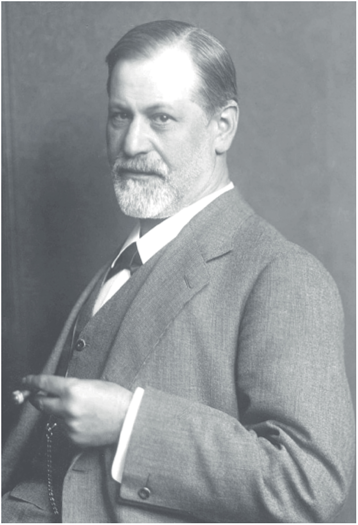
Figure 13.1 Sigmund Freud (1856—1939).
Freud
Freud spent most of his life in Vienna; while he was in medical school, he was deeply influenced by the professor of physiology at the University ofVienna, Ernst von Brücke (1819-1882), an MD who had been a colleague of Helmholtz. Freud began his medical career with work in neurology but soon devoted himself exclusively to psychopathology' and personality. Early in his career he worked with Joseph Breuer (1842—1925) in the application of hypnotic techniques to the treatment of hysteria, following Pierre Janet (1859—1947), whose ideas of unconscious processes and the traumatic etiology of psychopathology' also profoundly affected Freud; then he studied hypnosis with Jean-Martin Charcot (1825—1893) in Paris. It was Charcot, it seems, who first planted in Freud’s mind the idea that sexual problems play a decisive role in the etiology' of neurotic disorders.
After his sojourn in Paris, Freud returned to his practice with Breuer, and together they gradually worked out the therapeutic technique of free association, in which patients are required to talk without any censorship about anything and everything that comes into their minds. Breuer soon felt uncomfortable about the strong attachment (transference) that patients developed for the therapist with this new technique and about Freud’s growing conviction concerning the importance of sexuality, so Freud continued on his way alone.
Freud further developed the method of free association and began to make use of dream interpretation; a major early book, The Interpretation of Dreams, appeared in 1900. He published many' other influential works, and his theory continued to evolve until his death. Gradually, from the turn of the century on, Freud’s ideas attracted first a small and then a continuously' wider group of devoted followers, and by' the second decade of the 20th century the psychoanalytic movement was broadly international in scope.

