two: seeing the invisible
This experience of our environment as inducing experiences of differential significance can, with the help of insights from ethology and cognitive science, be both explained and understood and can also be seen as a now precisely meaningful example of “seeing the invisible.” This provides a potential or partial explanation of the concept broached in my introduction as part of the “problem” of the relationship of art and religion: the variety of claims concerning the ability of art in connection with religion to enable “seeing the invisible,” revealing the infinite in the finite, expressing the inexpressible, and so on. Such claims are often seen by secular scholars to be simple figures of speech denoting a special emotional response, or, by the more materialist and politically minded, as obfuscatory mystical mumbo-jumbo that seeks to gain an otherwise unwarranted privilege for a particular discourse. However, involving the understanding of “theory of mind” and of art as a window into the mind of others we can begin to make better sense of it.
This “perception of the imperceptible," as well as being connected to the theory of mind that enables an apparent perception of the inner state of the other, can also be seen as the epistemological equivalent of the optical effect of pattern recognition. When exposed to a confused or imprecise perception in which the “noise” overcomes the “signal,” we may not initially perceive the information contained in the experience. No clear response to the perception will be suggested. However, once another stimulus is supplied in the form of some semantic input so that the signal overcomes the noise, the appropriate response will become clear. The meaning of the perception will be apprehended. This sort of conceptually determined or paradigm-determined perception is known as “apperception," that is, a physical perception whose affect or significance is determined by experience other than the perception itself, and is thus experienced differently by differently prepared subjects. Thomas Kuhn argued in his Structure of Scientific Revolutions that even in the hard sciences, "paradigms determine large areas of experience” (1962, 129).
Without appropriate prior conditioning experience, some subjects will continue to be unaware of implications of a given experience that are apparent to others. That is, in specifically religious terms, they will experience no apperception of the sacred meaning of otherwise mundane physical perceptions— they will have no clear idea of how to behave in response to it. As we have seen: “|a|wareness of a miracle is only straightforward for those who are prepared by their personal experience and their religious background to recognize it as such. To others the ‘miracle’ is not evident, it does not exist" (my translation from Eliade 1978b, 7). Looked at in this way religious myths, symbols, and rituals can be seen as deliberately manipulated and communicable experiences, the aim of which is to transform our normal, mundane perception of the world into a perception (or more properly an apperception) that stimulates an emotionally assured behavioral response.
Eliade explicitly recognizes that in such cases “the meaning is in the mind, as the phenomenologists would say,” but he adds that, “it is not a creation of the mind" (1973, 103; Rennie 2006, 59, emphasis added). In order to explain further what I am suggesting here, let me refer to certain other optical effects, specifically these well-known Kanisza figures.
Here, the perception of the line is in the mind, but it is not solely a creation of the mind, it is strongly suggested by the data. These Kanisza objects demonstrate that it is often misleading to distinguish too strongly between experience and the interpretation of experience, between the perception and the implication of the perception. As far as I am aware, all sighted human subjects perceive the dividing line between the inner and outer areas of the implied shapes (which lines do not exist as an external physical stimulus or a properly intentional object). Likewise, the great majority will agree on the perception of a cow and a dog (and only a cow and a dog) in the earlier illustration. By contrast, the implication of the religious symbol, the apprehension
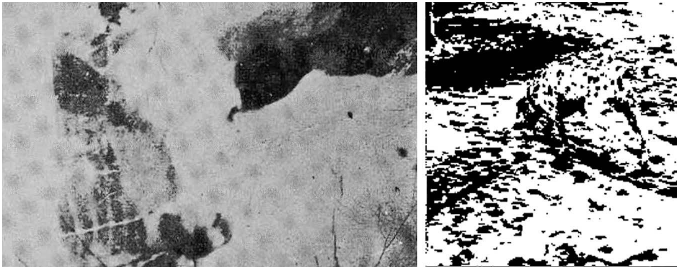
Figure 6.2 Visual Signal-to-Noise. Such images are usually not recognizable until the subject is told what they are. Then they become instantly and permanently meaningful. The left-hand image is a cow and the right, a Dalmatian dog sniffing among fallen leaves. The additional stimulus of the names is (usually) required to enable the perception.
124 Theorizing religion anil art

Figure 6.3 Left and right: Kanisza Figures in which the suggested shape is strongly perceived by the subject although not empirically present to the senses.
of the sacred, is not uniform or universal. Nor, of course, is it as simple as the optical effects that I have used to illustrate these ideas. The cow and the Dalmatian were deliberately and consciously formed into these challenging images and are “really” (that is, intersubjectively, verifiably) there. When it comes to religious symbols, which can only exist as part of a physically and temporally extended matrix of stylistically related items, there is no “God’s-eye view" from which to determine what is “really” there. The operation of religious imagery is something more like a combination of these two effects, in which “personal experience and religious background” serves to condition the apperception of the sacred—so different people apprehend different things. Like the Kanisza figures, what we seem to perceive is genuinely suggested by actual perception, but not to everyone. Of course, the ultimate litmus test of the “reality" of one’s cognitions is, in ethological terms, survival and reproduction and the concomitant persistence of behaviors determining and determined by that cognition.
Similarly, Eliade’s analysis of symbols suggests that the apperception of the sacred is not simply arbitrary or delusory (even if fictional), because it is based on our communal experience of the world and what that experience reveals to us. For example (please pardon the dated, gender-exclusive language):
Before the discovery of agriculture, man did not grasp the religious meaning of vegetation. But with the discovery, man identified his destiny with the destiny of a plant; he translated the meaning of human existence into vegetative terms. As is the case with a plant, I am born from a seed, I will die, I will be buried, and I will come to life again. This meaning is certainly in the mind, yet it could not have developed before the discovery of agriculture. At the same time we cannot say that this religious intentionality of the vegetation is a creation of the mind; it was already there in the fact that vegetative life starts from seeds, goes into flower and then dies and comes again. The intention is there and that intention is grasped by the human spirit, but it is not invented or created by the human mind because the intention is in the agricultural process.
(1973, 103; Rennie 2006, 59)
This is emphasized in Eliade’s article on the symbolism of the arrow, where he points out that ‘‘[n|o conquest of the material world was effected without a corresponding impact on human imagination and behavior" (1968, 465, 2006, 143). Similar to the discovery of agriculture, the discovery of the bow and arrow provided human cultures with images, effects, and relationships previously unthought-of. All new material technologies, like steam power and personal computing, make possible a range of symbolism that is not simply a creation of the mind but is (like the lines in the Kanisza illusion) suggested by the data of empirical experience and suggestive of the nature of the real. The implicit meaning of the experience is not simply the same thing as the physical perception of the experience, but recognition that some such meaning informs the experience.
Eliade also adds that,
an essential characteristic of religious symbolism is its multivalence, its capacity to express simultaneously several meanings the unity between which is not evident on the plane of immediate experience. The symbolism of the Moon, for example, reveals a connatural unity between the lunar rhythms, temporal becoming, the Waters, the growth of plants, women, death and resurrection
(1959b, 99; Rennie 2006, 133)
and “[e]very hierophany we look at is also an historical fact. Every manifestation of the sacred takes place in some historical situation. Even the most personal and transcendent mystical experiences are affected by the age in which they occur" (1958, 2; Rennie 2006, 43). Given this addition, it is necessary to add another layer of hopefully suggestive visual imagery to extend the explanation of this understanding of the perception of the sacred in the profane. Profane experience resembles an ambiguous (or, rather, polysemic, "multivalent”) image—Wittgenstein’s Duck/Rabbit image is a famous example, but there are plenty of other examples.
Not only is there an ambiguity between the sacred or meaningful apperception and the profane or meaningless empirical perception, but there is also a multitude of potential interpretations of our empirical perceptions, corresponding to a multitude of potential behavioral responses. The specific “apperception of the sacred” is a creative response, necessarily shaped and colored by the historical situation in which it occurs (it does not empirically

Figure 6.4 Left: The General’s Family by Octavio Ocampo (1990 used with permission of Visions Fine Art: Publisher/Agent/Representative for Octavio Ocampo USA). Right: the Wittgensteinian “Duck/Rabbit.” Like ambiguous or polysemic images, lived experience is multivalent, as is the religious symbol, and more than one meaning can authentically be seen in the “profane” or empirical experience.
differ from the historical situation in which it occurs), involving the production of further presentations utilizing the same stylistically related components. However, as creative, the apperception of the sacred is always more than that historical situation and remains cognizable to those who have experienced it. Once one has “seen” the sacred—or the cow—the prior perception of the image as meaningless is different, it has effectively become something else. For Eliade, the hierophany is always an anamnesis, an unforgetting, because one does not actually “see" anything “new" but rather "unforgets" or realizes the meaning of what was already there, as one recalls the duck/rabbit or the old man/peasant couple or realizes that the cow was there all along.
This is what the study of religion, as Eliade understood it, is about—the (ap)perception of experiences as meaningful—in the terms of this analysis, as implying an appropriate behavioral response. This is, in part, why the religious cannot be reduced to the economic, the psychological, the political etc. The economic, psychological, and political are specific strategies of meaningrecognition, specific ways in which the empirical data of physical perception and lived experience can be rendered more-or-less meaningful by prior attentive focus upon specific, “cooked” experiences organized in a particular tradition. The general category of such recognition, what I am calling the apperception of the sacred in the profane, is the specifically religious activity, which (by definition for Eliade) centered upon the hierophany that provokes that apperception. To interpret Eliadean “non-reduction" as insisting on the ontological autonomy of the sacred merely perpetuates and compounds an overly simplistic and inaccurate reading of his understanding of the sacred and the real.
There is another way in which the study of religion might be seen as “irreducible.” That is, it involves an unavoidably subjective component necessitating an aesthetic appreciation. The Oxford social anthropologist, Rodney Needham, recognized that anthropologists cannot describe anyone’s “attitude to God, whether this was belief or anything else ... it was one thing to report the received ideas to which a people subscribed, but it was quite another matter to say what was their inner state (belief for instance) when they expressed or entertained such ideas" (1972, 1—2). According to philosopher and cognitive scientist, Daniel Dennett, this signals a “need for recasting anthropological theories as accounts of religious behavior, not religious belief” (2006, 239). Dennett also recognizes that "people need to see their lives as having meaning. The thirst for a quest, a goal, a meaning is unquenchable, and if we don't provide benign, or at least nonmalignant avenues, we will always face toxic religions" (2006, 334). So Dennett encourages both the focus on behavior and the importance of meaning. As an internal, individual, and non-intersubjective phenomenon, meaning is not fully accessible to purely scientific theorizing, even though it issues from empirical experience and in empirical behavior.
This understanding of the role of religion might be thought unavoidably to doom researchers in religion to inescapably fruitless speculation about the content of other people’s minds (specifically their “pisteuma” as Raimon Panikkar has called it—the content of people’s faith-based apprehensions, Panikkar 1989). Happily, this is not the case. Just as "behaviorists were meticulous about avoiding speculation about what was going on in tny mind or your mind, or his or her or its mind” (Dennett 1991, 70), so the phenoine-nologist of religion can be likewise meticulous. Dennett explains that minds “are not among the data of science, but this does not mean that we cannot study them scientifically ... The challenge is to construct a theory of mental events, using the data that scientific method permits” (1991, 71). He calls this “heterophenomenology” and describes it as “a method of phenomenological description that can (in principle) do justice to the most private and ineffable subjective experiences, while never abandoning the methodological scruples of science” (1991, 72; see Rennie 2012 for my own application of ‘‘heterophenomenology” to the study of religion). This method “makes no assumption about the actual consciousness of any apparently normal adult human beings" (Dennett 1991, 73). Dennett goes on to consider the role of verbal interactions in empirical psychological or neurological studies. In, for example, preparing a written transcript of some such experiment from an audio record, we are interested in the sounds “that are apparently amenable to a linguistic or semantic analysis" (74, emphasis original). In so doing, he points out, “we move ... from one world—the world of mere physical sounds—into another: the world of words and meanings” (74). I would argue that, in Eliade’s terms, this is equivalent to a move from the profane to the sacred. This “yields a radical reconstrual of the data” (75) and Dennett asks, “[w]hat governs this reconstrual?” (75). Obviously, in Dennett’s example, “it depends on assumptions about which language is being spoken" (75). It is based upon such assumptions that the raw data of physical sounds can be “purified" into formal expressions and we can ‘“make sense’ of the sound stream in the process of turning it into words” (75). The history of religion is a process of making sense of the raw data of our observation of religious phenomena in the same way as I have attempted to "make sense” of the texts of Eliade, and religion itself is a comparable process of making sense of the world of our lived experience (Rennie 1996, 1—6). A large part of the process involved is, as Dennett insists, amenable to a linguistic or semantic analysis. However, I would argue that it cannot be reduced to this analysis without remainder. The unavoidable aesthetic and emotional components determine our behavioral responses in ways that are simply not amenable to a linguistic or semantic analysis.
Dennett recognizes that such "making sense” is not final; that is, it does not necessarily “proceed all the way to understanding” (76). The linguistic process might stop at word recognition with no understanding of the further implication of those words. However, even in that case “we must move beyond the text” (76) as a purely physical entity. Where Dennett is more precise that we must interpret the empirical text as “a record of speech acts” (76), Eliade spoke more vaguely of the meaning of the religious text. "We must treat,” says Dennett, “the noise-emitter as an agent ... who harbors beliefs and desires and other mental states that exhibit intentionality ... and whose actions can be explained ... uttered noises are to be interpreted as things the subjects wanted to say ... meant to assert" (76). Similarly, we must treat our entire lived experience, the “noise-emitter” that finally “tells” us how to behave, as an agent (or collection of agents) apparently exhibiting intentionality—and the ancestral behavior of art and religion ensures that we do. No matter how detailed our clinical investigations of religion may become, there will always be a remainder that concerns this "meaning" and that involves the speculative (re)presentation of this inaccessible, subjective, intentional state, homologous to differential perceptions of an individual’s character or personality, which remains irreducibly creative and variably skillful.
It would not be surprising to consider at this point some more complex version of Friedrich Max Miiller’s assertion that religion is a disease of language (see, for example, Sharpe 1975, 40—43). Since human agents are so accustomed and, indeed, neurologically "programmed,” to make sense out of language, we are misled into assuming that non-linguistic aspects of our experience likewise “make sense” and “communicate" meaning to us. The arguments from the ethology of art, however, indicate that it is a more-or-less unavoidable concomitant of representational consciousness that has potentially beneficial consequences. This would certainly be consonant with Eliade’s frequent assertions that religion is a human universal. As he says:
If, in the history of religions, the idea of the sacred is related to the idea of being and meaning, the historian of religions—who is also a phe-nomenologist because of his concern with meaning—will eventually discover something which has not always been evident: that the sacred is an element in the structure of human consciousness. ... man simply discovers himself in the world, that the structure of his consciousness is such that somewhere in his experience there is something absolutely real and meaningful, something that is a source of value for him. As far as I understand it, the structure of human consciousness is such that man cannot live without looking for being and meaning. If the sacred means being, the real, and the meaningful, as I hold it does, then the sacred is a part of the structure of human consciousness.
(1973, 101; Rennie 2006, 58)
Again, Eliade can be seen to agree with Dennett’s approach to the extent that both insist that “people need to see their lives as having meaning" (Dennett 2006, 334) and both attempt to “get at what these people are experiencing” (Dennett 1991, 78). Of course, Dennett continues (and I agree) that “[w]e can’t be sure that the speech acts we observe express real beliefs about actual experiences; perhaps they express only apparent beliefs about nonexistent experiences” (78). However, certitude in that respect is not required—we can observe the retention and protention of, and behavioral responses to, creative presentations. The phenomenal fact that people behave in specific ways and make specific claims is more important than any hypothesized intentional state "behind" that fact. As Dennett says, “[w]e can compare the heterophe-nomenologist’s task of interpreting the subject’s behavior to the reader’s task of interpreting a work of fiction” (79). Similarly, Eliade held that “it is regrettable that historians of religion have not yet sufficiently profited from the experience of their colleagues who are historians of literature or literary critics” (1969, 4). They are both conscious of the similarity of the analyses of literature and of religion. Works of fiction only weakly imply the ontological independence of their characters whereas the autonomy of their characters is strongly asserted by religious texts and their adherents—especially in the monotheist West. That is characteristic of the difference between the special in art and in religion, between beauty and the sacred. A focus on the human origins and literary nature of the religious text is assumed to reduce its ability to work its persistent effect. This does not change the role of the heter-ophenomenologist whose task is to interpret both the human origins and the sacred effect. The heterophenomenologist “lets the subject’s text constitute that subject’s heterophenomenological world, a world determined by fiat by the text ... The subject’s heterophenomenological world will be a stable, in-tersubjectively confirmable theoretical posit” (Dennett 1991, 81). The “text" for the historian (and philosopher) of religions is not only the sacred symbol, ritual, or scripture that inspires the believer (although it involves that), but is the record of the believers’ behavior as expressive of their subjective experiences.
Dennett considers the hypothetical case of certain “anthropologists who were to discover a tribe that believed in a hitherto-unheard-of god of the forest called Feenoman. ... Feenoman is being treated as merely an ‘intentional object,’ a mere fiction so far as the infidels are concerned" (1991, 82). However, the "heterophenomenological method neither challenges nor accepts as entirely true the assertions of subjects, but rather maintains a constructive and sympathetic neutrality, in the hopes of compiling a definitive description of the world according to the subjects" (83). Of course, the subjects may insist that, not only do the objects of their assertions really exist as autonomous entities, but also this is a point of crucial importance. Again, that may contribute to, but does not fundamentally change the heterophenomenological undertaking to describe the subjective world of the subject and to thus access its meaning—what conduct does this produce?
The point of this digression into the thought of Daniel Dennett here is that, despite the criticism of Eliade’s insistence that religion is a meaningful, irreducible, sni generis phenomenon, none of Eliade’s consideration of the sacred as definitive of religion fundamentally contradicts the observations of more recent reductionist theorizing in the academy. Dennett’s 2006 volume. Breaking the Spell, concentrates entirely on the cognitive study of religion.' Its principal thesis is that empirical and clinical observations and experimentations can be performed to evaluate whether or not religious behavior is genuinely adaptive, that is, contributory to human reproduction and survival. This assertion raises a series of questions: first, can effective empirical experimentation be done to determine whether some behavior was adaptive in the past, even though it might have become maladaptive now? Second, is the understanding and implicit definition of religion which Dennett (et al.) applies accurate, or is it a manifestation of the profoundly misrepresentative modern Western conception? Third, is human reproduction and survival, as assisted by actual adaptations, exhaustive of value? Finally, nothing is achieved by denying the existence of the sacred if it is seen as the implicate order of natural, physical (profane) reality, as apperceived in various ways by various traditions as an agent to which we have no choice but to respond and to which we might respond better or worse.
There is little doubt that Eliade considered religion in general to be a positive good, even though Ricketts (2006) has shown that he had no personal commitment to Christian metaphysics. Eliade’s analysis, as I have interpreted it, would allow that, while specific religious traditions might be non-adaptive "byproducts,” religious behavior in its most general sense is adaptive— emotionally assured and persistent behavioral responses have proven very effective in ensuring human survival and reproduction in the past. It was in this most general sense that William James defined religion as, “the belief that there is an unseen order and that our supreme good lies in harmoniously adjusting ourselves thereto" (1902, 69). In this most general sense, the apperception of the sacred would be the apprehension of some “order,” specifically some order to which we can "harmoniously adjust" our behavior to our own ultimate benefit, and this may be seen as self-evidently adaptive. The religious symbols (myths and rituals etc.) of specific traditions can be seen as attempts to present experiences conducive to apperceptions of that order. This undoubtedly leads to byproducts specific to local cultures that may be, as Dennett describes them, mutualist, commensal, or parasitic (2006, 84); that is beneficial, neutral, or harmful. However, the general apperception of an orderly whole to which we can respond coherently and consistently, makes a strong claim to being adaptive, since it permits a confident, consistent, coherent, and at least partially predictable response. It harnesses our ability to cognize the character of other people, and it is homologous to our ability to perceive meaning in the orderly, rule-governed nature of human language. Both of these are kinds of apperception since they require a considerable amount of preparatory experience to occur. Both of them are forms of “seeing the invisible.”
It is conceivable that clinical tests and empirical studies could be designed to investigate the adaptability of a function of the human mind that seeks consistent order and emotional affect in experience. Such a function would, no doubt, be closely connected to the “causal reasoning” and “theory of mind” functions already mentioned. It might, indeed, be more or less identical to them. It is interesting to note that Eliade commented in his journals on the “exile returning to Ithaca" who represents all of humanity in our “search for the center." It is better, he said, to recognize meanings and see signs even if they are not there (1977, 85—Eliade expounds on this theme further in his short story, “Incognito la Buchenwald" (written in 1974), in which his characters are forced to “interpret” meaningless water stains on a wall. Although this raised the ire of, for example, Ivan Strenski (1982, 392ff.) as an example of the apparent willful proliferation of non-entities, perhaps, if it is read as an existential need to (ap)perceive some zusammenhang to our experience that reveals clues as to how we might confidently respond, rather than leaving us clueless and aimless, it becomes more comprehensible and acceptable.
It is not my claim that Eliade somehow anticipated cognitive theories of religion. I simply seek to show that an understanding of the sacred as definitive of religion is not undermined by cognitive theory. It is, on the contrary, complementary to it. Cognitive theory indeed provides evidence of the coherence of this position on art and religion. In this way, religious symbols, myths, and rituals may not themselves be historically accurate or physically veridical and so they might appear to be inaccurate misunderstandings and misrepresentations of the world and acting as if they were not would appear maladaptive. However, as Eliade said, “a symbol is not a replica of objective reality [but] reveals something deeper and more fundamental” (1959b, 97, 1965, 201; Rennie 2006, 133). Symbols, myths, and rituals are physical, perceptible items that “fine tune” our apperception of the world enabling the cognition of a consistency and coherent character to which our behavior can conform. The image of "tuning” is taken from Wassily Kandinsky’s Uber das Geistige in der Kunst where he says that
die “Stimmung" des Werkes kann die Stimmung des Zuschauers noch vertiefen—und verklären. Jedenfalls halten solche Werke die Seele von der Vergröberung ab. Sie erhalten sie auf einer gewissen Höhe, wie der Stimmschlüssel die Saiten eines Instrumentes. (The mood [literally the “voice”—the way it speaks to one] of the work [of art] can deepen—and clarify—the mood of its audience. At least such works of art stop the soul from coarsening. They tune it to a certain pitch, as the tuning-key does the strings of an instrument.)
(1911, 5)
Religious symbols can be seen as catalytic “seminal experiences” that cumulatively enable the recognition of a meaning in experience, just as the words “cow" and "Dalmatian" enabled our recognition of the content of the confused images above, or as Eliade’s experience of Hindu devotees “fertilized” his understanding of Eastern Orthodox devotions. This also constitutes a significant contribution to our understanding of the relationship of religion and art. Religious art particularly and explicitly uses traditional forms— elements embedded in an extended matrix of stylistically related and skillfully wrought presentations—to enable and encourage the apperception of a specific “sacred" in mundane experience as something to which we can confidently respond.
It does not require a great deal of imagination to understand the evolutionary contribution of perceiving (or apperceiving) human experience as having some meaning as opposed to none, as soliciting some coherent and consistent response to the human situation as opposed to none, and as suggesting some potential resolution to the human dilemma. Eliade’s understanding of religious symbolism goes some way toward suggesting how such imaginary, or imaginal, responses to our environment might be “true” in the sense of workable adaptations to the human condition, even if their historical accuracy or physical factuality is unverifiable or even obviously false. He consistently stresses the imaginary as effective. As we have already seen, he insists that “no conquest of the material world was effected without a corresponding impact on human imagination and behavior,” and he adds to that, “I am inclined to add that the reflections of the objective conquests upon such imaginary Universes are perhaps even more important for an understanding of man” (1968, 465, 2006, 143). In The Quest he points out that initiatory motifs and symbols "partake of an imaginary universe, and this universe is no less important for human existence than the world of everyday life” (1969, 121, emphasis original); and in Images and Symbols: “that essential and indescribable part of man that is called imagination dwells in realms of symbolism and still lives upon archaic myths and theologies” (1961, 19, emphasis original). On a slightly different note, which serves further to explain his meaning and to support the consanguinity of religion and art, he states that “the novel must tell something, because narrative (that is, literary invention) enriches the world no more and no less than history, although on another level” (1977, 205).
That imagination is not only of great importance to art but also an integral part of religious life is indicated by Eliade’s statement that “One can pass through a Symplegades8 in so far as one behaves ‘as a spirit,' that is to say shows imagination and intelligence and so proves oneself capable of detaching oneself from immediate reality" (1959b, 101; Rennie 2006, 135). This identifies “spiritual" existence with imagination and, specifically, with the ability to “detach oneself from immediate reality" (cf. Boyd 2009, 53, 180). For Eliade, “spiritual” existence is constituted by the specific human imaginative ability to become detached from immediately experienced reality, Erlebnis, or “history.” This is his “escape from history," nothing more (or less) mystical than the ability to learn from that which one has not oneself experienced and, via “spiritual” discipline, to avoid the purely physical effects of causal determination and to see the world as something other, something more, than merely the sum of physical perceptions. At one extreme, this might possibly enable astonishing feats, like sitting naked on a glacier for days, at the other it is simply not allowing the quotidian pressures of life to “get you down” (which may, in the end, be no less astonishing a feat given human neuropsychology). One “escapes from history” every time one smiles in the face of adversity or performs any act that is not directly determined by historical/empirical preconditions (such as making any sacrifice). This can most effectively be accomplished with reference to the object of religious belief—the sacred—as apperceived in and through the mundane world as transformed by religious myth, symbol, or ritual. When one actually experiences the world as infused with meaning, possessed of a compelling causal narrative, having a consistent character, one can react to it with more confidence, control, and consistency, and assurance that one is "doing the right thing.”
Our ability to “escape history" in this way is directly dependent on our relationship to imaginative narrative. One illustration that I have already employed to explain this was taken from Martin Seligman's 1975 book. Helplessness (Rennie 1996, 223—224). "Helplessness” is the condition in which an experimental subject acquiesces and no longer makes any attempt to avoid “powerful negative stimuli” (suffering). This condition is induced relatively easily in subjects that have no way to control the suffering. Given some measure of control, subjects are considerably more resistant to such “helplessness” (this applies to a large range of animals as well as to people) but continue to strive for an improvement of their condition, no matter how elusive control may be. In an empirically controlled experiment Seligman reported that “merely telling a human subject about controllability duplicates the effects of actual controllability” (48). In other words, a story which one is told can have the same effect as if it were a part of the world of real experience (and Seligman was clear that it does not have to be “true” in the sense that it does not have to be factual or historically accurate). Stories, as stories, are in fact part of the world of experience. By dint of imagination and the apperception of the sacred in the profane the human spirit can be seen to “escape history,” to be “detached from the immediate reality,” to be “autonomous” in that it is not wholly determined by its physical environment but contributes, through the creative generation of skilled behavior, to the construction of its own determining environment. Imaginative creations become a component part of the conditioning factors in human experience, and one which history reveals to be of the greatest significance.
Even as concepts, an imaginative fiction in the sense indicated here, an intention, religious concepts, such as “God,” the Dao, karma, are infinitely creative entities, agents of unbounded imaginative fertility, capable of supporting a wealth of imaginary universes and providing powerful exemplary models. Once the idea of God has been conceived, it is eminently possible to conceive the idea of heaven, paradise, etc., that is to say a mode of being in which humanity is not entirely conditioned or limited by our actual, historical, and physical state. It can quite credibly be suggested that if one cannot imagine an eternal and perfect state of human existence then one cannot have really imagined, or imaginatively realized, the idea of God, one has not cognized the character of reality.
To those who, conditioned by their own experience of specific alternate skillfully-wrought representations that invoke a different apperception of the real, insist on the self-evident nature of the empirical and the perceptible as the ultimately real, Eliade’s equation of the sacred and the real appears simply wrong, as does his insistence that the religious cannot be reduced to any other area of human analysis. From that perspective, the creative hermeneutics of Eliade’s history of religions may remain an unwarranted proliferation of imaginary non-entities. The meaninglessness of “religion” from that perspective, however, clearly does not render religion meaningless from others. The characterization of religion as the mere proliferation of imaginary non-entities corresponds to a deliberate restriction of imagination, a denial of meaning, a refusal of creativity and little else—a sort of cultural autism. If it be accepted that the creative imagination and the various skills of cognition, representation, and reception have an effective role in inducing specific apperceptions, then symbols, as creative, meaningful, pre-reflective devices, are not just symbols but effective tools for directing and tuning perception and thence behavior. If one recognizes that imaginary ideas have real effects then the restriction of an idea capable of significant effects to the imaginary is finally no restriction at all.
Studies have indicated that, for example, religious kibbutzim behaved more co-operatively than their secular counterparts, and that the distinction was greatest with those who attended synagogue daily (Sosis and Ruffle 2003a, 2003b). The authors of that study suggest that it is the public display of devotion that effects this distinction. The understanding of art and religion proposed here suggests that those who attend to religious ritual more frequently and more closely will be more effectively conditioned by that ritual to (ap) perceive their world as being possessed of a nature or character that will (naturally) respond most favorably to co-operative, obedient, self-sacrificing, and “righteous” behavior, and they behave accordingly. Their experience of the world, conditioned by religious myths, symbols, and rituals, is an apperception of the profane as suffused by the sacred and possessed of a predictable and reliable nature. Religious traditions can (please note that I am not saying that they all do) stimulate their audience to apprehend the world in which they live as a meaningful event to which the appropriate response is co-operation and altruism. In this way, in Eliade’s words, it can “make the immediate reality ‘shine”’ (1986, 6).
If such an understanding of art and religion be adopted, what implications might this have for their study? No doubt the study will go on much as before with ethnography and philology leading the way, although ethology and neuroscience now have more to contribute. For methodologists and theorists (and philosophers of religion in the broad sense) there may be some fruitful implications. I agree with Dennett that empirical and clinical studies can and should be performed to distinguish the “mutualist” from the “parasitic” elements of religious traditions. As Dissanayake indicated, if “we see patterns of behavior that were adaptive in the original environment in which they evolved, and realize that they are maladaptive in present-day circumstances, we can set about trying consciously to change them (by cultural means)” (1988, 32)—but it is also implied that there is a complementary component to the study of religion that will remain for the foreseeable future irreducibly subjective or aesthetic, more akin to literary and artistic criticism, and indeed to literature and to art, than to any clinical procedure. In these ways, adding the insights of the ethology and anthropology of art to the cognitive science of religion and to an understanding of religion involving the Eliadean sacred could have considerable benefits.

