Braiding
We now turn to the task of computing the braiding a in the Fibonacci anyon category A. The only nontrivial component of the natural isomorphism a is aT,T, because components with a subscript 1 are identity morphisms and components with nonsimple subscripts reduce to direct sums of components with simple subscripts.
The nontrivial component aT,T is an isomorphism from т ® т = 1 ® т to itself. Representing objects of A by pairs of vector spaces, we have that aT,T is an automorphism of (C, C), so it amounts to two non-zero scalars, a multiplying vectors in the first (1) component and b multiplying vectors in the second (т) component. These are subject to the hexagon identity, which equates the composites

as well as the analogous identity with a-1 in place of a.
Consider the first (1) component of this equation. In the bottom composition, the aT,T factors in the first and third morphisms must act on the т components so that the ^-product with 1T has a 1 component. So both of these are b. The a between them, acting on the 1 component, is an identity map, because our previous calculation gave p = 1. So the bottom of the hexagon is b2. In the top, both of the a’s are again just 1. The a in the middle of that row is атдфт, i.e., the direct sum of ат1 and aT,T .The first of these two summands has no 1 component; the second does, and it is a. So the top of the hexagon is just a, and the hexagon condition reads a = b2. (The corresponding calculation for a-1 gives only a-1 = b-2, which is no new information.)
Now consider the second (т) component of the hexagon equation. We do the calculation in matrix form, using the natural bases

and

With respect to these bases, аттт is given by ^ ^ as computed earlier. Both отт ® 1% and IT ® отт are given by

because in each case, отт acts as a on the first basis vector (where it interchanges two т’s that were combined to 1) and as b on the second (where it interchanges two т’s that were combined to т). Finally, отт<дт is the direct sum of от1, which is 1, and от,т acting on the т component, which is b; since that direct sum decomposition
matches our choice of bases, охт%х is given by the matrix ^ °°^. Multiplying the
matrices for each of the rows, we find that the hexagon identity, in the т component, reads

Since we know, from our associativity calculation, that r and s are not zero, the (1,2) and (2,1) entries of this matrix equation reduce to q + bt — b3 = 0, or, since t = —q,
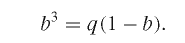
The (1,1) and (2,2) entries give, after we remember that rs = q and cancel a common factor q,

The last of these equations, being quadratic in b, can be solved explicitly:
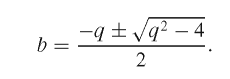
We note that, since q = - is between 0 and 1, the square root in the formula
for b is imaginary, so the two values of b are each other’s complex conjugates. The product of the two values for b is 1, so b is a complex number of absolute value 1 with real part .
The ambiguity in the choice of b is unavoidable in this situation. Replacing one choice by the other just replaces о by its inverse (since |b| = 1), and there is nothing in the algebra of A that distinguishes the counterclockwise motion defining о from the clockwise motion defining о—:1. To put it another way, the change from one value of b to the other can be exactly compensated by reflecting the orientation of the (2-dimensional) space in which the anyons live.
Although we have now computed b and thus also a = b2, we can get a more useful view of these numbers by manipulating the three equations above that relate b to q. Solving the last one for q in terms of b, and substituting the result, q = ~bb~1 into the other two equations, we obtain from the first equation that

which means that -b is a primitive fifth root of unity and therefore b is a primitive tenth root of unity. The third equation above confirms that by reducing to b5 = -1.
Among the four primitive tenth roots of unity only two, e±3n‘/5, have negative real parts, as b does (recall that its real part is —q/2). So we conclude that, up to complex conjugations,

This completes the calculation of the braiding a for Fibonacci anyons.
Remark 2 The multiplicative structure for Fibonacci anyons, summarized by the fusion rule т ® т = 1 ® т, is perhaps the simplest nontrivial fusion rule. Other fusion rules have been analyzed, either by hand as we have done here or with computer support. The appendix of [2] summarizes much of what is known about specific examples. There does not, however, seem to be any general theory for arbitrary fusion rules.

