The timelessness of historicism
In 1922, four years before Reza Shah crowned himself king of Iran, a group of secular reformists established the Society for National Heritage (Anjoman-e asar-e melli), the SNH.28 While the SNH’s founding members came from diverse class and intellectual upbringings, they all were in agreement regarding the implementation of secular, national, and heavy-handed reforms under the new monarchy. Many of the most influential men of Reza Shah’s first cabinet included the SNH’s prominent founders: court minister ‘Abd al-Hoseyn Teymurtash, described as a man of “brilliancy [with] elements of madness,” was the mastermind of the SNH.29 The prominent scholar among the group was former prime minister Hasan Pirniya, who was to write the three-volume History of Ancient Iran30 and is often credited with preventing Iran from becoming a British protectorate in 1919. Another scholar-politician, Mohammad ‘Ali Forughi, remained the most popular figure of the SNH. Firuz Mirza Firuz Nosrat al-Dowleh, the sharp Qajar nobleman and minister of finance, was instrumental in dealings with the French in the sphere of archaeology. The Zoroastrian representative to the parliament, Arbab Keykhosrow Shahrokh, was central to the revival of Achaemenid and Sasanian architecture in the 1930s. Justice and finance minister ‘Ali Akbar Davar assisted in financing the SNH’s projects by his manipulation of the bureaucratic machine.
Other high-ranking politicians and founders of the SNH included former prime minister Hasan Mostowfi; former ministers of public instruction Hasan Esfandiyari, Ebrahim Hakimi, and Hajj Seyyed Nasrollah Taqavi; and the politician and scholar Seyyed Hasan Taqizadeh. The SNH later recruited other men of power, such as future education and culture minister ‘Isa Sadiq, professor and editor Sa‘id Nafisi, and future minister of public instruction ‘Ali Asghar Hekmat. Most of these men had benefited from either a state-founded secular schooling in Iran or a state-sponsored education in Europe, which had convinced them of the rewards of modernization. They had often gained social mobility by Qajar efforts to modernize. No less critical was their exposure to western literature, etiquette, fashion, technology, and architecture, which were often first adopted by Qajar kings as new norms of culture. In matters of fine arts, especially architecture and cultural heritage, these highly influential men defined the parameters of the definition of high culture and good taste for the Iranian middle class. During its sixty years of activity, the SNH constructed some forty national monuments, carried out over sixty preservation projects, and erected a national museum and a public library. The cultural scope and diversity of the SNH’s undertakings were unprecedented in the history of Iran and were bolstered by numerous publications, lectures, exhibitions, and contributions to the tourist industry.31
The series of national monuments that were erected by the SNH employed historicism and eclecticism in design. Each also had a direct link to Iran’s history in its architectural program. The major landmarks included the tomb complex of the poet Ferdowsi (1926-34) in Tus by French archaeologist
Andre Godard; the tomb-garden of Sufi poet Hafez (1936-39) in Shiraz designed by French architect Maxim Siroux; the burial complex of scientist Avicenna (1945-52) in Hamadan proposed by Iranian architect Hushang Seyhun; the mausoleum of Nader Shah (1955-59) in Mashhad, also the work of Seyhun; the tomb of poet ‘Omar Khayyam (1956-62) in Nishapur, a collaboration between Seyhun and Mohsen Forughi; and the double-tombs of American Art Historians Arthur Pope and Phyllis Ackerman (1969-72) in Isfahan designed by Forughi. While each was programmatically modern, its style aimed to convey the eternity of the nation, deeply rooted in conceptions of tradition, race, language, and culture. Therefore, even though none were modernistic in style or iconography, intentionally so, they all served modern structures of knowledge, organization, and experience through a juxtaposition relationship to other sets of structures that was created to appeal to a timely modernity. They each aimed to work as heritage, which had to be read as venerable and timeless. While they were clearly implemented as part of the larger project of modernity - in fact they were the project of modernity - they were not intended to be deciphered as modernistic, timely, or fashionable.
The pseudoscientific process, or rather the semblance of scientificity, to which these monuments were exposed, was highly consistent. The burial places of historical figures that suited the national agenda were selected, located, and eliminated. After the confiscation of the corpse for autopsy, a modern building was erected on the original site, after which the relics were interred as part of an official royal inauguration. While ordinary Iranians were excluded from witnessing these events, state-run media covered each ceremony in detail. The main result of this process was that historical figures were given a physical place to inhabit in the form of modern, yet historically recognizable tombs. Their physiognomic particularities were reconstructed based on skull and bone examinations. This in turn served to produce each figure’s life-size sculpture and color portrait. The modified biography and persona of these men were circulated among the masses by means of photographs, stamps, postcards, and coins. Each fragment endlessly authenticated the implicit totality of the historically sanitized image invented by the SNH. Each also reinforced the cultural discourse on Iranian middle-class identity that was at once national, secular, and inherently bourgeois in its structural premise.
The significance of this historicist architecture lay in the way it penetrated most aspects of modernizing efforts, while providing the image of an enduring nation with a long history. Despite their simplicity, the monuments incorporated a complex range of modern practices under the gist of historicity. As a component in the larger mechanism of Pahlavi public instruction, these civil sites came to replace the Shi‘a pilgrimage destinations through a historicist stylistic language. Religious pilgrimage became middle-class tourism (see Figure 5.2). Autopsies of the remains of the historical figures stood as proof of the racial superiority of the nation, while the museums adjoining the modern tomb validated the logic of its display. The revival of both pre-Islamic and Islamic icons and prototypes was incorporated into centuries-old lived practices. The
The king’s white walls 103
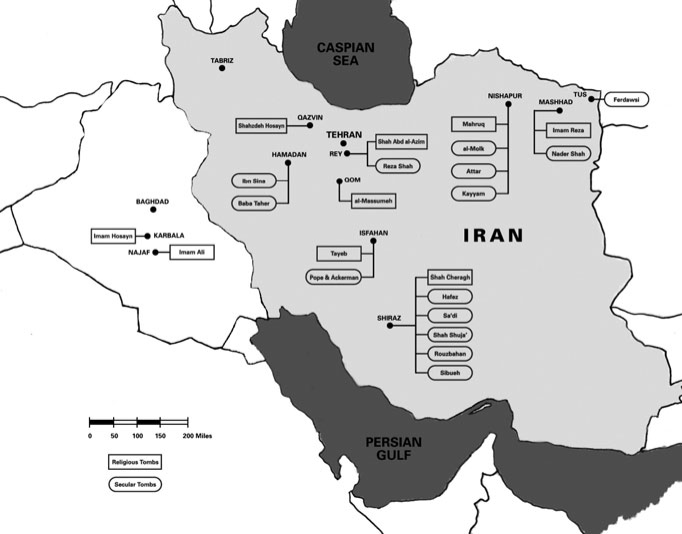
Figure 5.2 Map of major historical sites of pilgrimage for Twelver Imami Shi‘ism in Iran, overlaid by the modern sites of secular/civil pilgrimage constructed between 1934 and 1979 by the SNH. As an integral part of Iran’s modernization project, the state and the SNH intended first to utilize and then to shift the network and rituals of the Shi‘a pilgrimage to a different set of secular national destinations.
Source: Talinn Grigor, 2009.
construction process of each tomb harbored technically sophisticated documentation, categorization, and ordering of the national domain. Around each monument entire towns were revitalized as the expression of progress under the new dynasty. Furthermore, these projects provided a platform for western scholars including Andre Godard, Ernst Herzfeld, and Arthur Upham Pope to negotiate their conflicting personal and colonial ambitions. The discourse on Iranian architecture occasioned quarrels over techniques of preservation, authenticity of heritage, and ownership of archaeological sites.
Under the often unforgiving gaze of Reza Shah, form and style were segregated along the line of the structure’s functional relation to Iranian history. Because of their program as burial sites of historical figures and museums that displayed Iran’s golden moments, all of the SNH’s landmarks deployed historicism and selected revivalism as style. All of these were strategically erected in provincial towns outside the capital city as markers of national and cultural heritage. Within Tehran, however, the king ordered the rapid erection of a large number of governmental and administrative buildings in impressive
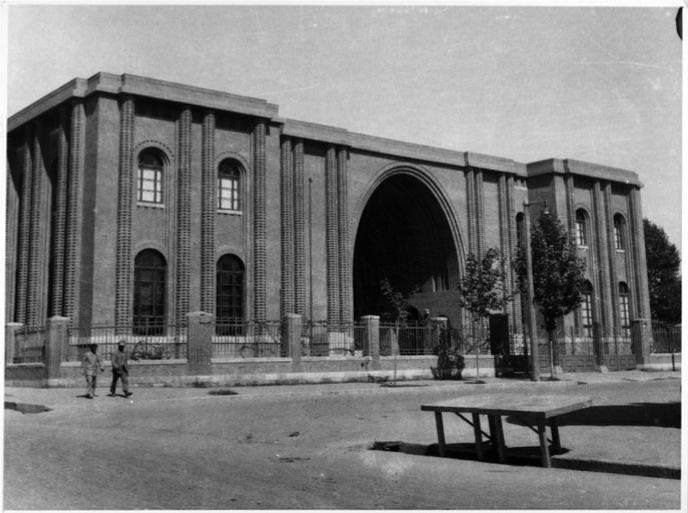
Figure 5.3 Andre Godard, main and southern fagade of the Archaeological Museum of Iran (Muzeh-ye Iran Bastan), Tehran 1936-39.
Source: Private collection, photo by Farokh Khadem; courtesy of Cyrus Samii.
revivalist street-fagades: the first National Bank (Bank-e Melli, 1935) designed by German architect H. Heinrich; the Archaeological Museum (Muzeh-ye Iran Bastan, 1939) designed by Andre Godard (see Figure 5.3); the first public library (c. 1940) proposed by Maxim Siroux; the central post office; the Anushirvan school for girls; the Police Headquarters (1933); along with a dozen monumental structures to house the newly established ministries. In these works, both Iranian and foreign architects designed public monuments that were imbedded in historicism - i.e. neo-Achaemenid, neo-Sasanian, neo- Samanid, neo-Seljuk, neo-Safavid, etc. - while simultaneously erecting private residential houses, leisure architecture, and military structures that rebelled against any kind of academic and historicist tradition.
In commissions that had to fulfil the demands of historical heritage, architects complied with the historicist trends despite their general discontent with eclecticism. In private commissions and those fulfilling contemporanity, they had license to remain faithful to the architectural discipline and its contemporary global trends. In these latter bids, their bourgeois patrons insisted on a modern built environment that matched their class ambitions. Free from the burden of history, often with a self-Orientalist underpinning, architects ventured into a range of imported and invented schemes that were distinct from the historicist architectural vocabulary reserved for the SNH’s monuments and state structures: from a minimalist art deco in the then fashionable New Lalehzar Street apartments, to the austere International Style villas tucked in the small alleys of northern Tehran. Rarely, if at all, did Achaemenid and Sasanian revivalism find its way to these private commissions. Revivalism under Reza Shah was a mere strategy to arrive at a modernity that aimed to be uniquely Iranian. The modern middle class desired a timeliness that was only possible with the presence of a timely architecture juxtaposed to the timelessness of historicism. Being modern meant inhabiting the modern as timely.
For the project of nation-building, the historicist style met the central need of historical lineage as well as national symbolism. Those architects who practiced historic eclecticism believed that their work was part of a continuous process of cultural evolution that was capable of recapturing the true spirit of a given period in Iran’s (art) history. The various Muslim golden ages - Seljuk, Samanid, Safavid, etc. - were recast as a purified version of an Islam that was deeply Persian and uninhibited by colonial expansionism. The various pre-Islamic golden ages - Achaemenid, Parthian, and Sasanian - were reinvented as unpolluted from Muslim-Arab influence and equally deeply Persian in essence. In either case, these authors were in search of a visual language that was appropriate for their age - as all modern architects had been since the nineteenth century inside and outside the western canon of architectural practice. In spite of the claims of its protagonists and its later apologists, in the case of Reza Shah’s Iran, both historicism and avant-gardism in architecture were deeply modernist practices in search of the same thing: formulating new ways to look authentically modern, yet of a nation millennia old. Iranian architects were not only rethinking the nature of their own relationship to Iranian history and its contemporary political currents, but also the nature of their rather unstable affinity with the hegemonic West as the centre of modernity’s image.

