Stamps in Qajar Iran
Communication between the various parts of Iran, and government control over the communication systems, was enhanced by the reorganization of the postal service, which proved to be one of the most effective institutions of Qajar Iran, especially after its reorganization by an Austrian expert.10 In order to facilitate the payment and transport of mail, the officials soon took into consideration the introduction of postage stamps, as they were already in use in Iran’s neighbouring countries, i.e. in India, Russia and the Ottoman Empire.11 For this purpose, a delegation was sent to Paris in 1865 to discuss the design and printing of stamps at the imperial mint.12 The first Iranian stamps,13 which were issued in 1869, were eventually printed in Iran itself.14 The design finally chosen for these stamps, with the royal coat of arms of the lion and sun in the centrepiece, was strongly oriented to the design of contemporary coins. To some extent the function of postage stamps was identical to that of coinage.15 By displaying the royal coat of arms, they not only referred to the character of the postal service as an official, state-controlled institution, but through their employment as confirmation of the payment of the transportation fee, they also signified the authority of the state over its
Depicting power: the commemorative stamp set of 1935 151
fiscal affairs. Finally, the postage stamps, on a symbolic level, transported the claim of the crown to absolute control over its territory and subjects. In both functions, as a means of payment as well as a ubiquitous instrument of political propaganda, the postage stamps fulfilled the same role that coins had played in earlier centuries.16
The latter function as a medium that was supposed to create the symbolic presence of Naser al-Din Shah all over Iran was emphasized by later stamp sets issued from 1876 onwards, which, together with the royal coat of arms on the lower (Shahi-) denominations, displayed the Shah’s portrait (Figure 7.1).17
In this way they introduced, at least in effigy, the person of the monarch and the new institutions that to a growing extent formed the fundament of the Qajar state to his subjects in all parts of the country.18 An indication of this growing institutionalization of power was given by the inscription “Post-e Dowlat-e ‘Aliyyeh-ye Iran”, that was to be found on stamps from 1260q/1880 onwards (Figure 7.2).

Figure 7.1 1882 definitive set, 5000 Dinar, portrait of Naser al-Din Shah. Source: Author’s collection.
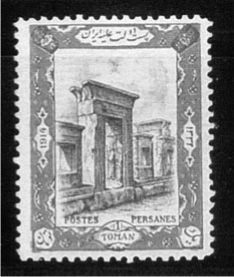
Figure 7.2 1914 coronation set, 1 Toman, ruins of Persepolis. Source: Author’s collection.
With these stamps, a pattern for design and propagandistic message was created that was to set the trend for those of the following decades, during the reigns of Naser al-Din Shah and those of his successors, Mozaffar al-Din Shah (1269-1324q/1853-1907)19 and Mohammad Ali Shah (1251-1304q/ 1872-1924).20 Unlike his predecessors, who usually had been portrayed on stamps in unadorned clothing and with a heron’s crest as the only sign of royalty,21 Mohammad ‘Ali Shah emphasized his claim for absolute power by having himself portrayed on the highest denomination of the only stamp set issued under his rule22 with the Kayani crown,23 the ancient symbol of the Qajar monarchy. In this way, he expressed his pretension to absolute authority by a claim to represent and to personify the institution of the monarchy that had been founded by his ancestors.24
Such forms of self-representation, however, had become anachronistic in face of the changes that had taken place in the political culture of Iran during the decades before the Constitutional Revolution of 1285-1288/1906-1910. For many intellectuals, the encounter with the West had generated an acquaintance with the findings of oriental studies and archaeology, and especially the re-discovery of the pre-Islamic heritage of Iranian culture as a foundation of cultural and political identity.25 The Iran of the Achaemenid and Sassanid periods was seen in contrast to that of the Qajar monarchy, whose rulers, irrespective of their attempts for modernization, were regarded as incapable and despotic and thus unable to implement fundamental social and administrative reforms that were deemed necessary to enable the country to compete with the challenges of imperialism.26 In a fundamental change of paradigm the state of Iran was no longer defined as the territory controlled by a dynasty, but rather as a nation, i.e. a community of citizens that was held together by a common culture and history.27 In the course of the Constitutional Revolution, these ideas made their breakthrough as formative political ideology, a process that was accompanied by a vivid debate in the media. Cartoons and caricatures published in the constitutionalist press played a crucial role in the shaping of a new public awareness. In the iconography of the nationalist discourse, the ruling dynasty was associated with despotism and decadence, while the symbolism of the new order was taken either from modern Western civilization, such as images of modern technology, or from the pre-Islamic period.28 After Iranian intellectuals, with the mediation of Western archaeology and philology, had encountered the cultural heritage of the Achaemenid and Sassanid eras and their country’s glorious past during the pre-Islamic period, the architectonic reminders of that period had become symbols of Iran’s cultural and political identity, while the past itself had become a source of inspiration and a projection screen for nationalist aspirations.29
This change had become evident in two sets of stamps that had been ordered from the printing house of J. Enschede and Sons in the Netherlands (which had been entitled with the printing of stamps by the Iranian mail since 18 94)30 on the occasion of the coronation of Ahmad Shah in 1293/1914.
Among the Iranian stamps of the Qajar period, these two sets are of special interest as they formed the first attempt to convert this new ideology on postage stamps into a coherent iconographical system.
The iconography of the first of the two sets31 was innovative insofar as it constituted a first attempt to find a symbolic form of representation for the new constitutional monarchy. The Kayani crown as emblem of Qajar rule did remain a central symbol in the motifs of all denominations, but instead of the Shah’s portrait, it was now combined with views of the ruins of Persepolis as a new symbol of cultural and political identity (see Figure 7.2). The legitimacy of monarchic rule was thus not derived any more from the king’s person, but the ruler himself had become the supreme representative of the Iranian nation, and the guardian of her independence and political identity.32
Even more ambitious in its attempt to create a new iconography to represent the modern state and to legitimize Qajar rule was the second stamp set of nineteen denominations, known among collectors as the “ruler’s set” (seri- ye salatin-e vabineh).33 Whereas the seventeen denominations of the coronation set displayed three motifs, for all of the denominations of the ruler’s set individual motifs had been chosen. The significance that was ascribed to this set could also be seen from the accurate printing and the careful layout. A possible inspiration for the whole set may have been a similar set that had been issued in Russia in 1913 in celebration of the 300th anniversary of the House of Romanov,34 and possibly there had been an intention on the Iranian side to have the new Qajar state represent by a similar and equally impressive series of stamps.
Just like the coronation set, the stamps of the seri-ye salatin betrayed an obvious effort to formulate a topical concept of monarchy and statehood, whereby the subjects of the stamps combined both traditional-conservative as well as nationalist elements. As an attempt to provide the rule of Ahmad Shah with a legitimacy drawn from tradition and history, the first ten denominations presented some sort of a line of ancestors, by displaying portraits of the young Shah and his predecessors from the Qajar dynasty. Remarkably enough, this line of ancestry was not just traced back to Agha Mohammad Shah, the founder of the dynasty (who, after Karim Khan Zand, only came third), but to Nader Shah, whom the nationalist discourse praised as one of the great rulers of Iran, and who was credited with the restoration of Iran’s territorial integrity after the Afghan invasion, the creation of a centralized administration and the restriction of Shi‘i clerical power.35 Another member of the dynasty who was included in Ahmad Shah’s ancestry was ‘Abbas Mirza, the reform-minded, but prematurely deceased son of Fath ‘Ali Shah.36 As on the stamps of the coronation set, the new role of the monarch as supreme representative and first servant of the Iranian nation, and his foremost task to guarantee her identity and cultural heritage, was exemplified in the other denominations, whose motifs, with their depictions of royal palace buildings, followed the pattern set some decades earlier by the official newspapers with the depiction of royal palace buildings.37 In doing so, the stamps did fulfil in a traditional way the task of representing the institution of the monarchy in a symbolic way, as the palace buildings did all over Iran. But in this set, the illustrations also reflected the nationalist discourse, which saw the territory and civilization of Iran symbolized by the sum of her historical (and especially pre-Islamic) monuments.38 The reference to the tradition of the Iranian monarchy from ancient times was further emphasized by having the views of those buildings on the stamps flanked by elements of Achaemenid palace architecture, which for the second time appeared as an iconographic element on Iranian postage stamps. Another remarkable feature of this set is the selection of monuments. Apart from pictures of royal palaces and the marble throne at the Golestan Palace, the stamps also gave a hint to Shi‘i Islam as the state religion, in the form of a view of the Gowharshad Mosque in Mashhad, and two illustrations dedicated to the parliament building in Tehran,39 thus introducing the constitution and the sovereign people as new and supplementary pillars of the Iranian state.
By an irony of history, however, the issuing of this set had been prevented by the beginning of World War I, which inhibited the delivery of the total stock of ordered stamps. The already delivered stamps remained at the Ministry of Post and Telegraph and were for the most part destroyed some 25 years later,40 making this set one of the biggest rarities among the stamps of Iran. In the years to come, the war events made it impossible to think of issuing new stamps, and right into the post-war period the Iranian postal administration confined itself to using up the existing stocks.41

