The subvention as a barrier to Irish unity?
Overall, there can be no disguising that high levels of public expenditure are an integral feature of the Northern Ireland economy - the share of total government revenue in total regional income - regional GDP in the lingua of economists - is approximately 50 per cent, which in comparative terms is disproportionately large. Without high levels of public expenditure, living standards in Northern Ireland would be severely squeezed. Since the annual subvention is the elixir that allows high public expenditure to be sustained over time, it is widely believed that it is critical to allowing Northern Ireland citizens enjoy a reasonable standard of living even though everything is far from rosy in the economic garden. But of course maintaining the subvention amounts to Northern Ireland being fiscally tied to the UK Treasury. It needs emphasizing that the subvention is large in the context of Northern Ireland economy, but puny when placed in the setting of the UK economy overall. It is this fiscal dependency that most of unionism view as the clincher argument against a united Ireland - the subvention is seen as making reunification economically unfeasible: since Dublin has not got the fiscal capacity to take over the financing of the subvention, a united Ireland would be economically ruinous for both parts of the island (see Birnie 2013). It is an argument that has held sway, unchallenged, for some time.
Until recently, that is. Over the past few years, republicans and some nationalists have challenged this view with increasing assertiveness. They argue that the Northern Ireland subvention is not the fiscal drag on Irish unification as often claimed. Sinn Fein, unsurprisingly, has been leading the charge on this point. It portrays the argument that the subvention weakens the economic viability of Irish unity as a ‘myth’. Pearse Doherty, one of the party’s leading spokespersons, has argued:
even a basic understanding of the public finances in the north of Ireland dispels the subvention myth. The £9bn figure is a mish-mash of local spending, accounting procedures, and billions of pounds of British obligations that simply wouldn’t exist in the event of Irish unity. By way of example, the £1.1 bn the north is forced to pay towards its ‘share’ of the British military, exceeds the entire military spending of the Irish government. Irish unity saves money.
(Doherty 2019)
Thus, for Sinn Fein, it is illusory to believe that the subvention represents a big fiscal chasm standing in the way of Irish unity. On this view, there are no insurmountable public finance problems standing in the way of Irish unification.
As the implications of this argument are far reaching, it needs to be assessed carefully. Two key points appear central to Sinn Fein’s position on the subvention. First of all, it suggests that the £3.4bn currently paid out in pensions each year would remain the responsibility of the British government in the event of Irish unity. This is a reasonable point and as a result should not be contentious: if people have paid a lifetime of national insurance contributions in the UK context then it is only reasonable that they have continued access to their UK state pension should a new Ireland be created. No great departure would be required from existing practice as, already, people whose working life was spent in the UK but who now live in retirement in Ireland receive their UK state pension. The second point Sinn Fein makes is that the creation of a new Ireland would more or less end the need for any element of non-identifiable public expenditure to be part of Northern Ireland’s public finances. If this were to happen then it would be possible to slice off roughly another £2bn - the rough amount of Northern Ireland’s non- identifiable public expenditure in 2019 - from the subvention. On this point, Sinn Fein is on much weaker ground. To treat non-identifiable public expenditure as some type of accounting element that could quickly be erased from Northern Ireland finances displays not only political naivety but also an astonishing lack of developed thinking about how to fiscally disentangle Northern Ireland from the UK.
Remember non-identifiable public expenditure can be viewed as that part of the Northern Ireland public expenditure that is spent outside Northern Ireland by the UK Government, but which is deemed to be either ‘on behalf of’ Northern Ireland or in the shared interest of all nations and regions of the UK. Although it would provoke political controversy, stopping Northern Ireland’s contribution to the overall UK’s defence budget could be done more or less immediately, which would allow £1.1 bn to be shaved off the subvention. But to suggest that Northern Ireland’s contribution to the UK’s public sector debt interest repayments could be stopped quickly is an entirely different matter. It is this element of non- identifiable public expenditure that opens the door to the huge complexities associated with fiscally separating Northern Ireland from the UK. Public sector net debt represents the amount of money the public sector owes to private sector organizations (including overseas institutions) that has been built up by successive governments over many years. It reflects the amount of money Governments have borrowed to finance their spending plans. Like all debt it comes with repayment obligations that involve annual interest repayments. At the moment, the public sector net debt stands at approximately £1.8tr, which equates to 83.1 per cent of UK national income (GDP) in 2019 - high, but not out of control.
102 The economics of Irish unity
Sinn Fein suggest that Northern Ireland’s contribution to repaying UK’s net public sector debt would, in the words of Pearse Doherty, a leading party member, 'be subject to post-unity negotiations'. The overwhelming impression is that the party would be untroubled by such negotiations, presumably thinking this expenditure could be stopped relatively painlessly, waived away in one stroke of an accountant’s pen. But this is likely to be far from the case. A UK Government would most likely argue that as nearly all of the national debt was accumulated when Northern Ireland was a full member of the UK and since the borrowing effectively allowed the U К as a whole to live beyond its means then Northern Ireland must ‘own’ a share of the debt. History would be on side of the UK Government were it to make such an argument - in the Anglo-Irish Treaty of 1921 the newly formed Free State agreed to assume responsibility for a proportionate part of the UK’s debt at the time of signature, although the UK forfeited its claim at a later date it has to be said. Thus negotiations about Northern Ireland's contribution to repaying UK’s net public sector debt are likely to be anything but straightforward. More likely these would prove to be complex and protracted. And it is fanciful to believe that any outcome would be benign for the new Ireland.
If a UK Government were to take a tough line in post-unity negotiations and demand that Northern Ireland’s large, inherited proportion of the UK’s national debt is fully owned and serviced by the new Ireland, then the fiscal bill could be extremely hefty. Various different methods could be used to work out Northern Ireland’s share of the UK’s public sector debt, but the most accepted - and straightforward - is based on relative size of population. Rough calculations using this method produces the following result. On the one hand. Northern Ireland has a population of 1.9 million, which amounts to 2.9 per cent of the UK’s total population of 66.4 million. On the other hand, as already pointed out, the overall public sector net debt amounted to £1.8tr at the end of 2019. Thus, under the hard line scenario of the new Ireland having to fully repay Northern Ireland’s share of accumulated UK debt, it would be facing a fiscal bill of 2.9 per cent of £1.8tr, which amounts to £54bn, some 193 per cent of total public expenditure in 2019 and
103 per cent of regional GDR
It is fairly certain that those negotiating on behalf of a new Ireland administration would baulk at the idea of having to pay the UK exchequer £54bn and instead could come up with an alternative repayment plan. At this stage, the exact shape of such a plan is anyone’s guess, but one credible negotiating stance would be to negotiate that the current level of Northern Ireland's contribution to public sector debt interest repayment, which is approximately, £lbn per annum, would continue for a limited time period of perhaps 10, 15, or 20 years. If a version of this softer scenario were to be agreed, involving the new Ireland’s administration making a contribution to accumulated UK debt for 15 years, then the fiscal bill arising from separating from the UK would be roughly £15bn, a much more manageable sum than £54bn. But the bottom line is that it is unlikely that any new Ireland administration would be able to stop immediately Northern Ireland’s public sector debt repayments. As a result, Sinn Fein are on very shaky grounds arguing that the scale of the subvention to Northern Ireland could be reduced by immediately shaving the annual £lbn of UK public debt repayments of the £9.6bn subvention total - such a saving is unlikely to happen.
Further bad news for those who hold the Sinn Fein position is that the UK government is likely to argue that the new Ireland was also responsible for Northern Ireland’s share of future public financial liabilities other than servicing net public sector debt. Keen discussions are likely to take place about what should be included in this wider category of future public financial liabilities. Even within the UK there is considerable debate about what should and should not be included in this calculation. Some argument that students loans, which could amount, if included in the national accounts, upwards to 7 per cent of public debt. Additionally, some argue successive rounds of quantitative easing by the Bank of England, which under one calculation would amount to 20 per cent of public debt, should also be included in future public financial liabilities accounts. It would be disingenuous of a UK Government to put categories of public liabilities on to any post-Irish unity negotiating table that were not included in their own official national accounts figures. But if this were to happen, the new Ireland administration would face a whopping fiscal bill in the area of future public financial liabilities.
However, it is unlikely this scenario would materialize, so for the purposes of the analysis here, items such as student loans and quantitative easing are excluded from calculations. Instead, we focus exclusively on public sector pension entitlements, the most significant public liabilities after public debt. The net present value of future public service pension payments arising from past employment was £1.8 trillion billion in 2018, the latest available figures. When it comes to dividing up financial responsibility for future public sector pension entitlements, the potential for acrimony is enormous. Like public debt, it would probably be judicious to use the share of population rule to divide up future public sector pension liabilities. It is a fairly straightforward rule to apply thus allowing long, complex, and anguished negotiations to be avoided. Moreover, it is likely to ensure that a broadly equitable solution is reached. If the rule were to be applied it would mean the new Ireland administration acquiring a fiscal bill amounting to 2.9 per cent (Northern Ireland’s share of the total UK’s population) of the overall £1.8tr UK liabilities for future pension payments, which works out at £55bn.
Thus, on the debt side of the equation, the cost of fiscally separating Northern Ireland from the UK could amount to anything up to £109bn, a huge 213% of regional GDP at current prices. But as Sinn Fein rightly argue, any post-unity negotiations would not only include Northern Ireland’s share of future UK public liabilities, but also future public assets. Like in other areas, calculating Northern Ireland’s share of UK’s future public assets with any degree of accuracy is hazardous. Public assets to be divided include natural resources, physical assets such as buildings, and financial and capital assets. Some of these assets would be more difficult to divide than others. In terms of physical assets such as schools, hospitals, and Government buildings, a sensible approach would be to follow the example of the ‘velvet divorce’ of Czechoslovakia into the Czech Republic and Slovakia in 1993 where a general geographical principle was followed that led to property being assigned to the country in which it was located. Dividing up natural resources ought not to be the source of much antagonistic negotiations for, unlike Scotland, which is endowed with oil and gas reserves, Northern Ireland is not overly abundant in natural resources. Working out Northern Ireland's share of overall UK financial and capital public assets would probably be the most complicated area. For example, in terms of capital assets who would own the huge amount of sophisticated technical equipment in hospitals across the region? Faced with the prospect of negotiations that could very quickly run into the sand, it may be prudent once again to revert to the simple share of population rule. If this rule were to be followed, it would lead to the following arithmetic. In 2019, the government reported public assets of £1.9tr, of which Northern Ireland would be entitled to 2.9 per cent under the share of population rule, which would lead to a transfer of £55bn into the coffers of the new Ireland.
The calculations presented here suggest that the net fiscal cost of Northern Ireland leaving the UK and joining a new Ireland run along a spectrum: at the hard end, the cost amounts to £55bn, approximately 106 per cent of regional GDP at current prices, and at the softer end, £15bn, a manageable 30 per cent of regional GDP. A reasonable projection is that the final figure would be nearer £27bn, amounting to 53 per cent of regional GDP, a tough outcome, but one that would not break the bank, particularly if the new Ireland were permitted to make the payments over a prolonged period of time. But the calculations reveal as seriously misleading Sinn Fein’s assessment that billions of pounds could be slashed from the subvention because Irish unity would end Northern Ireland having to contribute to such things as the upkeep of UK defence and UK public debt repayments. The truth is that once elements of Northern Ireland's public finances begin to be unpacked in relation to Irish unity, a hornet’s nest is stirred about past and future assets, debt, and liabilities.
Disentangling Northern Ireland fiscally from the UK is going to take careful and complex negotiations. Moreover, it is hard to envisage any outcome from these negotiations that would reduce to negligible levels the current subvention to Northern Ireland. A reasonable estimate would be that a new Ireland would be required to pay the £lbn-£2bn that is currently allocated to non-identifiable public expenditure, but renamed so that it is earmarked for UK liabilities payment. At the same time, it would continue to receive funding from the UK for those citizens of the new Ireland who have amassed enough national insurance contributions to entitle them to a UK state pension. This figure will get progressively lower due to deaths and
The economics of Irish unity 105
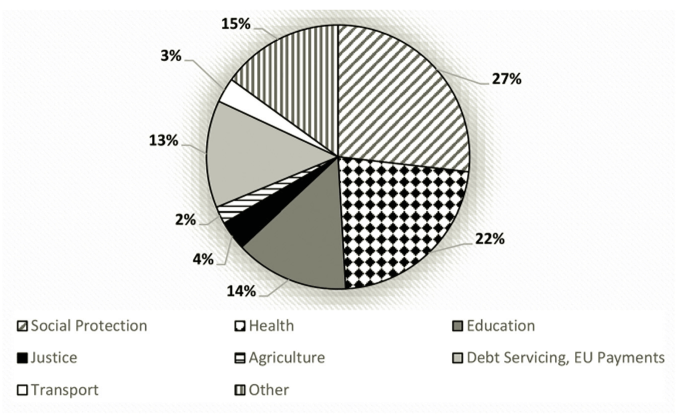
Figure 6.3 Public expenditure in Ireland by sub-function, 2019 (%)
Source: Central Statistics Office, Ireland.
falling contribution levels due to people no longer working in the UK context. Generously, it could be estimated that the current £3.4bn expenditure will continue in the future. This means that the current £9.4bn subvention could be reduced to approximately £5bn-£6bn.
Thus, if a new Ireland were to be created, this analysis suggests that to maintain existing living standards Northern Ireland would continue to need an annual subvention of around £6bn at current prices. Whether this subvention would arrive from Dublin or London would no doubt require protracted negotiations. However, it is difficult to envisage London funding anywhere near the lion’s share of the £6bn beyond the short term. Sooner or later, Dublin would have to assume responsibility for financing the subvention and it is naive to suggest this would not be politically challenging. Overall, public expenditure amounts to 50 per cent of regional GDP in Northern Ireland, whereas it represents only 35 per cent of national GDP in the south. So citizens of Ireland would be required to foot a higher tax bill to finance a level of public expenditure which is much higher than they enjoy. This fiscal arithmetic does not get any more comfortable if we look at the structure of public expenditure in the two economies. Figure 6.3 suggests that about 27 per cent of public expenditure in Ireland goes to social protection, whereas Figure 6.2 suggests the equivalent figure for the north is 44 per cent. Thus, the Irish tax-payer will be asked to take a hit to finance a bigger social protection budget in the north than what exists in the south. Moreover, if social and welfare benefits in the north were increased to the levels that currently prevail in the south then the bill for the southerner tax-payer is likely to be much higher.
It is hard to get away from the observation that the dowry required to acquire Northern Ireland is going to be hefty enough for Ireland. Moreover, it needs emphasizing this assessment does not even start to consider the problems of integrating two public sectors that operate in quite contrasting ways. For example, in the area of health spending less than 10 per cent of households in Northern Ireland purchase private health insurance compared to a corresponding figure of nearly 50 per cent in Ireland. Does this disparity mean that some type of NHS systems needs to put in place in the south or that more households in the north require to take out private health insurance? Education is delivered quite ditferently in the two parts of the island, so after reunification will the north be required to recast its educational system root and branch? Discussion of these issues remains rudimentary, if it is occurring at all. But one thing is for certain, the administrative challenges thrown up be any move towards quick reunification would be formidable and challenging. Trying to unite Ireland in the near term would be anything but a walk in the park.

