Compulsion to Kill
In order to understand compulsive murderers, it is necessary to consider the role of sadism and fantasy in their lives. However, these components are not sufficient explanations for offenders’ drive to act out their fantasies. As previously noted, most individuals who harbor sadistic, sexually oriented fantasies do not act on their imaginings (Crepault and Couture, 1980; Templeman and Stinnett, 1991, Maniglio, 2009). Schlesinger and Revitch (1997b) examined numerous individuals—many of whom had committed nonsexually motivated crimes or no crimes at all—who reported elaborate sadistic fantasies but never felt the desire to act them out. For example, Figure 8.4 contains drawings by a man who was briefly incarcerated for the theft of a watch, an act that seemed impulsive and spontaneous. Although he had never been involved in any sexually motivated crimes, he wrote about and drew pictures of men who cut off female breasts, stabbed women, chained them, scraped the skin off their bodies, whipped them, and introduced swords and rods into their vaginas. Many of his sketches depicted medieval dungeons and executions. He claimed that his creations were a mere pastime. His actual life seemed more masochistic than sadistic. The following is a sample of his writing:
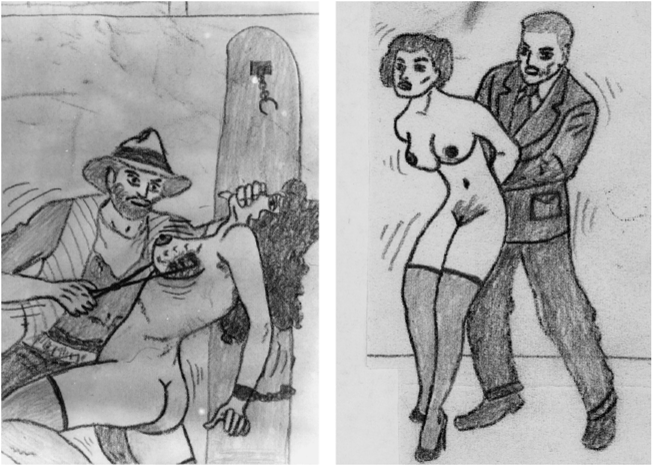
Figure 8.4 Sketches by a man who denied having a desire to engage in any sadistic acts; he considered his drawings a mere pastime.
He heard the howling grow louder now, which meant more victims. He looked out and gasped.
A naked man hung swinging and writhing by his genitals. Next to him hung a plump woman who had cords threaded through her breasts and she was hanging by them. The weight of her body pulled them up by her face. It was a pitiful sight, and she writhed and squirmed. The mob was jabbing sticks at her buttocks and vagina while she hung there writhing. The man was being jabbed about the thighs, chest, and buttocks; and over by the wall hung two naked girls. The men were inserting objects into their vaginas while others were scraping the skin off their arms and breasts with little steel rakes. Men ran around with parts of bodies, women’s breasts and legs, also men’s genitals.
Why do some individuals act on their violent and sadistic fantasies, and others do not? Revitch and Schlesinger (1981, 1989) concluded that those individuals who act out these fantasies do so because of a compulsion. In many cases, the compulsion is so strong that an attempt to resist it results in anxiety and various somatic manifestations. For example, Krafft-Ebing (1886) cited the case of a 21-year-old man who attacked and stabbed girls in the genitals during broad daylight. “For a while he succeeded in mastering his morbid craving, but this produced feelings of anxiety and a copious perspiration would break out from his entire body” (p. 74).
Vincenz Verzeni, described by Krafft-Ebing and reported on in Chapter 7, recognized the strength of his compulsion to kill. “Verzeni said, himself, that it would be a good thing if he were to be kept in prison, because with freedom he could not resist his impulses” (Krafft-Ebing, 1886, p. 66). In fact, most compulsive murderers recognize the strength of their compulsion to act; as Brittain (1970) notes, “Given the opportunity the [compulsive] murderer is likely to murder again and he knows it” (p. 205). Perhaps William Heirens best explained the strength of this compulsion by writing on his victims’ mirrors his infamous plea for help: “Catch me before I kill more, I cannot control myself” (quoted in Kennedy, Hoffman, and Haines, 1947, p. 120).
An offender can describe his fantasies simply by reporting his thoughts. But a compulsion is more abstract and difficult to explain. Offenders, therefore, often do not attempt a description, and many examiners also overlook the importance of the underlying compulsion when they evaluate such individuals. Those offenders who do describe—and attempt to explain—their strong urge to act report that a feeling of tension drives their behavior. A 25-year-old compulsive murderer spoke of “a feeling that comes into my head; a sharp pain in the back of my head, an angry overwhelming feeling to kill,” in explaining his urge to act. People who report sadistic fantasies but do not act out lack a corresponding state of tension. Thus, the release of the tension seems to be directly linked to the underlying compulsion. The acting out liberates compulsive murderers from this pronounced inner tension (see Figure 8.5); they achieve a sense of satisfaction and then return to their prior state. As one individual said, “After I kill, I am out of the zone and back to myself.” After a time, however, the inner tension builds again, and the urge to act out resurfaces; thus the repetitive nature of compulsive murderers’ actions.
Some offenders describe “another personality taking over” in an attempt to explain— or concretize—the compulsion. These statements are sometimes thought to be an attempt

Figure 8.5 Fantasy grows out of sadism and creates a state of tension that leads to a compulsion to act out the fantasy and gain relief.
to create a legal defense, such as multiple personality disorder or “irresistible impulse.” But compulsive offenders know exactly what they are doing, and they can, to a large extent, control their actions. They usually choose not to exercise restraint because they seek gratification as well as relief from the building inner tension. Such a tension state is totally different from the tension state found in individuals who commit catathymic homicides. The catathymic offender is driven not by fantasy or a compulsion but by a change in the thinking associated with a released sexual conflict. Catathymic homicides are rarely repeated, except when there is also an underlying compulsive aspect (as reported in Case 6.4).
Meloy (2000) attempted to determine “the factors that contribute to the behavioral acting out of the fantasy: the most important predictive data in sexual homicide cases” (p. 9). He proposed a “structuring” of sexual fantasy that provides the offender with “certain positive reinforcements prior to, or between his sexual homicides.... If a sexual homicide is committed this mechanism would reset, but the high arousal of the actual sexual violence would have less propensity to extinguish over time” (p. 9). Perhaps Meloy’s model explains the “reinforcing” quality of the compulsion once a homicide is committed.
In addition to a behavioral component, a physiological ingredient is also quite likely in the compulsion to kill. In fact, a neurobiological substrate underlying sexual murder was first theorized by Krafft-Ebing and was supported years later by MacLean (1962), who pointed to an anatomical interconnection between sex and aggression. More recently, Miller (2000) has contended that an abnormality in the temporal lobe-limbic mechanism is the foundation for the “driven quality” of the compulsive murderer’s urge to kill: “He won’t stop and doesn’t want to, because nothing in life could possibly replace the thrill of dominating and destroying another human being” (p. 158).
The following case of a 16-year-old who prayed at bedtime not to wake up so that he would not have to carry out his crimes clearly illustrates the strength of his compulsion.
Case 8.7: Overpowering Compulsion to Kill
A 16-year-old male (GG) was arrested for two murders, attempted murder, voyeuristic acts, and a series of burglaries. Because of the numerous burglaries which had occurred prior to the homicides, the police department had set up an investigative task force to apprehend the unknown offender. The investigators obtained one fingerprint, but because of GG’s lack of a prior criminal record, they were unable to make a match. The offender was finally caught when he was spotted leaving a home after an attempted burglary. Unfortunately, GG was not apprehended until after two women were killed and a third was seriously assaulted. He was linked to the murders and the burglaries by his fingerprints.
During the evaluation, GG spoke in a bland, matter-of-fact way, without displaying any emotion. He did not seem upset by the homicides, burglaries, or his legal predicament. He stated repeatedly that he could not control the urge to peep into houses, break inside, or kill. The offender first explained the burglaries:
I started breaking into homes. I don’t know why I did it. I just started when I was sleeping one night. Something woke me up. I heard some kind of voice inside my head that told me to go out and rob a house. I sent away for a gun. It cost 14 dollars. I used to send away for a lot of things.
GG also obtained burglary tools, which he kept hidden in his room. He said that he burglarized mostly when it rained, about once a week. Around 9 or 10 o’clock at night, after his parents thought he was asleep, he would sneak out of the house with his burglary tools and either peep into other people’s homes or burglarize them for money, “which I didn’t need.” At one point, he broke into his school and vandalized it, an act he could not fully explain.
I was looking for money. I don’t really know why because I didn’t need it. After a while, it was just to get into the houses. It was a drive to get into the houses. I think it was looking for money, but the drive was really, really strong.
About 18 months after the burglaries began, GG committed his first murder. He woke up around midnight, laid out his burglar tools on a table, and climbed out his bedroom window, which was on the second floor of his one-family house. He began looking for a home to burglarize. He wound up at the home of his math teacher, a house that he had been to in the previous week to get an award.
GG entered through the basement window after cutting the phone lines. He went directly to his 36-year-old teacher’s bedroom. When she awoke, “I told her to stay there. I won’t hurt you. I just want your money.” The victim began to scream, which prompted GG to strangle her. As he ran out of the house, he bumped into the woman’s daughter, whom he pushed away. Following the homicide, GG went back home and slept well. When questioned regarding the strangling of the victim, he said that he did not want to do it. “I just wanted to leave, but I couldn’t go until I finished it. I had to kill her.”
The next day, a Saturday, a girl from school told GG about the murder when she ran into him in front of his house. He questioned the classmate as to how it happened, and the girl answered, “She was strangled.” GG stated, “I didn’t think about it. I felt sorry for her. Then I went back outside and continued to wash the car. I never thought about it at all.” He said he liked the victim very much. “She was a nice lady and the nicest teacher in the school. That was my best class. I got A’s in her class. My best subject was math.”
About 3 weeks later, the offender broke into another home, where he came upon a 43-year-old woman sleeping in her bedroom. He gagged and hogtied her and forced her into her car after brutally sexually assaulting her, twisting her breasts, and inserting objects into her vagina, including a toothbrush. He drove the victim around, torturing her for several hours. GG dumped her in an unconscious state in a park, returned home, went to sleep, and “didn’t think about it.” Miraculously, the woman did not die.
Following this attempted murder, he continued his voyeurism and burglaries. Several weeks later, he laid out his burglar tools, left his home in the same ritualistic manner, and broke into another house in the surrounding area. Since no one was home, GG waited, watched television, and ate some of the occupant’s food. When the 60-year-old woman entered her house, she became terrified at the sight of GG lying on the couch. She begged, “Don’t kill me.” GG reassured her, “I just want your money.” He then gagged her, hogtied her, dragged her upstairs to the bedroom in a brutal manner, and abused her sexually by twisting her breasts and inserting various objects into her vagina. He then filled the bathtub with water and drowned her; he compared this incident with drowning a dog years earlier.
Something made me go back and pour the water in the bathtub. I was on my way out. I grabbed her and put her in the bathtub when she was tied up and gagged. I pushed her in. Pushed her down and left.
GG then went home, slept well that evening, and continued his uncontrolled acts of voyeurism and burglary until his arrest.
The offender was raised in a middle-class family; his father was an accountant, and his mother worked in business. His mother had pulled a knife on him once; he was frightened of her, yet protective as well, and he thought she was “sexy.” He had an abusive relationship with his father and once thought that his father would kill him. GG had a history of bed-wetting, cruel behavior toward animals (including killing dogs and birds), and no friendships with males or females. He admitted to having sadistic and grandiose fantasies but did not elaborate on them except under the influence of sodium amytal when he revealed ideas about being “the king and ruler.” GG explained that he first got the urge to peep after making a hole in the wall separating his room from his parents; he watched them having sex, which stimulated and also frightened him. He claimed he had a girlfriend (although his family and classmates knew nothing about her), and he also claimed that he had had sex with her on one occasion, but this assertion seemed doubtful.
The Rorschach elicited many primitive and aggressive responses: “A spider ready to attack.” “A dead bird.” “A bull. He is going to stab somebody. He is lying down because his head is pointing down.” “A man with a bow tie, being shot.” “A monster ready to attack. They are trying to kill it and it’s bleeding. An army is trying to kill it. His hands are tied behind his back.” “A man and a firing squad, he’s been shot. The blood’s coming out of his chest too. Blood is splattering out on the wall.” “A jet shooting a rocket, attacking another plane.” “Explosion. An atomic explosion.” “Two spiders fighting. There is a couple of bodies in the middle,” etc.
The TAT reflected themes of loneliness, isolation, and abandonment. On Card 14, he gave the following production:
A man and a dog were looking out and feeling all alone. Nobody to love him. Since he was a child, he was abandoned and grew up in an orphanage. He had no education. He is not too smart. He is in his early thirties now and figures he can make it in the world, but no one will give him a chance. He spends time with himself in his room. He doesn’t eat or drink much.
He is thinking why nobody will help him.
On Card 13BM, GG said,
somebody is behind him telling him to look. His wife was killed. He has to identify her. He sees blood, and he is scared to look. There is blood. He is afraid it will be his wife. The person behind him is a detective. It’s his wife. She is dead. He breaks out crying and says “why.” The detective tells him a robber did it. They catch the guy who did it.
Further insight into some of the psychodynamics of GG’s conduct is gained through his TAT story to Card 13MF:
A lady is dying in the bed. She is dead. He just killed her. He is crying, saying he is sorry. But it’s too late. He calls the cops and turns himself in. He knows he’d done wrong. If he lets it go for the night, he might do more. He wanted to go to bed with her; she didn’t want to, so he killed her. He thought that she would come over to help him with his homework and hoped she liked him a lot, enough to go to bed with him. He just couldn’t have her. He was real hurt so he tried to take it out on her. He strangled her and felt sorry. He might see another girl he liked and she’d say no, and he might end up killing her or somebody else. There is too much anger after the person says no. He can’t stop himself. He has to turn himself in.
Although GG was unable to articulate his motivation for the break-ins and homicides, he could describe the powerful compulsion that drove him to these actions. He referred to his compulsion as “a drive” that he could not explain. In fact, he stated that he would “pray at bedtime, so that I would not have to wake up and commit these crimes again”—an indication of the force of the compulsion. GG told several examiners that if he did not get help, he would kill again because “the drive is too strong.”
The compulsion to kill, rather than the number of victims, distinguishes the compulsive murderer from other offenders. However, some cases are complex and may involve a mixture of motives. For example, doctors (or nurses) who kill their patients may be driven by compulsion or they may be motivated by money, other incentives, or a combination. The case of physician Marcel Petiot (Grombach, 1982) is illustrative. Petiot killed many people during World War II, primarily for money. Most of his victims were wealthy Jews fleeing the Nazis. The doctor gave them a “typhoid inoculation,” which caused their death; he then took their money and valuables. Although monetary compensation seemed to be the primary motive, he observed their “death agonies through a peephole” (Schechter and Everitt, 1996, p. 221)—behavior that perhaps reflects an underlying compulsive element as well. The strange case of nurse Beverely Allitt (Askill and Sharpe, 1993), who killed four children, attempted to kill three others and caused severe harm to six others who had mixed and unclear motives. Some argued that she had M unchausen by proxy (Feldman, 2004), but clarity was never achieved. Since the crime scene in a hospital homicide is quickly sterilized, the investigation is made more difficult.
Although serial sexual murderers have a strong compulsion to act out, the temporal patterns (i.e., the time periods between murders) of their homicides have hardly been examined. Anecdotal case reports have described serial sexual murderers as committing homicides in a methodical manner, taking a substantial period of time between homicides in order to plan their next attack and to avoid law enforcement. But a study by Schlesinger, Ramirez, Tusa, Jarvis, and Erdberg (2017) found that many serial sexual murderers behave in a rapid-sequence fashion. Slightly over half their sample (44 serial sexual murderers and their 201 victims) killed with longer than a 14-day period between homicides; however, just under half (43.2%) committed homicides in rapid-sequence fashion, with fewer than 14 days between all or some of the murders. In fact, six offenders (13.6%) killed all of their victims in one rapid-sequence, spree-like episode, with homicides just days apart, or they sometimes committed two murders on the same day at different times and in different locations. And 13 offenders (29.5%) killed in one or two rapid-sequence clusters (i.e., with more than one murder in a 14-day period), as well as committing additional homicides with greater than 14 days between each. The authors argue that mental disorders with rapidly occurring symptom patterns, or perhaps atypical mania or mood dysregulation, could serve as exemplars for understanding this previously unrecognized group of offenders.

