Diagnostic Testing
Bloodwork
In an effort to delineate the root cause of AD, these initial serology assessments are recommended as outlined in Tables 6.1-6.4.
Nutrients: We w'ant to look very closely at some vitamin and mineral levels. There are tests out there that can look at levels of 80 to 100 different important nutrients. It is quite reasonable though, to test for a few that can typically be done in any hospital or traditional lab. What I tell patients is, “as your gut
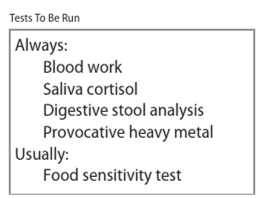
FIGURE 6.4 Diagnostic testing.
TABLE 6.1
Initial Blood Work: Men and Women (Fasting)
|
General Serology |
|
|
CBC |
TSH |
|
Chem package |
Free T4 |
|
Insulin |
Free T3 |
|
Ferritin |
Reverse T3 |
|
RBC magnesium |
TPO antibodies |
|
RBC zinc |
COQIO |
|
Vitamin D (25-OH) |
Thyroglobulin antibodies |
|
Homocysteine |
DHEA-S |
|
B12 |
IGF-1 |
|
TTG abs |
Gliadin abs |
Sex hormone binding globulin (SHBG)
TABLE 6.2
Testing for Systemic Infections
|
Initial Blood Work: Men and Women (Fasting) |
|
EBV (Epstein-Barr virus) |
|
Lyme antibodies IgG, IgM |
|
Chlamydia (serum) IgG, IgM |
|
Mycoplasma IgG, IgM |
|
Babesia microti antibodies IgG, IgM |
|
Bartonella IgG, IgM |
|
Ehrlichia IgG, IgM |
|
Herpes virus 6 IgG, IgM |
|
Strep pneumonia 23 IgG |
|
Coxsackic virus IgG, IgM |
TABLE 6.3 Women Only
|
Initial Blood Work Women Only: In Addition to Blood Work for Both Sexes |
|
|
Note: these always need to be run on day 19-21 of the menstrual cycle. |
|
|
Day 1: first day of menstrual flow |
|
|
These may be run with initial blood work if convenient or at a later date if menstrual- related issues/sex hormone issues don’t clear spontaneously with your interventions. |
|
|
Estradiol (E2) |
TT (total testosterone) |
|
Estrone (El) |
Free T (free testosterone) |
|
Progesterone |
DHT (dihydrotestosterone) |
TABLE 6.4 Men Only
|
Initial Blood Work Men Only: In Addition to Blood Work for Both Sexes |
|
TT (total testosterone) |
|
Free T (free testosterone) |
|
DHT (dihydrotestosterone) |
|
Estradiol |
health improves and you get better at digesting and absorbing nutrients from the food you eat, you will fix most of these nutritional deficiencies all by yourself.” The body is so smart. We don’t have to go chasing everything. We just take care of the “biggest fish to fry.” The body will take care of the rest all by itself.
Hormones: It is so important, when it comes to hormones, to look at the big picture. A thorough overview is needed of many hormones, all done at the same time. You can think of the hormones like a big symphony orchestra. In a symphony orchestra, all the players individually are very important. But what might be more important is how they are all working together. All it takes is one player to be off and that throws the whole orchestra off. The same is true with hormones. Each hormone is very important. But what might be more important is how they are all working together. All it takes is for one hormone to be off and it throws off all the other hormones. Thus, whenever you see one hormone off, you should wonder about all the others.
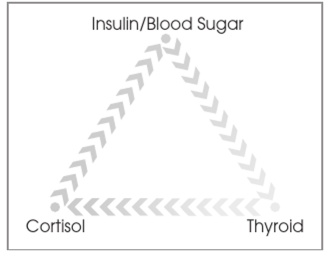
If the symphony is off, it needs to be fixed. But you can’t just look at the woodwind section and figure out what is going on. You need to look at the whole orchestra at the same time. Then you can say “oh, now I see who is throwing off everybody else.” Within this symphony of hormones is a very tight triad (Figure 6.5): cortisol, thyroid, and insulin/blood sugar. Just like any triangle in space, you change one angle and it will change the other two. This is one reason why finding insulin and blood sugar to be off, at least a little bit if not a lot, is so common in AD patients with chronic pain.28 Cortisol and thyroid are almost always off and create problems with blood sugar control.20-21
Chronic infections: These are very common drivers of AD and the related chronic pain.13-18 As stated earlier, with a dysfunctional immune system, downregulated immune system issues develop at the same time as the upregulated issues. Downregulated immune system issues include colds, flus, infections, recurrent infections, and cancer. More data are accumulating on the role of chronic infections driving chronic disease. An example is an article that came out in 2015. This discussed a new bad microorganism found in the oropharynx of people with schizophrenia but not in healthy controls. The oropharynx microbiome difference between patients and controls could be used to predict who would have the disease.29
Now, this should really not have surprised anyone given that we know “the gut is the second brain.” What goes on in our gut has such a profound impact on the brain as well as the body as a whole. Most people don’t think about this aspect of the gut in regard to the brain though. The gut is really just one long tube though, from the sinuses and mouth all the way down to our rectum. We already know what happens with chronic infections in the large intestine, and in the small intestine with small intestine bacterial overgrowth (SIBO), as well as infections of the stomach like H. pylori, bad bugs in our mouths driving gingivitis and increased risk of cardiovascular disease,30 chronic fungal infections of the sinuses that drive headache pain,31 and recurrent supra-infections involving bacteria. These bacterial supra-infections of the sinuses occur over and over, with the antibiotics used that disrupt gut function more and more each time. The underlying fungal infection keeps the environment disrupted, and the chronic sinusitis continues between antibiotic courses. Unfortunately, many people end up getting sinus surgery. But because the fungal infection is still present, the sinus symptoms continue. And perhaps they end up having a second sinus surgery, never being able to clear the pain, fullness, post-nasal drip. It is also amazing how often people will test positive for tick-borne illnesses even though they supposedly don’t live in an area where “these things occur.” These tick-borne illnesses are classic drivers of chronic pain and multi-organ system symptoms and are becoming more and more common.32
Testing for celiac disease (CD) always needs to be done. There is an increased risk of CD when a person already has the ADs type 1 diabetes (T1DM), rheumatoid arthritis, Hashimoto’s thyroiditis, autoimmune hepatitis, and Sjogren’s. When a person has untreated CD, painful conditions can develop (e.g., headaches, migraine headaches, joint pain/arthritis, peripheral neuropathy, and bone fractures). The untreated CD can also cause painful ADs such as TIDM, multiple sclerosis (MS), and dermatitis herpetiformis.33-34 Only 20% of all people with CD are ever diagnosed. This
is because only 20% of people have significant GI symptoms, that is, classic CD, while 80% have minimal or no GI symptoms, thus, atypical CD.3335
All the testing done will help us understand why a person has developed their pain and AD, but it will also help show us where the person is going in the future. If they are moving towards something like celiac disease or diabetes, we want to know so we can try and turn them around before they get there. Both TPO and thyroglobulin antibodies need to be checked in all people with an AD to see if they are developing an autoimmune process involving the thyroid (e.g., a true Hashimoto’s thyroiditis) or just starting with an early autoimmune thyroiditis.

