Experimental Results and Discussions
In this section, we compare the experimental results of our proposed compendium network recommendation method with the following methods.
- 1. Latent Dirichlet Allocation (LDA) (Blei, Ng, and Jordan 2003): This method handles the content affinity among the topics that are obtained from the title of the papers. For the user’s new seed document Sd, we use the text content of seed document Sd and the documents referenced by Sd to train the topic distribution for Sd.
- 2. Collaborative Topic Regression (CTR) (Wang and Blei 2011): This method combines matrix factorization and the probabilistic topic model, which studies user-item ratings and textual affinity between papers.
- 3. User-Article based Graph Model with Tags (UAGMT) (Cai, Cheng, Luo, and Zhou 2016): This method proposes new paper recommendation by considering the bipartite graph, which takes the readership, tag, content, and citation into account.
- 4. MPRec (Ma, Zhang, and Zeng 2019): This method trains the model using meta-path-based topological features and resolves the recommendation problem in heterogeneous information networks.
5. HIPRec (Ma, Zhang, and Zeng 2019): This method fuses different topological features extracted from the meta-path and meta-graph and uses these combined features as a prediction model for the recommendation.
Evaluation: The efficiency of the proposed domain-specific recommendation method and existing journal paper recommendation methods are evaluated using a prediction accuracy rate, which is defined as:

where Rsd represents the number of recommended papers for the query researcher and N, indicates the total number of tested journal papers.
Configurations
To find similar papers that are close to a given query in the embedding space, we used the approximate nearest neighbors (https://github.com/spotify/annoy) search algorithm. This algorithm works by building a binary tree of points in a higher dimension by choosing random hyper-planes that allow searching of nearby candidates in 0(log n) time. To optimize various hyper-parameters, such as the size of hidden layers, learning rate, and regularization strength, we used the python library “hyperopt.”
We evaluated the accuracy of the proposed DICN technique and the other existing techniques from the literature. From Figure 5.6, it can be seen that LDA and CTR performances are low compared to other methods. The reason behind this low performance is that LDA and CTR rely only on the title data of the paper, w'hich is not sufficient to generate accurate recommendations. UAGMT maps the recommendation problem into a bipartite graph and solves the problem by considering text contents and citations. We may notice from Figure 5.6 that the performance of UAGMT is somewhat superior to that of LDA and CTR. From Figure 5.6 we can see by analysis that the proposed compendium network attains significantly improved accuracy
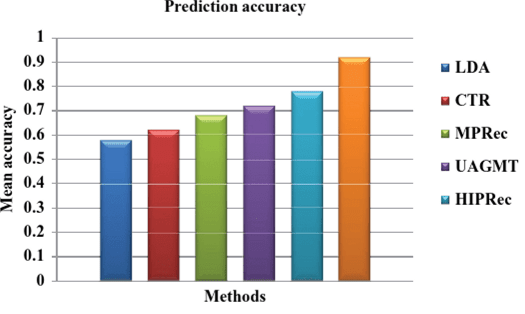

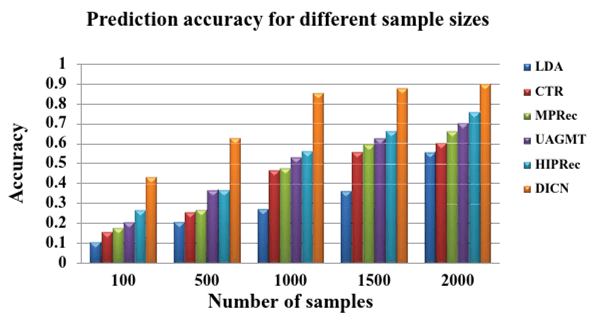
FIGURE 5.7 Prediction accuracy for different samples.
over all other models. This is because our proposed technique is constructed to handle the paper recommendation problem in the domain-specific environment.
Secondly, we assess the competence of the proposed DICN method with a varying number of samples. The outcomes are as shown in Figure 5.7. It can be seen from the figure that the prediction accuracy of the proposed method improves with the increase in the number of training samples. This is because, with the rise in the training sample size, better features can be learned, thus the learning model will be more significant. However, when the number of sample pairs reaches around 1000, the set size does not significantly affect the efficiency of the model. To conclude, an almost small share of training samples are enough for the proposed compendium network to learn the patterns effectively.
Figure 5.8 shows the running time of the proposed method and other existing methods with a varying number of samples given as input. It can be seen that there is a substantial rise in running time for the proposed method compared to existing
techniques when the size of the sample pairs grows. From the empirical results, one can conclude that, as the size of the sample pair increases, the time to train the model also increases. However, analyzing Figure 5.7 and 5.8 shows that a large quantity of samples does not significantly affect the performance of the prediction model but results in a worse running time.
Result Analysis
From the empirical results, the following conclusions can be made.
- 1. As explained in the data collection process, it is usually hard to get all the text data of even a few papers. Hence the accessible data of the papers are somewhat partial; for example, when only the title of the paper can be used, then the content-based recommendation achieves poor outcomes. In contrast, the computational complexity will be very high if all the text data of the paper are used for solving the recommendation problem.
- 2. Most of the existing graph-based methods do not consider the semantic meaning underlying the networks; they handle the recommendation problem using homogeneous or bipartite networks.
- 3. Compendium network-based recommendation is influential and it encapsulates much more vibrant and more complex semantic meaning than simple graph-based methods. Recommendation approaches that incorporate domain- specific data perform better with less computational cost compared to other methods.
Conclusion and Future Work
In this chapter we have proposed a neural network and the nearest neighbor based method to recommend domain-centric research articles for researchers. To do so, we built a knowledge network by scraping, integrating, and pre-processing domaincentric data from multiple web repositories, like Google Scholar, Semantic Scholar, Scopus, Web of Science, and Microsoft Academic data. Mainly, we have suggested a method to recommend domain-centric research articles for researchers based on their domain of interest. In the proposed compendium network, the user’s domain knowledge and his or her research interests are used to find out the knowledge gap, and the compendium network aims to recommend domain-centric papers that can help bridge that gap. The method firstly scrapes the domain-centric data based on the domain corpus. Then the data is thoroughly pre-processed to make it suitable for the recommendation process. The contributions of this chapter are as follows. In the first phase, curated domain-centric documents are embedded into a linear space using a neural network such that a similar domain-centric document tends to be closer. Then the nearest neighbors of a seed document are selected as candidates, which are re-ranked using a neural network trained to assign a probability rank to differentiate whether the document should be recommended or not. The empirical outcomes show that the proposed domain-centric-based method gives the best overall performance in comparison to the state-of-the-art methods. The domain-centric data reduce the search space and help in faster identification of the documents similar to the seed document and thus improve the recommendation by reducing the computational cost. Regarding future work, the proposed compendium network method could be automated and deployed in a distributed environment to recommend domain-centric research articles.
References
Balia. A., A. Stassopoulou, and M. D. Dikaiakos. 2011. Real-time web crawler detection. In 201118th International Conference on Telecommunications. IEEE, Avia Napa, Cyprus, pp. 428^132.
Basu, C.. Hirsh. H., Cohen, W. W.. and Nevill-Manning. C. 2001. Technical paper recommendation. A study in combining multiple information sources. Journal of Artificial Intelligence Research. 14, 231-252.
Bhagavatula, C„ S. Feldman, R. Power, and W. Ammar. 2018. Content-based citation recommendation. arXiv preprint arXiv: 1802.08301.
Blei, D. M., A. Y. Ng and M. I. Jordan. 2003. Latent Dirichlet allocation. Journal of Machine Learning Research 3(Jan):993-1022.
Bomhardt, C.. W. Gaul, and L. Schmidt-Thieme. 2005. Web robot detection pre-processing web log files for robot detection. In New Developments in Classification and Data Analysis. Springer, Berlin, pp. 113-124.
Cai, T, H. Cheng, J. Luo, and S. Zhou. 2016. An efficient and simple graph model for scientific article cold-start recommendation. In International Conference on Conceptual Modeling. Springer. Berlin, pp. 248-259.
Cantador, I. and P. Castells. 2006. Multilayered semantic social network modelling by ontology-based user profiles clustering: Application to collaborative filtering. In International Conference on Knowledge Engineering and Knowledge Management. Springer, pp. 334-349.
Das, H.. N. Dey, and V. E. Balas. 2019. Real-Time Data Analytics for Large Scale Sensor Data. Academic Press, London.
Das, H., A. K. Jena. J. Nayak. B. Naik, and H. Behera. 2015. A novel pso based back propagation learning-MLP (PSO-BP-MLP) for classification. In Computational Intelligence in Data Mining. Springer, Singapore, Vol. 2. pp. 461-471.
Das, H., B. Naik. and H. Behera. 2018. Classification of diabetes mellitus disease (DMD): A data mining (DM) approach. In Progress in Computing, Analytics and Networking. Springer, Singapore, pp. 539-549.
Das, H.. B. Naik. and H. Behera. 2020a. An experimental analysis of machine learning classification algorithms on biomedical data. In Proceedings of the 2nd International Conference on Communication, Devices and Computing. Springer, Singapore, pp. 525-539.
Das, H.. B. Naik. and H. Behera. 2020b. A hybrid neuro-fuzzy and feature reduction model for classification. Advances in Fuzzy Systems 2020:1-15.
Das, H., B. Naik, and H. Behera. 2020c. Medical disease analysis using neuro-fuzzy with feature extraction model for classification. Informatics in Medicine Unlocked 18.
Das, H.. B. Naik. H. Behera, S. Jaiswal. P. Mahato. and M. Rout. 2020. Biomedical data analysis using neuro-fuzzy model with post-feature reduction. Journal of King Saud University-Computer and Information Sciences.
Davoodi. E.. M. Afsharchi, and K. Kianmehr. 2012. A social network-based approach to expert recommendation system. In International Conference on Hybrid Artificial Intelligence Systems. Springer, Berlin, pp. 91-102.
De Gemmis, M., P. Lops, G. Semeraro. and C. Musto. 2015. An investigation on the serendipity problem in recommender systems. Information Processing & Management 51(51:695-717.
Dey, N„ A. S. Ashour. H. Kalia, R. Goswami, and H. Das. 2018. Histopathological Image Analysis in Medical Decision Making. 1GI Global, Hershey. PA.
Dey, N.. H. Das. B. Naik. and H. S. Behera. 2019. Big Data Analytics for Intelligent Healthcare Management. Academic Press, Boston. MA.
Drachsler, H„ H. Hummel, and R. Koper. 2008. Identifying the goal, user model and conditions of recommender systems for formal and informal learning. Journal of Digital Information 10(2):4—24
Glez-Pena, D., A. Louremjo, H. Lopez-Fernandez. M. Reboiro-Jato, and F. Fdez-Riverola. 2013. Web scraping technologies in an API world. Briefings in Bioinformatics 15(51:788-797.
Guan, Z.. C. Wang. J. Bu. C. Chen, K. Yang. D. Cai, and X. He. 2010. Document recommendation in social tagging services. In Proceedings of the 19th International Conference on World Wide Web. Raleigh, pp. 391-400.
Haddaway, N. R. 2015. The use of web-scraping software in searching for grey literature. Grey Journal 11(31:186-190.
Liang, Т.-P.. Y.-F. Yang. D.-N. Chen, and Y.-C. Ku. 2008. A semantic-expansion approach to personalized knowledge recommendation. Decision Support Systems 45(3):401—412.
Lu, W.-Z. and S.-Z. Yu. 2006. Web robot detection based on hidden markov model. In 2006 International Conference on Communications, Circuits and Systems. IEEE. Guilin. Vol. J.pp. 1806-1810
Ma, X.. Y. Zhang, and J. Zeng. 2019. Newly published scientific papers recommendation in heterogeneous information networks. Mobile Networks and Applications 24(1 ):69-79.
Meschenmoser, P, N. Meuschke. M. Hotz. and B. Gipp. 2016. Scraping scientific web repositories: Challenges and solutions for automated content extraction. D-Lib Magazine 22(9/10).
Pan. C. and W. Li. 2010. Research paper recommendation with topic analysis. In 2010 International Conference on Computer Design and Applications. IEEE, Qinhuangdao. China. Vol. 4. pp. 4-264.
Rout, M., A. K. Jena, J. K. Rout, and H. Das. 2020. Teaching-learning optimization based cascaded low-complexity neural network model for exchange rates forecasting. In Smart Intelligent Computing and Applications. Springer, Berlin, pp. 635-645.
Shobha, K. and S. Nickolas. 2020. Integration and rule-based pre-processing of scientific publication records from multiple data sources. In Smart Intelligent Computing and Applications. Springer, Berlin, pp. 647-655.
Smith-Unna. R. and P. Murray-Rust. 2014. The content mine scraping stack: Literature-scale content mining with community-maintained collections of declarative scrapers. D-Lib Magazine 20(11/12).
Strohman, T, W. B. Croft, and D. Jensen. 2007. Recommending citations for academic papers. SIGIR 7:705-706.
Tang, J.. J. Zhang, L. Yao, J. Li, L. Zhang, and Z. Su. 2008. Arnetminer: Extraction and mining of academic social networks. In Proceedings of the I4tlt ACM SIGKDD International Conference on Knowledge Discovery and Data Mining. ACM. pp. 990-998.
Tang, T. and G. McCalla. 2004. Beyond learners interest: Personalized paper recommendation based on their pedagogical features for an e-learning system. In Pacific Rim International Conference on Artificial Intelligence. Springer, Berlin, pp. 301-310.
Wang, C. and D. M. Blei. (2011). Collaborative topic modelling for recommending scientific articles. In Proceedings of the 17th ACM SIGKDD International Conference on Knowledge Discovery and Data Mining. ACM, San Diego, CA, pp. 448-456.
Wang, J., Y. Song, T. Leung, C. Rosenberg. J. Wang, J. Philbin. B. Chen, and Y. Wu. 2014. Learning fine-grained image similarity with deep ranking. In Proceedings of the IEEE Conference on Computer Vision and Pattern Recognition. San Juan, Puerto Rico, pp. 1386-1393.
Zhang. H., W. Ni, M. Zhao, Y. Liu. and Y. Yang. 2014. A hybrid recommendation approach for network teaching resources based on knowledge-tree. In Proceedings of the 33rd Chinese Control Conference. IEEE. Nanjing, China, pp. 3450-3455 Zhao. W„ R. Wu, and H. Liu. 2016. Paper recommendation based on the knowledge gap between a researcher’s background knowledge and research target. Information Processing & Management 52(5):976—988.

