May
Labors and Agricultural Tasks
I May from all extorte suborned grace,
That views my sweet and Paradice-like face:
Flora hath cloath’d me with her Tapestry,
Wrought by Dame Nature fine and curiously. (Hawkins 1624, A54)
As in Figure 3.3.10 from Buckminster’s 1567 almanac, the visual iconography of May is almost entirely concerned with pleasure: dining al fresco, flirting, making music, birding, picking flowers, and wandering in the pleasantly burgeoning fields. As Hawkins’ calendar poem for 1624 suggests through the personified May with her “Paradice-like face,” this is the most idealized of the twelve months, a time “wherin Nature hath her fill of mirth, and the Senses are filled with delights” (Breton, Eantasticks, C2r).
The actual tasks of husbandry for May include tending bees, which are now “ready to swarm” (Tusser, 87), planting kitchen gardens, fallowing fields, and weeding. The herbs and vegetables most often recommended for sowing this month include “parsly and onions, corainder and leekes” as well as “Smailage,” a kind of celery, and “basill” (Prid, A6r), “sweete Marjerom”

Figure 3.3.10 May, Thomas Buckminster, A New Almanacke and Prognostication (1567), A8r. University of Illinois at Champaign-Urbana, Rare Book and Manuscript Library, 529.5 H484a-1567.
and “Sommer saverie” (Alleyn 1606, B8v), “Leeks, Onyons, Purselan” and “Gourds, Cucumbers and Mellons” (Frende 1622, A5r, B7r), “pescods,” and “Good flaxe & good hemp” (Tusser, 86). Women were encouraged to work the still to produce “Aquavitae, and other stilled waters” (Alleyn 1606, B8v). To these busy planting tasks in May, Tusser adds copious advice about the care of livestock. The time to separate lambs from their mothers was “Phillip and Jacob,” the first of May, if the husbandman “thinkest to have any milke of their dams” (84); milking of sheep was to be stopped at Lammas, the first of August. Calves should this month be let out to pasture with their mothers. Weeding continues apace in May, which is also a good time to mend thatched roofs and hire children to rid fields of stones.
Zodiac, Astronomy, and Astrology
The Sun enters the sign of Gemini, the Twins, on May 11th (Figure 3.3.11). Gemini “is of the West[,J masculine, ayrie and sanguine” (Alleyn 1606, B8r). Sirius or Canis Major, the Dog Star that will wreak havoc in July and August, now sets in the evening, and “if the full Moone happen within two daies before or after, it prognosticates blasting to corne and other flowers” (Hopton, Concordancy, 105). Hopton reports a number of potential hazards to crops depending on the interplay between stars and the Moon this month, lore drawn from Stadius, Ptolemy, and Cardano. For example, if the Moon is new or full on the 23rd when Aquila (the Eagle) rises at dawn, then “all fruites bee hurt with wormes and Caterpillers.” If the Sun shines on May 25th, “Some say...wines shall prosper well” (105). Rain on Ascension Day—which was usually in May, more rarely on April or June depending on the date of Easter—“it doth betoken scarcitie of all kinde of foode for cattell, but being faire, it signifieth plenty” (Hopton, Concordancy, 104).
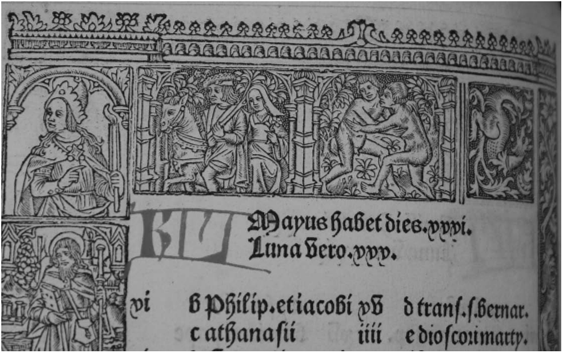
Figure 3.3.11 May, Catholic Church, Höre Beate Virginis Marie (Paris, 1520, STC 15926), [A4v]. Photograph by Phebe Jensen, from the collection of the Folger Shakespeare Library, STC 15926.
The Ages of Man
As in the month of maye all thyng is in rnyght.
So at xxx yeres man is in chyef lyking.
Pleasaunt and lusty/ to every mannes sight
In beaute &c in strength / to women pleasyng. (Thys Prymer, 1538, STC 16008.3, fol. 6v)
The lovers who often figured in the May labor of the month are also prominent in the twelve-month ages of man scheme, which identifies this month with the years between thirty and thirty-six. As in April, illustrations for May often feature courting couples: on horseback, perambulating or sitting in enclosed gardens, and cavorting in woods or fields. Just as May itself “is bothe fayre and pleasaunte,” so a man in this time of year is “moste joyfull and pleasant...and seketh playes, sportes, and lusty pastyme” (Kalender, A7r).
Physic
Now art thou bid by gentle May,
Purge, vomit, bath and bleed:
Leave bed, walke fieldes in morne, use meanes,
Of Health to sowe the seede. (Dauncy 1614, A5r)
May is a particularly good month for health, auspicious for all medical interventions including purging, bathing, and bleeding. The almanacs especially encourage taking physic this month, as it must be avoided—“except ne-cessitie inforce thee” (Alleyn 1606, B5v)—during the hot months of June, July, and August. “Now whosever doth desire, / Of learned skill the helpe to finde,” Johnson advises, “Delay not time for durt or mire, / For Phisicke will soone be out of kinde” (1613, A5r). Other general recommendations are to rise early and take exercise if able-bodied, especially by walking in “the fields, that smell most fragrantly” (Rudston 1613, A5r). Hawkins does warn that the bounteous flowers of May with their “various colours,” each “of different power,” can sicken as well as heal: “some of them can / Give health in sickenesse, others killeth man” (1627, A4r). Eating lightly (but not fasting) is recommended for this month; healthful drinks include “clarified whay, with coole herbs” (Burton 1617, B7v), especially Sage (Rudston 1613, A5r).
Diseases governed by Gemini and prevalent in May include “Flegmous” (phlegmatic) inflammations such as cellulitus, “Farnuculus” (faruncles, or boils), and other diseases involving swelling, especially in the shoulders, arms, and hands (Alleyn, 1606, B8r).

