Physic
Warm clothes and fire prepare you must
Yet use thou not excesse in lust:
Good Christmas keepe, such pastime take,
As may in Christ thee mery make. (Hopton 1606, A8v)
Medical problems common under Capricorn are “ache in the knees, deaf-nesse, losse of speech and sight, itch, scabbes, and foulenesse of the skinne”
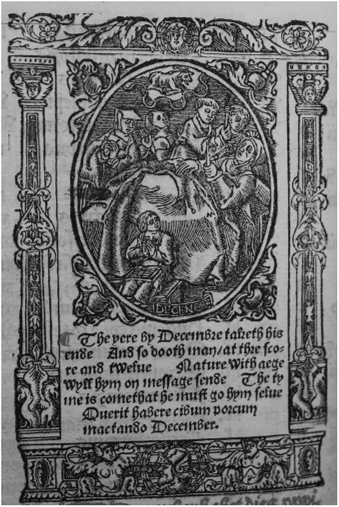
Figure 3.3.26 December, Catholic Church, Enchiridion, preclare ecclesie Sarum (Paris, 1530, STC 15965), B4v. Photograph by Phebe Jensen, from the collection of the Folger Shakespeare Library, STC 15965.
(Alleyn 1606, C4r). On the bright side, the enforced leisure, dining, and good company that characterize the long twelve days of feasting and conviviality at Christmas accord with the recommendation for physic: “In this month be quiet, and use good diet, let them be thy Phisitions. Let thy kitchin be thine Apothecarie, let warme clothing be thy nurse, merry company thy keepers, and good hospitalitie thine exercise” (Alleyn 1606, C4v). All warm things are good: “Hot meat, sweet wine, & fire of fragrant wood, I the spirits raise, and help to chear the blood” (Bretnor 1615, B8r). “December loves warme Potions,” as Frende’s 1593 almanac notes, as well as good shoes against the damp, and warm clothes (B7v). Medicine is still to be avoided, and other interventions discouraged, though not with the violence of the Summer prohibitions against phlebotomy and baths.
The Church Calendar
Seasons and holy days
Advent begins on Advent Sunday, the fourth Sunday before Christmas, which can be as early as November 27th or as late as December 4th; that season ends on Christmas Day. The Book of Common Prayer and other calendars note December 16th as the day in which the seven or eight “O Sapientia” antiphons were introduced into the liturgy, continuing a medieval tradition though with Protestant revisions. The first red-letter holy day for the month is the feast of St. Thomas (December 21st), remembered for being “doubtful in thy sonnes resurrection,” a lesson for the faithful to “without al doubt...beleve in thy son Jesus Christ, that our faith in thy sighte never be reproved” (BCP, K6v).
Christmas Day ushers in four consecutive red-letter holy days. On the 25th, thanksgiving is offered to God for having “given us thy only begotten sonne to take our nature upon him, and this daye to be borne of a pure virgin” (B7v). On the 26th, the martyr St. Stephen is said to teach by example how “to learne to love our enemies,” as he himself “praied for his persecutors to thee” (Civ). St. John, the Apostle and Evangelist, is noted on the 27th for his “doctrine” which helped “cast thy bryghte beames of light upon thy church” (C2r). On the 28th, the slaughter of the “Innocentes” by Herod is presented as a model for the faithful to “mortifie and kill all vices in us” (C2v).
Three saints are commemorated with black-letter notice in the Book of Common Prayer for December. The first is St. Nicholas, the sixth-century bishop in Gaul. The second, St. Lucy, was a Roman Virgin, whose feast day on December 13th is sometimes the shortest day of the year, hence amplifying the symbolism of the candles associated with her commemoration. The third is St. Silvester, a fourth-century Pope. December also includes the last Lady Day of the year, the Conception, given black-letter observance on December 8th.
The veneration of St. Thomas a Becket, the Archbishop murdered in Canterbury Cathedral, was outlawed by proclamation in 1538, as the many annotations in late medieval primers and books of hours striking out his name attest. Although banished from the Book of Common Prayer, St. Thomas is still noted on the day of his martyrdom (December 29th) in most early modern almanac calendars.
Lectionary
In December, the Gospel reading begins in Acts 2, and by the end of the month, the third and final cycle of Gospel readings for the year is completed. The Epistle readings start on December 1st with Hebrews 7, continuing through James, Peter, and John. The readings in the Old Testament for this month are entirely in Isaiah.
Fairs
As would be expected, December is a thin month for fairs, with a total of only approximately twenty-five. About eight of these are on St. Nicholas’ Day, December 6th, and nine are on the final Lady Day of the year, December 8th, celebrating the Conception. The rest are scattered throughout the calendar, with the three for December 29th, the feast of St. Thomas a Becket, perhaps the vestige of the more extensive commemorations of this saint in late medieval England.

