The immediate consequences of the success of the MPB: obedient public opinion, polarization, and xenophobia
The MPB has proven to be successful in its main aim: to overcome the loss of popularity of Fidesz at the end of 2014 (Figure 4.3).19 However, when the

Figure 4.3 The level of popularity of FIDESZ (proportion of potential voters among those entitled to vote) 2014-201920
Source: Own design. The arrow shows the significant drop of popularity. Calculations are based on the data of the three public opinion research firms who conducted surveys during the entire period. The data is available at: Sik 2019.
use of MPB proved to be successful in gaining back the lost popularity of the government within just a few months, it became the main tool of maintaining popularity. Moreover, after several pressings, the MPB became a smoothly running machine used to mobilize the voting camp of Fidesz.
The success of the MPB is clearly demonstrated by the changing directions of the public opinion as well, i.e. the population follows the messages that the MPB emits towards them. Figure 4.4 demonstrates that the shift between the prevalence of threats of immigration, terrorism, and national sovereignty from 2017 to 2018 corresponds to the change in the framing of the ‘refugee crisis’ in the MPB.21 Figure 4.5 shows that the choice of the main enemies changed as well, in accordance with the influence of the MPB: the actors of the international conspiracy became much more important. Furthermore, not only was the prevalence of mentioning international actors higher, but the relationship between threats and ‘enemies’ became stronger: among those, who perceived external threats to be the most important, the mentioning of external enemies, with the exception of immigrants, doubled in a year.
Through the MPB, the government defines the core topics of the public discourse to make sure that their sympathizers learn the language of full agreement. However, this leads to increasing polarization within society:25 while Fidesz sympathizers perceive that external threats (losing national

Figure 4.4 The prevalence of the perception of immigration, terrorism, and the loss of national sovereignty as the main threats for Hungary, 2017-2018, percentage of the total of selected items
Source: MTA Cooperation of Excellences, Mobility Research Center project, own calculations.

Figure 4.5 The extent to which respondents hold international actors responsible for the main threats for Hungary, 2017-2018, percentage of the total of selected items
Source: MTA Cooperation of Excellences, Mobility Research Center project, own calculations.
sovereignty and immigration) are the most important threats and they hold international agents responsible for them, the opposition feels that the threats caused by the ruling elite - the demolition of democratic institutions and state level corruption, are the most important threats. Naturally, the main cause of these threats is the Orban government (Gero &. Szabo, 2017; Szabo & Gero, 2019). The opinion of respondents positioning themselves in the ‘center’ are usually in between those of the two groups with stronger political affiliation (Figure 4.6).
As Figure 4.1 already showed, since 2002, Hungarian society has been more xenophobe than other European countries. However, if we focus on the more recent changes represented in Figure 4.1, we find that the Hungarian results deviate from all countries - even from those where the level of rejection has increased - i.e. the prevalence of the Rejection Index was significantly faster.24
Moreover, unlike in other European countries, in Hungary there is no difference in the level of xenophobic attitudes between the various social groups (Figure 4.4).
While in Portugal, Austria, and the UK certain social groups exhibit significantly higher or lower levels of rejection of migrants, in Hungary, there is no deviation from the high level of the national average of rejection. We
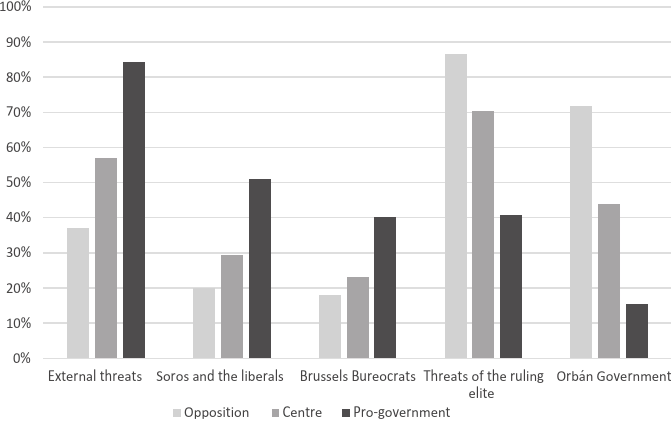
Figure 4.6 Perceived threats and the actors/groups held as responsible by political affiliation. Percentage of those who mentioned external threats (immigration and terrorism and losing national sovereignty) or threats of the ruling elite (state level corruption, demolition of democratic institutions), 2018
Source: MTA Cooperation of Excellences, Mobility Research Center project own calculation.

Figure 4.7 Rejection Index by demographic groups in four countries in 2016/2017 Source: Our design, based on Messing-Sagvari 2019.
consider such uniformity (i.e. the lack of social group specific deviations) to be a result of MPB, since only intense brain-washing can create a situation where the same proportion of all parts of a complex society answers the questionnaire similarly.
We conclude, therefore, that even in the short run, the MPB 1) made the Hungarian society extremely xenophobic, and 2) successfully streamlined intolerant thinking of the entire society into an equally non-thinking formless mass. However, it is important to point out that we have been experiencing a twofold process: the unification of opinions regarding immigration on the one hand, and the simultaneous polarization of opinions about the importance of issues and enemies on the other.

