Appendix C Proof of proposition 3
To check operational profitability for the public investor, we need to check that the airline carrier’s profit, to which we add the airport’s profit, is at best higher than A, denoting aid transferred. We must therefore check that

Once calculations within the scope of our specification have been completed, the condition depends on the sign of the following expression:

First of all, we must ensure that the expression is not negative for all possible parameters. The first part represents fixed costs and is negative. The second part depends on parameter values. Lasdy, the third expression is a positive value for a G [a, a]. Thus, we are sure to find a subset of parameters that strictly satisfies this inequality. A condition could be imposed on the maximum value of fixed costs, for example.
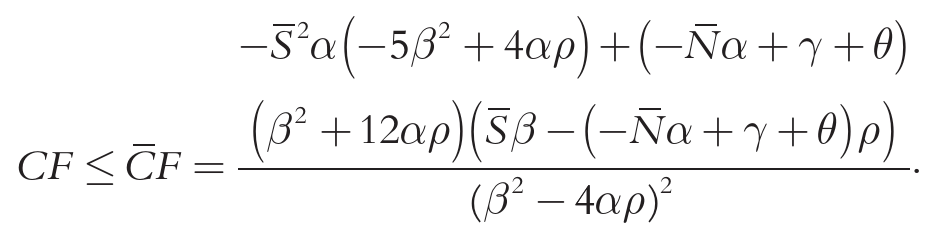
This threshold CF is positive if

- 5i32 This condition holds under the following sufficient condition: a > a4 = ——.
- 4p
Notes
- 1 This was the case in Nimes for Ryanair (SA.22961, €6.4m), in Pau for Ryanair (SA.22614, €2.4m) and in Transavia (€400,000).
- 2 In certain cases, the European Commission positioned itself in favour of the private investor in a market economy. This was the case for Frankfurt Hahn and Ryanair (IP/08/956) and for Saarbrücken Airport and Air Berlin (IP/12/156).
- 3 Within the framework of the OECD report on the analysis of strategic interactions between airline carriers and airports (2009), Starkie explained that it is harder for an airport to use its market power if the latter is overcapacitated and if direct competition in the airport between airline carriers is low. Moreover, a report by the Conseil Supérieur de 1’Aviation (CSAC — High Council for Civil Aviation) on French airport mergers, which was released in 2017, estimated that relationships between carriers and low-traffic airports are characterised by ‘reverse monopolies’ on the part of airline carriers.
- 4 According to the CSAC, these contracts can be assimilated to back margins imposed by large-scale distributors on small producers. In this respect, they inevitably raise questions regarding vertical restrictions, which will not be directly addressed in this chapter for the moment. See, for example, Rey (2003) for a general economic analysis on vertical restrictions. Note that commercial air transport—sharing agreements may have beneficial effects, as shown by Fu and Zhang (2010), in that they internalise demand effects. Nevertheless, they harm competition between companies in the case of unidirectional externality (Hagiu and Wright, 2015). Thus, the model remains valid even if the decision made by passengers to travel is not unequivocally affected by the commercial services offered by the airport.
- 5 This regulation seeks to prevent the manager from potentially abusing its market power, resulting in principle from their naturally monopolistic position. However, secondary airports do not retain such market power, to the extent that they must leverage existing infrastructure, sustain destinations served in a context in which airline carriers can easily arbitrate between several airports and represent the airport’s only client.
- 6 Furthermore, we showed that the absence of charges on one side of a two-sided platform can be economically justified (see Malavolti and Marty, 2013).
- 7 Other support mechanisms exist, such as the cofinancing of marketing campaigns, that we liken to this mode in our analysis, for convenience.
- 8 We limit our analysis to the most important effect of the price parameter on the demand for travel by passengers. However, demand for travel could also be a function of the number of shops in the terminal or the number of hours of operation of these shops. Indeed, if a passenger is waiting at the airport for their flight, they might prefer having shops around. On the contrary, a passenger might prefer not having shops around for fear that they might forget about the time of their flight. Hence, we could have considered a demand for travel as a function of the shops, with an undefined effect. However, because the effect would be undefined — see note 9 — and, more importantly, because the effect might be not vital compared to the price effect in the choice of a particular travel/airport, we assume that the ticket price is the only determinant of demand for travel.
- 9 We chose a positive externality exerted on shop revenues by passenger flows. A number of two-sided models take into consideration externalities that cross over both sides of the market (video games, shopping centres, newspapers, etc.). In the present case, shops arguably also exert an externality on passengers. However, because it is difficult to determine the sign of this externality, we can consider that the presence of shops is desired by passengers. Consumers undoubtedly consider it preferable to wait in an airport with plenty of shops. However, some studies show that waiting times could be extended due to the presence of shops, who are prepared to pay higher rent if it means passengers spend longer in the airport. See, for example, Torres et al. (2005) and Malavolti (2014). Because studies have failed to conclude on a sign, we prefer not to consider externalities that shops have exerted ex ante on passengers. On the other hand, results will be discussed according to the sign of this externality.
- 10 The scope of regulation varies according to the size of the airport: as per ICAO guidelines (document 9082), small European airports generally adhere to single-till regulation, whereas larger airports opt for dual-till regulation. Single till corresponds to a situation in which the scope of regulation includes all airport revenue. Dual till corresponds to a situation in which only aeronautical revenue is included. Economic literature has examined this issue and reached various conclusions. The first series of papers (Starkie, 2001; Starkie and Yarrow, 2000) analyses the impact of the type of regulation implemented on the airport’s long-term objectives. By using a capital cost approach, the papers show that the airport’s investment incentives will be reduced if it is not able to retain sufficient resources. They therefore conclude that dual-till regulation is preferable. However, more recent papers (Fröhlich, 2011; Malina et al., 2012; Malavolti, 2014) reach opposite conclusions when the airport is considered as a platform. These studies recommend single-till regulation in order to consider existing externalities between both sides of the market: aeronautical and commercial. Lastly, Perrot (2014) suggests that for large airports, issues concerning congestion can justify dual-till regulation. The consequence on the equilibrium price structure as a result of positive externalities exerted by passengers on shops is that shops subsidise airport tax reductions and therefore indirectly subsidise passengers. Thus, at equilibrium, there are more passengers in the airport, which increases congestion problems. If the social costs of congestion are sufficiently high, it may be preferable to regulate the airport, by using two separate tills.
- 11 By way of illustration, some airports conclude commercial profit-sharing contracts. This is the case for Ryanair in France, which makes sharing car-parking revenue a condition of service launches at certain airports. This is also the case in Tampa, Florida, where the airport shares revenue from commercial concessions with companies operating in its infrastructure. Fu et al. (2011) present this example in their paper on the analysis of vertical relationships between airline carriers and airports. In this case, it would be similar to add in the contract offered by the LCC the level of the price of the rents paid by shops and the maximum amount of aid to be asked from the Competition Authority.
- 12 The possible profit the airport can make outside of the transaction may also correspond to the opportunity to conclude a contract with another airline carrier. Under this condition, the airport will choose the most attractive contract among those proposed. However, these contracts can be uncertain or even nonexistent. In any case, state aid implicated in these contracts relates to start-up aid for new routes launched, which are limited in time (three years at maximum, nondiscriminatory). We instead focus on aid for potentially perennial activity, such as from a region. This would correspond to airports for which airlines are attracted with difficulty, justifying our assumption of economic dependency. Introducing competition in our model would result in increasing the aeronautical tax and decrease the aid received by the region. The airport would be able to keep some profit. To the limit, the airport could behave as a monopolist. However, this would result in no state aid allowed by a competition authority. We instead want to analyse a situation in which the aid can be a way to keep an activity at an unprofitable airport, even at the expense of giving much power to an airline.
- 13 For simplicity, we normalised the airline’s fixed costs to zero.
- 14 Note that the solution would have been the same if chosen freely by the airport, taking into consideration both sides of the market, since it would have applied its monopoly power and therefore determined the same rental price level for commercial space. See Malavolti (2016) for an analysis of two-sided market impacts on equilibrium price structure.
- 15 The airline carrier cannot recover the airport’s total profit via the contract it proposes. Its best option is therefore to reduce the airport’s portion of profit corresponding to the cost of aeronautical services.

