Data analysis
For the purpose of structuring our analysis, we applied a theory-refinement approach (Creswell, 2003; Thomas, 2006). We went from very personalized accounts with rich information to accounts that were more aggregated, abstract, and analytical as well as embedded in our theoretical framework (Figure 8). This iterative process implied going back and forth between the raw interview data and the theoretical framework (Corbin & Strauss, 1994; Huberman & Miles, 2002). For instance after first interviews we concluded that the asset allocation by private institutional investors was key to a thriving environment of the VC/PE sector and, hence, institutional investors had to be included in our research, both theoretically and empirically. In our initial data analysis, we focused on the perceptions of the interrelations between the major actors along the ‘finance-innovation-policy nexus’ as our main categories for structuring and processing the incoming data. The established coding scheme is portraying the interrelations between the nexus of actors: Policy - Institutional Investors, Policy- VC/PE, Policy - Innovators, Institutional Investors - VC/PE, PE/VC - Innovators, Institutional Investors - Innovators (see Figure 11). The coding process resulted in 625 individual quotes. Based on these relationships we could explore the direct and indirect consequences of innovation policy and financial regulation.
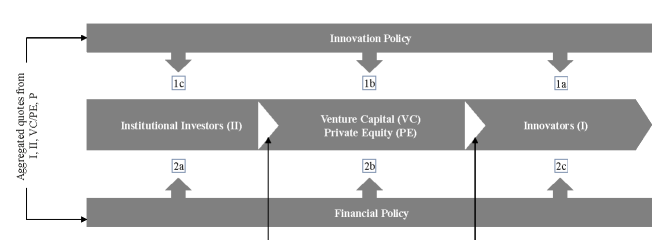
Figure 11 — Coding Process
We investigated the relationships among the primary actors of the ‘finance-innovation- policy nexus’, specifically emphasizing previously unstudied relationships with institutional investors and contrasting Germany and US. Within the actor driven coding scheme we looked for emerging themes during our open coding analysis (Glaser & Strauss, 1967); for instance, subsidy-dependence, (local) anchor investors or a mismatch of investment cycles or sizes emerged. The different quotes in the categories were aggregated into themes[1] by recognizing patterns in the data, that describe relationships between the various actors (see Figure 12). For example the role of anchor investors was mentioned by VC/PE funds and by limited partners alike, who both perceive the importance of an early and considerable involvement as key to a successful fundraising process. Thus we could verify the involvement of public investors as anchor investors in subsequent interviews.
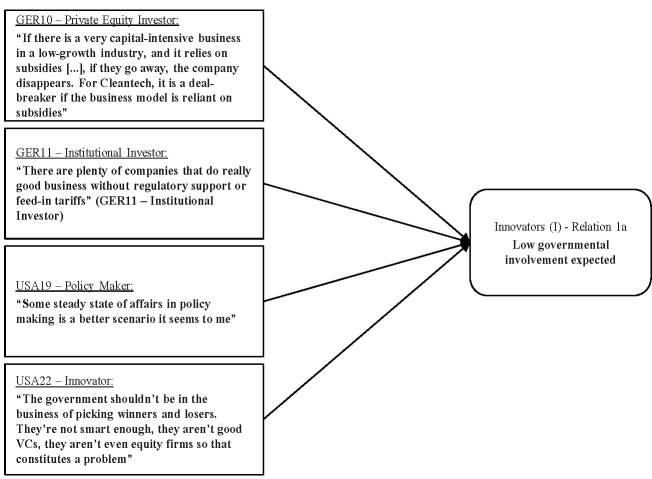
Figure 12 — Example of coding process
In our final step, we went beyond a mere presentation of patterns and descriptive comparisons to explain the reasoning behind the categories that were identified. Adopting a comparative case narrative we developed an understanding through organizing the different themes within, the ‘finance-innovation-policy nexus’ which has different characteristics in the US and Germany.
To ensure the robustness of our analysis a number of measures have been taken (Moran-Ellis et al., 2006; Patton, 2002): Firstly, to ensure construct validity several data sources have been used (archival documents for the interview preparation, notes and interview transcripts). This allowed us to triangulate the understanding of a key concepts to avoid misinterpretation (Patton, 2002). Secondly, to ensure internal validity (avoiding alternative explanations) we compiled a multi-stakeholder sample (including policy makers and innovators) which includes typical cases across of a large set of technologies. This approach allows us to add to existing theory (Moran-Ellis et al., 2006). Thirdly, reliability was ensured by conducting the field research with two scholars, developing and refining the semi-structured interview guide for the interviews, recording and transcribing the evidence. Fourthly, we verified and extended the Anglo-German comparison by holding a workshop with scholars and practitioners active in the Cleantech sector.
- [1] We refer to a theme when at least 3 interview participants coded in different relationships(categories) discussed a topic (Huberman & Miles, 2002; Patton, 2002).

