Unemployment
International comparisons often use unemployment as an important yardstick for assessing the functioning of labour markets. Unemployment statistics register the number of people out of work and actively looking for paid employment. Since economic fluctuations have a major international component, differences in unemployment rates largely reflect the ability of countries to strike a balance between supply and demand on their labour markets. And since supply and demand can differ widely according to region, work experience, training, and working hours, the unemployment rate says a great deal about the ability of the various Member States to adapt to economic change. In 2007, the unemployment rate in the EU range between 5 and 11 per cent of the labourforce. Here again, the trend has been one of convergence since the 1990s, with unemployment falling sharply in Spain and Ireland in particular until 2007, and rising and diminishing again in the Scandinavian countries (Fig. 7.24). Continental welfare states have unemployment rates of around 10 per cent, with the Netherlands (where long-term unemployment is partially 'hidden' in the disability benefits system) as positive outliers. The variation in youth unemployment is much wider, with upper end rates of more than 20 per cent in most Mediterranean welfare states and Finland, and less than 10 per cent in Denmark, the Netherlands, Austria, and Ireland (Fig. 7.25). The differences are even greater when it comes to long-term unemployment, though the majority of welfare state clusters have seen a fall in the number of long-term unemployed as a proportion of the total unemployed population since the mid 1990s.
Figure 7.26 shows that the degree to which long-term unemployment (>1 year) strongly drives the overall unemployment rates varies across European countries and thus no consistent relationship is visible.
Unemployment rates also differ for native-born and foreign-born citizens. While the absolute unemployment rates for foreign-born citizens in Finland, Belgium, Germany, and France are the highest in the EU from the countries
Figure 7.25. Youth unemployment (15-24 years). Source: Eurostat.
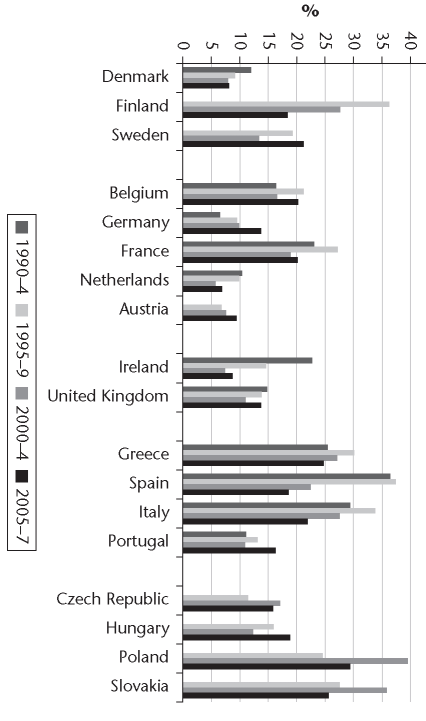
Figure 7.24. Standardized unemployment rate, 1990-2007. Source: Eurostat.
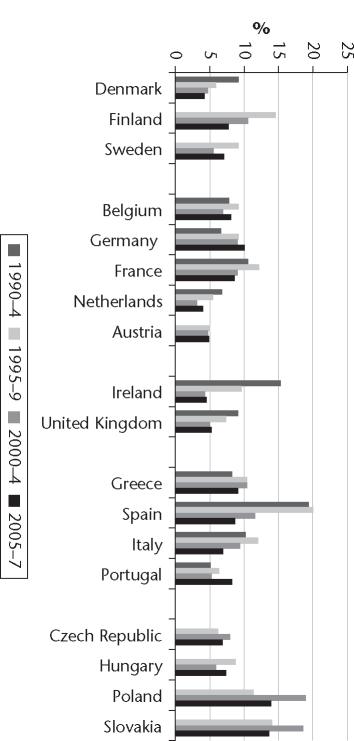
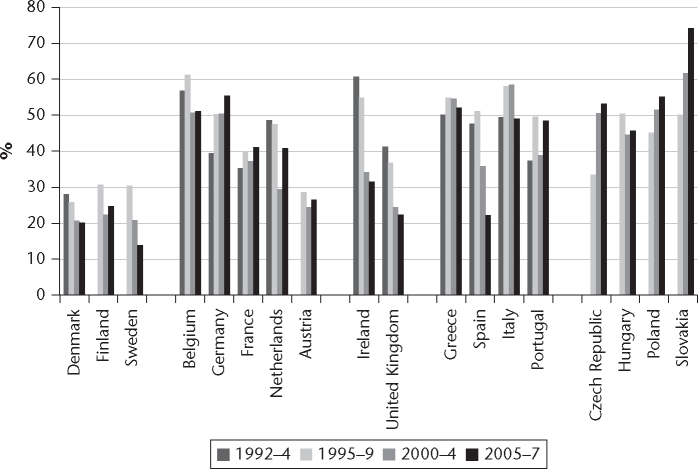
Figure 7.26. Long-term unemployment, 1990-2007. Source: OECD, labourforce statistics.
compared, the unemployment rate of immigrants relative to the native-born in 2006 reveals that in the Netherlands, Austria, and Belgium the unemployment rates of foreigners are more than twice as high as the unemployment rates of natives (Fig. 7.27). Also the Scandinavian countries show unemployment rates of foreigners compared to natives as twice as high, while the differences are smaller in the Anglo-Saxon and Mediterranean countries and the new Member States.
One reason for the difference in performance is that both Denmark and Sweden have faced a high inflow of migrants for humanitarian reasons in the past decades, in contrast to other European countries that have had much more labour immigration. Migrants received for humanitarian reasons are in general less likely to be employed owing to self-selection (OECD, 2007e). However, especially for Denmark which also faces high levels of unemployment for second-generation migrants, this does not explain the high unemployment rates for people with a migration background (ibid.). One reason for the better performance of the Anglo-Saxon countries might be that immigrants are more likely already to have use of the language of the host country. Furthermore, it is important to take into consideration the timing and the educational level of immigrants. In the Continental countries most immigrants are from the former guest-working countries and have often
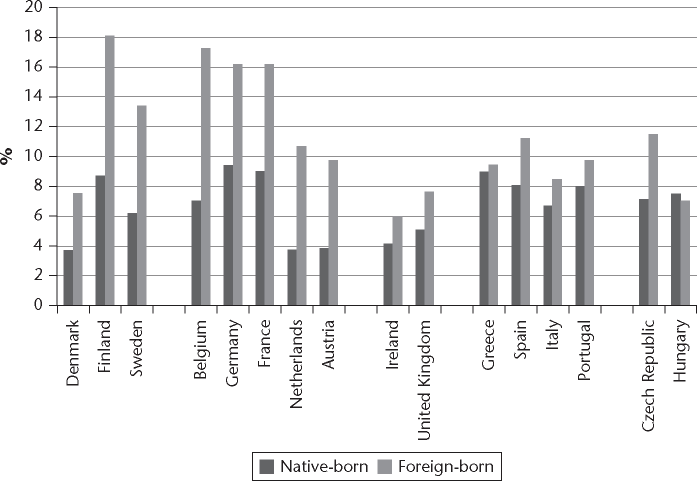
Figure 7.27. Unemployment rate of native-born versus foreign-born population (1564 years), 2006.
Source: Eurostat European Labour Force Survey.
lived in these countries for decades. Guest-worker programmes attracted less- educated people to work in the industrial sector, and with the decline of the industrial sector, for instance in Belgium, they began to face severe problems in finding jobs (OECD, 2008b). In the Mediterranean countries migration is a much more recent phenomenon (OECD, 2008a).

