Towards pre-emptive austerity
By the end of 2009 it became increasingly evident that the aftermath of the global financial crisis proved to be a far more serious 'stress test' for Europe's welfare systems than initially recognized. The cumulative effects of costly
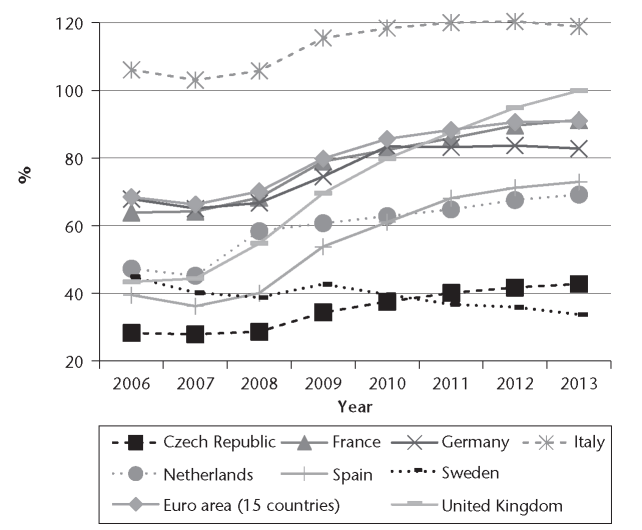
Figure 9.3. Public debt.
Source: OECD.
bank bail-outs, tax cuts, rising social expenditures, lower revenue from social contributions, and other stimulus measures drained the public purse, and in turn raised the stakes for social reform. Public debt increased significantly in many countries (see Figs. 9.3 and 9.4).
In the spring of 2010 the Greek sovereign debt crisis confronted the European Union with a completely new and challenging aftershock. As contagion fears spread across the weaker periphery of the eurozone, including Spain, Portugal, and Ireland, investors began to speculate against the euro, anticipating that eurozone governments would ultimately fail to underwrite its stability. In an attempt to stave off contagion, Greece, Spain, and Portugal staged impressive fiscal consolidation measures. The dire straits of Greek public finances obliged European governments, after some procrastination, to come to the rescue. This began with ad hoc measures for Greece (€115 billion in conditional loans, in cooperation with the IMF contributing €30 billion). On 10 May 2010 the EU Council agreed on the establishment of a European Financial Stabilization Mechanism (EFSF) designed to come to the aid of countries experiencing budgetary difficulties that could endanger the eurozone, as a so-called 'special purpose vehicle' outside the EU treaties. Member
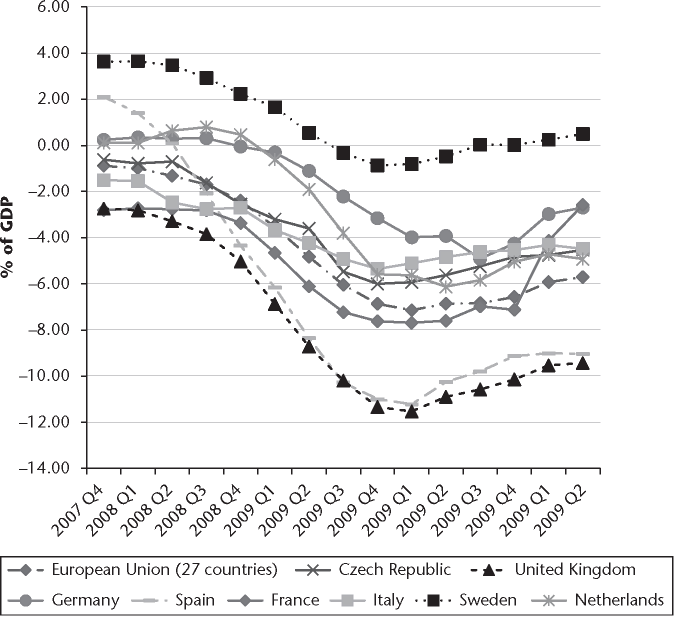
Figure 9.4. Government revenue minus expenditure. Source: OECD.
States as well as the European Commission and the IMF contribute to this fund. The maximum amount available is €750 billion, of which €250 billion would be provided by the IMF, €60 billion as a direct loan from the European Commission via the European Investment Bank (EIB), and €440 billion would come from the EU Member States, broken down between them using a measure reflecting their weight in the European economy. The agreement on the EFSF was above all intended as a message to the financial markets. Serving the same purpose, its introduction was accompanied by a commitment on the part of the Member States' governments to reduce excessive public debt and deficits as the core route to exit from the crisis. In the meantime, the ECB shifted gears to the unorthodox strategy of buying government bonds of besieged economies. In this new context of predicament, many European governments stepped up austerity commitments, away from the Keynesian automatic stabilization, fiscal, and monetary stimulus measures of 2008 and 2009.
Below, I survey the main characteristics of domestic fiscal consolidation strategies up to the autumn of 2011. I pay special attention to the more emblematic social reforms, including cuts in social transfers and subsidies, pensions and public sector pay, employment, and services, together with measures to increase revenue. The timing of austerity measures differs across countries, depending on their macroeconomic performance and political complexion. I start with the Mediterranean welfare regimes, two of which— Greece and Portugal—have had to seek assistance from the EFSF. Next, I assess the adjustment packages of two Anglo-Irish economies, which have both been heavily implicated in global financial deregulation. Thereafter, I review fiscal consolidation strategies in the Continental welfare regimes of Germany, France, and the Netherlands. Then, I compare Nordic crisis management in Sweden, Denmark, and Finland. Finally, I touch briefly on the more desperate adjustment experiences of some of the new Central and East European Member States.

