Safety Planning
As detailed throughout the informed consent process, crises and emergency situations may arise requiring a provider’s swift response, potentially
Table 4.4 Summary of recommended videoconferencing-specific informed consent content areas
|
Factor |
Specific components |
|
Indication of general practice |
|
|
Strengths and limitations |
to see nonverbal cues that are more evident during F2F services, the potential for increased costs of securing proper equipment for the videoconferencing, the lack of a “cool-down” period (e.g., traveling home after session) following the end of the session that may occur during F2F services, the ongoing changes to ethical and legal standards, the need for additional research on the various aspects and implementation methods of the videoconferencing, and the potential for someone to hack the technology' and gain access to session content |
Table 4.4 Cont.
|
Factor |
Specific components |
|
General delivery factors |
|
|
Communication |
|
|
Troubleshooting |
|
|
Administrative |
|
involving medical care or law enforcement. Unfortunately, a lag in response time, or potentially no response if the provider is unable to establish pertinent information for the patient, has the potential to result in negative outcomes. To ensure safety throughout the use of the videoconferencing, it is suggested that the provider preventatively plan for crises at the onset of services. As adapted from work by Luxton and colleagues (2016, chap. 3) and Shore and Lu (2015), safety planning should occur in five broadly defined primary steps. First, a provider should determine the appropriateness of a patient for videoconferencing. Second, a provider should evaluate the appropriateness of the provider’s and patient’s available technology to meet the needs of the services. Third, the provider should critically evaluate the patient’s location in which they will receive care, including any supports (e.g., family, friends, community organizations) they may have in the immediate area. Fourth, the provider should develop an emergency contact list and plan that is included in the patient’s record. Fifth, and finally, the provider should create a step-by-step plan detailing expectations. When broken into more detail, as adapted by work by Luxton and colleagues (2016, chap. 3), the safety plan should have eight primary components:
- (a) the location address, phone number, and email address for the patient;
- (b) alternative emergency contacts of spouses, family members, friends, or local community members that may be able to assist during an emergency situation (i.e., names, addresses, phone numbers, emails); (c) the name, address, and phone number for the nearest medical center; (d) the name, address, and phone number for the nearest law enforcement office; (e) the criteria for what is considered an emergency situation versus a “write down and we’ll talk about it at our next session” event; (f) the steps to make the environment safe if risk presents including the removal of alcohol, weapons, and other hazardous materials; (g) a step-by-step plan for what to do if the provider is available to speak to; and (h) a step-by-step plan for what to do if the provider is not available to speak to. While this information is suggested to be built into the informed consent forms (i.e., as part of the forms or added as a secondary emergency contact form that is a supplement to the primary informed consent forms), whether it is or is not, such information should be reviewed verbally and provided in writing. It is also suggested that regardless of whether a provider may be able to legally break continentality for an emergency situation, they secure release of information forms for the listed nonmedical and non-law enforcement contacts so that they may communicate with them as needed. Copies of the documents should be placed into the patient’s medical record for easy access, with copies being provided to the patient. Finally, the provider should document that the plan was discussed, and the patient both understood and agreed. As sometimes patients may not provide the most complete information, it may also be wise to include a clause in the forms indicating that the provider or a representative of the organization may look up supplied information to verify correctness of the medical and law enforcement office (Lustgarten & Elhai, 2018). See Figure 4.3 for a sample template of an emergency contact information form.
While crises may be the most obvious reason to safety plan, the patient may also experience events during session that make them feel uncomfortable or unsafe, and desiring of an immediate stop to the videoconferencing. Unfortunately, some patients may be unable to vocalize this request in the moment. For instance, a patient may not have told a spouse or other family member that they are receiving psychological services due to a fear of stigma, legal challenges (e.g., custody battles), or a potentially abusive relationship. If during session, the patient directly says that they want to end the call, or if the provider continues talking while others can overhear the subject matter, such events can inadvertently disclose the therapeutic relationship. Regardless of the situation, it is important that the patient feels that they have a level of control to ensure a perception of safety and comfort. As such, it is suggested that the patient and provider collaboratively create a safety word or phrase. This word or phrase would be a cue for the provider to immediately end session without a required reason why. As an example, one could
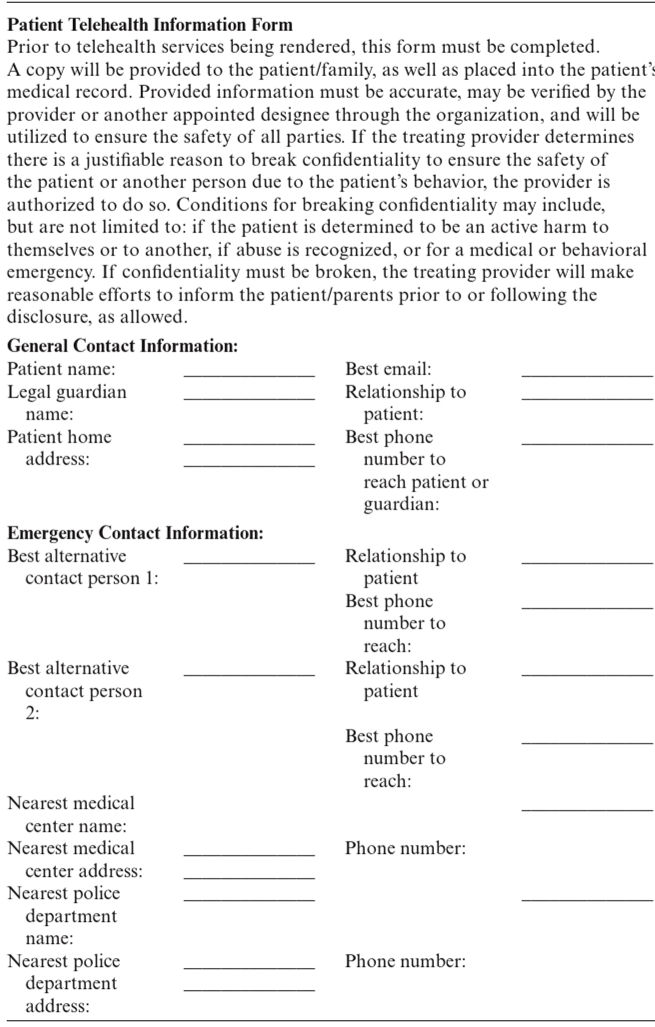
Figure 4.3 Sample emergency contact form*.
Note: *The sample information, especially the “Emergency Plan” section, will require additional tailored detail.
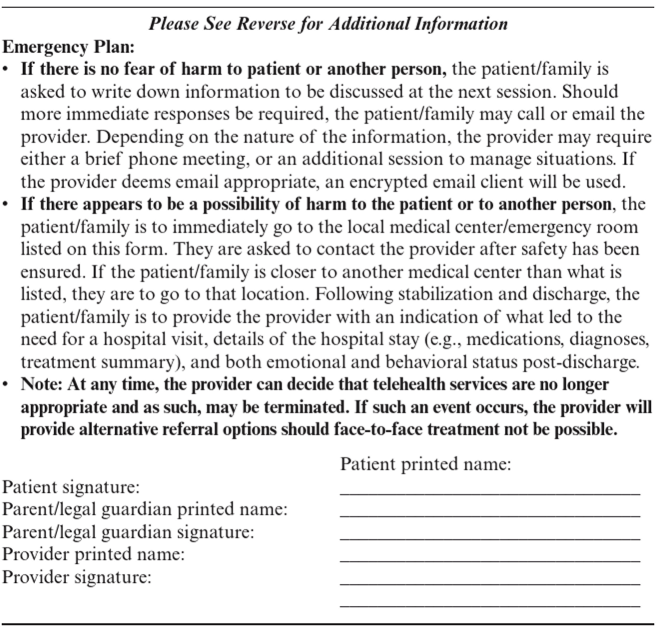
Figure 4.3 Cont.
use the word “banana” as their word in the context of individual therapy. Perhaps the patient had not disclosed that they were receiving therapy and did not want others to know. During session, the patient’s significant other arrives home early and is already in distance to hear what is being discussed. The patient can then indicate, “I’m pretty hungry, I think I am going to go eat a banana” or “I really want a banana, gotta go,” to immediately inform the provider that they should end the session. The provider can then immediately say “goodbye” and end the videoconferencing call. Alternatively, the provider and patient can agree that the provider would say a bit more, such as “I’m having some issues with the video/audio connection, I’ll just talk to you later,” to make it seem more friendly. Ultimately, having a code word or phrase can create an additional level of comfort for the patient without having to draw extra attention to the therapy itself.

