Generalized Feynman Path Integration
Coordinate Representation
The transition amplitudes 4.47 and 4.82 of chapter 4 may be generalized for a problem with s degrees of freedom that may be described by a set of operators q = |

Here, the Hamiltonian:

We evaluate the integral 4.1 over the momenta and this gives the Feynman transition amplitude:

The functional measures in equations 6.1 and 6.3 are defined respectively as in equations 4.49 and 4.70 of chapter 4.
We examine the transformation from the Hamiltonian to the Feynman transition amplitude by generalizing the Hamiltonian in 6.2. Consider an example of a system with s degrees of freedom described by the following Lagrangian quadratic in qa:

Here, the real nondegenerate matrix m, is symmetrical relative to transposition:

The matrix, m, in the given Lagrangian 6.4, does not only describe the general case of the quadratic expression for the given variable but as well its derivative. For the relativistic field system, where the variable q is understood as the field degree of freedom, the non-degenerate matrix ma/! describes the gauge of the field.
From equation 6.4 we construct the Hamiltonian of the system via the canonically conjugate coordinates qa relating canonical momenta:

Introduce the following matrices:
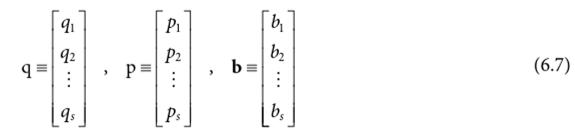 then

If the matrix m has an inverse then
 and the speed in the matrix form is represented:

We now conveniently arrive at the following Hamiltonian:

where pT denoting the transposed of the matrix p and

We rewrite the transition amplitude of the quantum system in the Hamilton form:

where,

The evaluation of the functional integral may be done based on the functional analogue of the change of variables in the integrand:

This yields the following transition amplitude:

We evaluate the integral over the momenta with the aid of the following:

The evaluation of each of the above multiple integrals yields the following:

Thus, we arrive at the Feynman transition amplitude:

Here, now

and

So, for the matrix representation 6.7, the Hamiltonian 6.11 permits the transformation of the Feynman transition amplitude equation 6.3 to the modified form 6.13. The quantity j^det m 1J 2 is common for the Feynman transition amplitude transformation seen in reference [8].

