Polar Equation
We consider the motion in a central symmetric field and begin bv deriving the quantities found in the
-i
Hamiltonian where the polar angles are expressed via the square of the angular momentum operator L :

Here the Laplacian, Ag^ acting only on the polar variables в and ф is expressed as:

The motion in a central symmetric field has the Schrodinger equation expressed in the form:

Here, V(r) is the potential and M the mass of the particle. In the central symmetric field, the potential V{r) is independent of the distance between a given point and the center of the field where we place the origin of the coordinate system. The square of the angular momentum satisfies the eigenvalue equation:

With

The component of the operator Lz of the angular momentum in the z-axis direction satisfies the eigenvalue equation:
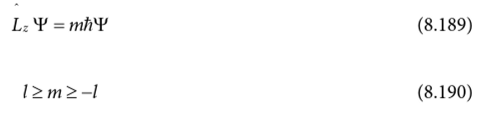
In the above relations, / is the azimuthal quantum number and m the magnetic quantum number. We substitute 8.40 into 8.43 considering 8.44:

From here, for motion in a central symmetric field where we have a rotationally symmetric potential, the solution of the Schrodinger equation 8.186 can be obtained in the form of separation of variables with factors being the radial R(r) and polar ©,(тф} parts respectively:

We substitute 8.48 into 8.47, where the radial function R(r) and the factor exp {тф} will fall off:

Let us do the change of variable cost? = c then we obtain the equation for the associated Legendre polynomials PJ" ) of order / and rank m:

and

where

is the so-called Rodriguez recurrence formula for the Legendre polynomial P,(c). Thus, the eigenfunction *Р(г,#,):

where

is a spherical function called the spherical harmonic that is an eigenfunction of the operator of the
_ 2
square of the angular momentum L and N,„, is a normalization constant for the associated Legendre polynomials.
For brevity, let m = 0 then equation 8.193 becomes

Letting,

then
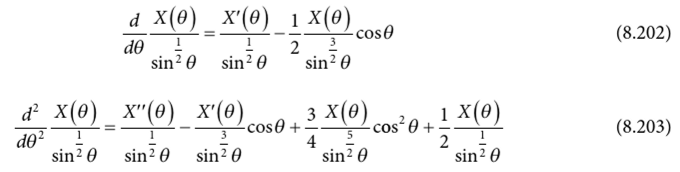
and

For quasi-classical approximation /» 1 then W » 1 and 1{я - в) » 1 is everywhere fulfilled except at the small neighborhood of в = 0 and в = n.
So, for

then

and

This is an equation of a harmonic oscillator with solution:

If now,

then considering
 Equation 8.200 becomes
 with solution

Неге, ]0(в) is the Bessel function of the first kind and of order 0 and argument в.
So, the asymptotic solution for 8.204 takes the form

Hence, the quasi-classical expression for P,($):
 and
Radial Equation for a Spherically Symmetric Potential in Three Dimensions
We substitute 8.200 into 8.186 and find the solution of the Schrodinger equation, which is the eigenfunction of the operators L and Lz, i.e., the eigenfunction of such a state where E, L2and L-have a defined value:

Here, for consistency in the entire heading,

In equation 8.216, it is convenient to introduce the following function to ease solution:
 and we have the simplified radial equation:

So,

The corresponding force to this term (which is equal to minus the gradient of the given term) tends always to repel the particle from the force center and so the name of the term centrifugal potential (or centrifugal barrier) and similar to that in classical mechanics for the Kepler problem. In addition to other boundary conditions (three conditions: wave function should be finite, continuous and singlevalued), X should satisfy the condition:

l2
The effective potential Vclr(a) is the sum of the true potential V(q) and the rotational energy-- as
2 mq-
in classical mechanics. It should be noted that q > 0 and for small q then the de Broglie wavelength:
 and so, for the quasi-classical approximation /» 1 then

Hence, if / is small, the quasi-classical condition is violated by the centrifugal forces.

