The Decomposition of the Gini Index Between and Within Groups: A Key Factor in Gender Studies An Application in the Context of Salary Distribution in Spain
Introduction
Inequality in the distribution of income and wealth and its impact are at the root of the rise of populist leaders and constitute the basis of many of the problems that today's societies are experiencing. In fact, some of the world's
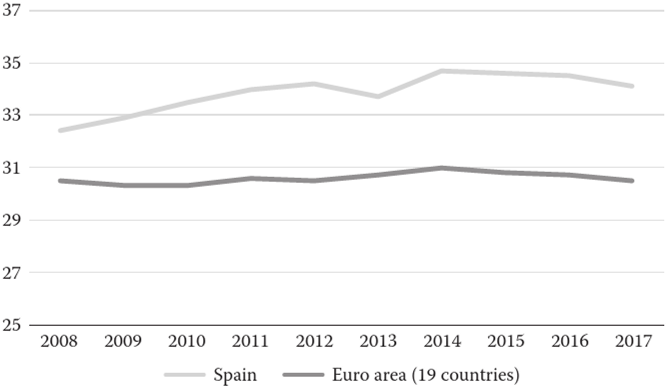
FIGURE 2.1
Gini coefficient of equivalised disposable income - EU-SILC survey (Eurostat, 2018)
leading economists including several Nobel laureates (e.g., Amartya Sen, Joseph E. Stiglitz, and Paul Krugman) have highlighted this as one of the biggest challenges that western democracies currently face. In the international context, Spain is one of the least developed EU countries in terms of inequality figures in recent years (see Figure 2.1). A detailed study of the salary structure of its workers and the analysis of its evolution is therefore of special relevance.
Despite the fact that gender equality is an indisputable issue the labor market shows that gender equality is still far from being achieved in practice. This is despite the fact that, in 2000, one of the main objectives of the United Nations was to promote gender equality and women's empowerment as a step towards sustainable development in the world by 2015 (UN, 2000). In the words of the International Labour Organization, gender equality is essential in order to achieve the global goal of Decent Work for All (ILO, 2013).
Thus, in 2010, the EU presented its strategy for equality between men and women for the period 2010-2015, to work towards improving the role of women in society (EC, 2010a). The foundations of that strategy were established under the principle that men and women have the right to receive the same remuneration for work of equal value. But it seems that implementing the policies and wishes expressed in the documents has been more difficult, as evidenced in Spain.
In fact, the data from the latest Structure of Earnings Survey (SES), carried out in Spain by the National Institute of Statistics in 2014 (INE, 2016), indicate that the average annual female salary represents only 76.8% of the male salary, with three out of ten women working part time (30.1%) compared to only one in ten men (8.6%). This greater presence of women in part-time work, in other words, fewer working hours per year, is partly the cause of the pay difference, exasperated. If allowance is made for this, the average hourly wage of women increases to 87.0% of that of men. However, even after the correction, the average salary per female hour is still 13% lower than the male salary.
Unfortunately, this is not the only problem of inequality in the labor market in terms of wages. In addition to this unequal distribution of mean wages between male and female workers, there is another problem: the increase in wage inequality among all workers in general. Recent recruitment practice favors temporary work and precarious wages which increases the gap between the different types of workers, making the distribution of income more unequal. Hence, given the importance that the increase in wage inequality holds for Spanish workers, a detailed study of the salary structure of its working population from the point of view of the between- and within-wage distribution is of special interest.
From a methodological point of view, selection of the Gini coefficient (Gini, 1914) is imperative since it is the most commonly used measure of inequality (Frick et al., 2012; Rasner et al., 2013), still valid more than a century after its creation. In this paper, the methodology described in Larraz (2015) on decomposition of the Gini Ratio is used. Among its strengths are that: (i) it uses Dagum's between-groups inequality index concept, which is more enlightening than the widely used Theil's index (used by authors such as Frick et al. (2004), Yitzhaki (1994), or Yitzhaki and Lerman (1991)), among others; (ii) it can be used when dealing with discrete distributions (while Dagum (1997) or Mussard (2004) proposals lead only up to a certain percentage of the real Gini Ratio); and it has been deduced to be used with survey data (where weightings are non-integer figures).
In this paper, after identifying the labor characteristics of those groups of workers in which the wage concentration is greater and, therefore, show a less equal wage distribution, we use the methodological approach proposed by Larraz (2015) to unravel the problem. On the one hand, we study the extent to which inequality is caused by inequalities between men and women. On the other hand, we consider the importance that inequalities within the group of female workers and within the group of male workers have on global inequality. These inequalities are what are known as between- and within-group inequalities, respectively.
Given that one of the main objectives of the EU is to promote gender equality policies to increase the participation of the labor force up to the year 2020 (EC, 2010a, 2010b), this analysis will go some way towards helping the relevant authorities to make decisions and evaluate the effectiveness of policies in reducing gender inequality.
The remainder of the paper is as follows. Section 2.2 provides a decomposition of the Gini index, considering the more general between-groups inequality concept, based on the Gini mean difference, valid for overlapped groups and survey data. Section 2.3 presents the data. Section 2.4 is devoted to the analysis of gender wage inequality in Spain during the period 2006-2014. Finally, Section 2.5 covers the conclusions.

