Monument for the Digital Era
Andreas Huyssen, a theorist and historian of German culture, questions whether monuments need to be built at all in a postmodern era in which monuments live as images. He remarks that the artists Christo and Jean-Claude’s veiling of the Reichstag in 100,000 square meters of polypropylene, which lasted for a mere 14 days, lives indefinitely through reproduced images in books, posters, digital files, and souvenirs.68 Similarly, the cube, as one of the most photographed landmarks in New York City and the world (Figure 6.13), lives in a countless number of devices and computers, leaving an enduring virtual mark in the collective memory of this generation. Whether the physical glass cube lasts forever seems less significant. “Memory becomes stone in architecture,”69 writes Huyssen. The Apple cube suggests that people yearn for architectural monuments even in the digital era, but monuments need not be made in stone. Glass is, symbolically and materially, a reflector of the era in which Apple made its intimate machines in glass. Glass is as mercurial as the images of the surroundings that it reflects and the information it transmits. A mediator between computer devices and humans, glass is apt for a monument symbolizing the age of information.
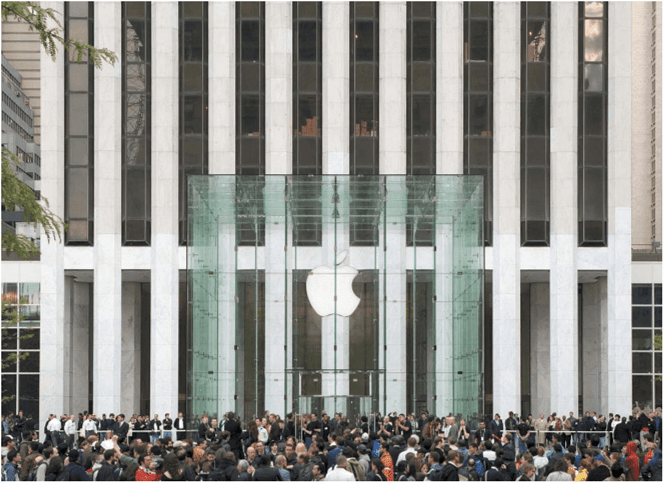
FIGURE 6.13 People gather around the cube on the GM Building plaza.
Photograph: Peter Aaron (2006)/OTTO.
Notes
- 1 Tim Bajarin, “Learning This 1 Thing Helped Me Understand Apple’s Strategy,” Time, April 3, 2013, accessed July 1, 2019, http://time.com/4723389/apple-strategy-iphone-ipad-apple-tv/.
- 2 Le Corbusier, Paul Stirton, and Tim Benton, “Glass, the Fundamental Material of Modern Architecture,” West 86th: A Journal of Decorative Arts, Design History, and Material Culture 19, no. 2 (Fall-Winter 2012), 297.
3 Partner James O'Callaghan was working for engineering firm Dewhurst Macfarlane & Partners at the time he began collaborating with Apple, and until he co-founded his own firm in 2004. He credits his former employer Tim Macfarlane as a pioneer in the field of structural glass. James O’Callaghan “Glass Challenges: Past, Present, and Future” in Paulo J. da Sousa Cruz, Ed., Structure and Architecture
Karl Backus, a Principal at Bohlin Cywinski Jackson who has served as the Design Principal for Apple retail stores, invited James O’Callaghan to work on the Apple project following collaboration with BCJ on the Coming Museum. For Corning, the team also worked with TriPyramid Structures, a Massachusetts metal design and fabrication firm that would provide the custom fabricated metal fittings for many of Apple’s glass structures. BCJ had mentioned the possibility of an all-glass staircase with Apple prior to O’Callaghan’s involvement on the SoHo store. Karl Backus, phone interview by author, August 16, 2019.
Katy Devlin, “The Amazing Evolution of Glass at Apple,” Glass Magazine, accessed June 18, 2018, https://glassmagazine.com/glassblog/amazing-evolution-glass-applc— 1513465.
O’Callaghan, “Glass Challenges,” 45.
James O’Callaghan, “Glass Structures and Stairs to Cubes” in Freek Bos, Christian Louter, and Fred Veer, Eds., Challenging Glass: Conference on Architectural and Structural Applications of Glass, Faculty of Architecture, Delft University of Technology (Delft: Delft University of Technology, 2008), 30.
O’Callaghan, “Glass Structures and Stairs to Cubes,” 30.
Armstrong, Victorian Glassworlds 205.
Backus says it is ambiguous whether it was Bohlin who first sketched a cube, or it was Jobs who first suggested the idea of a cube or square, which Jobs considered a pure shape. He recalls they happened nearly simultaneously, suggesting that no single person generated the idea of the cube. Karl Backus, phone intcrview2019. William Bostwick, “Apple Store Cube Is More Popular Landmark than Statue of Liberty: Cornell Report,” Fast Company, March 24, 2010, accessed September 18, 2018, www.fastcompany.com/90182902/applc-store-cube-is-more-popular-land mark-than-statue-of-libcrty-cornell-report.
O’Callaghan, “Glass Structures and Stairs to Cubes,” 32—33.
Martin Tamke, Jacob Riiber, and Hauke Jungjohann, “Generated Lamella,” LIFE in: Formation. On Responsive Information and Variations in Architecture: Proceedings of the 30th Annual Conference of the Association for Computer Aided Design in Architecture, ACADIA (New York: ACADIA, 2010), 342.
Noel Y.C., “Apple Store Fifth Avenue Glass Cube Getting Simplified,” NYC loves NYC (blog), August 22, 2011, accessed June 20, 2019, https://nyclovesnyc. blogspot.com/2011/08/apple-store-fifth-avenue-glass-cube.html.
Stephen R. Ledbetter, Andrew R. Walker, and Alan P. Keiller, “Structural Use of Glass,” Journal of Architectural Engineering 12, no. 3 (2006), 139. tonoplast is a clear, tough ionically cross-linked ethylene copolymer.
O’Callaghan, ““Glass Challenges,” 40—41. O’Callaghan credits British glass engineer Tim Macfarlane, for whom he worked prior to establishing his own firm, for pioneering experimental laminated glass beams in the 1990s with such projects as the Yurakucho Subway Station canopy at the Tokyo Forum by Rafael Vinoly and the Keats Grove structure by Rick Mather.
Tanay Warerkar, “Apple Store’s Glass Cube on Fifth Avenue is Taking a Sabbatical,” Curbed NYC, May 9, 2017, accessed June 18, 2019, https://ny.curbed.eom/2017/4/ 20/15369578/apple-glass-cube-fifth-avenue.
Benjamin Pattou, application for building permit for construction at 767 5th Avenue, filed March 16, 2017 with New York Department of Buildings, accessed February 16, 2019, http://a810-biswcb.nyc.gov/bisweb/JobsQueryByNumberServ let?requestid=2&passjobnumber=123023799&passdocnumber=01.
Zoe Rosenberg, “Apple’s Improved Fifth Avenue Store Will Include Glass Cube, More Natural Light,” Curbed NYC, September 12, 2017, accessed August 10, 2018, https://ny.curbed.com/2017/9/12/16296646/apple-fifth-avenuc-expansion-renderings-nyc.
Warcrkar, “Apple Store’s Glass Cube.”
Michael Mulhern, partner at TriPyramid Structures, fabricator of metal hardware for all three cubes, phone interview by author, August 23, 2019.
Aki Ishida, “Metabolic Impermanence: The Nakagin Capsule Tower,” Inflection: The Journal of the Melbourne School of Design 04 (November 2017), 32—43.
O’Callaghan, “Glass Structures and Stairs to Cubes,” 32—33.
“Glass Stair, Apple SoHo Store, Rebuild,” TriPyramid, accessed August 20, 2019, www.tripyramid.com/projccts?n=932.
James O’Callaghan, email message to author. August 23, 2019.
O'Callaghan “Glass Challenges,” 43.
Devlin “The Amazing Evolution of Glass at Apple”
“Glass Stair, Apple SoHo Store, Rebuild.”
Jolie Lee, “Glass Panel Shatters at Apple’s Flagship Store in NY,” CNBC, last modified January 23, 2014, accessed July 10, 2018, www.cnbc.com/2014/01/22/ giant-apple-glass-panel-shatters-due-to-snowblower.html.
“iPhone Screen Repair,” Apple, accessed June 26, 2019, https://support.apple. com/iphone/repair/service/screen-replacement.
“AppleCare+ Plans for iPhones,” Apple, accessed June 26, 2019, https://support. apple.com/applecare/iphone. In addition to the already high price of the device, Apple consumers can pay up to $9.99 a month for ApplcCare to protect glass and other parts of the phone.
Tim Bajarin, “How Corning’s Crash Project for Steve Jobs Helped Define the iPhone,” Fast Company, accessed November 10, 2017, www.fastcompany.com/ 40493737/how-cornings-crash-project-for-steve-jobs-helped-define-the-iphone.
“How it’s Made,” Corning, accessed June 26, 2019, www.corning.com/gorilla glass/worldwide/en/technology/how-it-s-made.html.
“The Float Process,” accessed June 26, 2019, Pilkington, www.pilkington.com/en/ global/about/education/thc-float-process/ the-float-process.
“How it Works: Corning’s Glass Fusion Process,” Coming, accessed June 26, 2019, www.conring.com/worldwide/en/innovation/thc-glass-age/scicncc-of-glass/ how-it-works-comings-fusion-process.html.
Encyclopaedia Britannica, s.v. “Pyramids of Giza,” accessed June 4, 2019, www.britannica.com/topic/Pyramids-of-Giza.
Sigfried Gicdion, Josep Lluis Sert and Ferdinand Leger, “Nine Points on Monumcntal-ity,” in Sigfried Gicdion, Architecture, You, and Me: The Diary of a Development (Cambridge: Harvard, 1958), 48.
Steve Jobs: The Man in the Machine. Directed by Alex Gibney. New York: Magnolia Pictures, 2015. www.amazon.com/Stevc-Jobs-Man-Machine/dp/B014WH94MQ.
Steve Jobs: The Lost Interview. Directed by Paul Sen. New York: Magnolia Pictures, 2012.
Steve Jobs: The Man in the Machine.
Urbach, “Garden of Earthly Delights,” 112.
Gicdion, Architecture, You, and Me, 50.
O'Callaghan “Glass Challenges," 45.
Backus, phone interview.
Mulhern, phone interview. The glass supplier for the second and the third cube was Sedak of Germany.
Bruce Trigger, “Monumental Architecture: A Thermodynamic Explanation of Symbolic Behaviour,” World Archaeology 22, no. 2, 128.
O'Callaghan “Glass Challenges," 46.
Vicky Ward, “The Untold Story of How the Apple Store Cube Landed in Midtown,” New York Magazine, September 28, 2014, accessed May 2, 2019, http://nymag.com/ intclligencer/2014/09/story-behind-thc-applc-store -cube.html.
Ward, “The Untold Story.”
AppleInsider Staff, “Jobs Wants 32-Foot Glass Cube Following Apple Store Lease,” AppleInsider, December 05, 2005, accessed May 2, 2019, https://appleinsider.com/ articles/05/12/05/jobs_wants_32_foot_glass_cube_following_apple_store_lease.
Katie Marsal, “Apple Wins Patent for Steve Jobs-Designed Fifth Ave Glass Cube,” AppleInsider, August 28, 2014, accessed August 1, 2019, https://applcinsider.com/art icles/14/08/28/applc-wins-patent-for-steve-jobs-designed-fifth-ave-glass-cube.
Kenneth Frampton, “Maison de Verre,” Perspecta 12 (1969), 77-109, 111-128.
Karl Backus Peter Bohlin, Robert Bridger, Benjamin L. Fay, Ronald Bruce Johnson, James O’Callaghan, and Steve P. Jobs. 2014. Building. US Patent D712,067 S, filed October 15, 2012, and issued August 26, 2014.
Joshua Randall, “The Rise of Design Patents: Insights from the Apple v. Samsung Battle,” Lexology, December 4, 2018, accessed July 25, 2019, www.lexology.com/ library/detail.aspx?g=bd796b2e-c0a0-409a-b0ft)-ed8570418401.
Lewis Mumford, “The Death of the Monument,” in Naum Gabo, Ben Nicholson, and Leslie Martin, Eds., Circle: International Survey of Constructive Art (London: Faber and Faber, 1937), 263-270.
Cecil Elliot, “Monuments and Monumentality,” Journal of Architectural Education 18, no. 4 (March, 1964), 51—53.
Elliot, “Monuments and Monumentality',” 52.
Elliot, “Monuments and Monumentality',” 52.
Elliot, “Monuments and Monumentality',” 52.
Elliot, “Monuments and Monumentality',” 52.
Donald Keene, “Japanese Aesthetics,” Philosophy East and West 19, no. 3, (July, 1969), 305.
Stanford Encyclopedia of Philosophy, s.v. “Japanese Aesthetics: Mono no aware,” accessed March 3, 2019, https://plato.stanford.cdu/entries/japanese-aesthetics/#MonoNo AwarPathThin.
Steve Jobs: The Man in the Machine.
Andreas Huyssen, Present Pasts: Urban Palimpsests and the Politics of Memory (Palo Alto, CA: Stanford University' Press, 2003), 46-47.
Huyssen, Present Pasts, 30.

