Our values’ values
If values are indeed posited as a major determinant, there is an apparent need to discuss what these values actually are. Some may see them as stemming from the Kantian Enlightenment and the sacred values of the French Revolution - liberty,
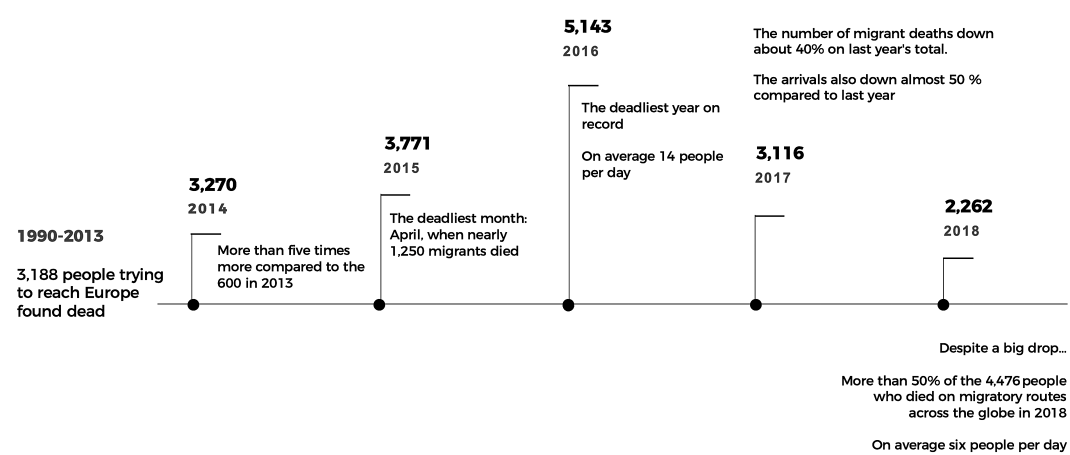
Figure 4.1 Deaths at Europe’s borders. Illustration by the author. Data Source: International Organization for Migration (IOM).
equality and fraternity - which sparked great enthusiasm across Europe. More recently, the Charter of Fundamental Rights of the European Union (CFR),4 which enshrines the rights for EU citizens and residents in EU law, contains specific titles dealing with substantive rights under the headings of dignity, freedoms, equality, solidarity, citizens’ rights and justice. Of particular interest for the argument here are the title on freedoms, which covers inter alia personal integrity, thought, religion, expression, assembly, and asylum, the title on equality, which prohibits discrimination on the basis of cultural, religious, and linguistic diversity, and covers the rights of children and the elderly, and the title on solidarity, which includes access to healthcare and social assistance.
The European Commission officially defines the fundamental key values on which the Union is founded in the Treaty on European Union (TEU). Article 2 of the Treaty enshrines these values as consisting of respect for human dignity, freedom, democracy, equality, the role of law and human rights, including the rights of minorities. The Europarlamentti (2014) website, maintained by the European Parliament Information Office in Finland with Mosaiikki ry, a Finnish immigrant association promoting the European Parliament among immigrants living in Finland by providing information in simplified language “to make it easier for immigrants to understand’’, refers to the same set of values yet goes further in explaining that "[t]hese values unite all the member states - no country that does not recognise these values can belong to the Union”.
Should this interpretation hold true, recent events involving the treatment of immigrants suggest the time may be ripe to begin exit discussions with a number of other member states in addition to the UK. In its own wording in the Treaty the European Commission is less stern in confining itself to stating that these values “are common to the Member States in a society in which pluralism, nondiscrimination, tolerance, justice, solidarity and equality between women and men prevail”.5 Although the Treaty establishes a mechanism for the suspension of certain rights in the event of a serious and persistent breach by a member state of these values, straightforward exclusion seems unlikely.
Whatever the definitions may be, the values referred to are as a role positive: Others who presumably do not share these European values possess values that may easily seem more negative. The overarching presupposition behind such thinking is itself far from trouble-free and may even have contributed to the very challenge which now confronts us. As Ahtisaari (2017) warns, Europe and more broadly the West may have made a major mistake in presenting these values specifically as European or Western. The semantics have created space for others to reject policies based on these values. To exactly what end then can "European” values indeed be held to be European? At the risk of over-generalisation, it can be noted that the EU’s key values seem to differ little from those of the United Nations, to which all its 193 current member states have committed. Second, it may not be an overstatement to claim that the widespread security-oriented and nationalist reactions to the "refugee crisis" in Europe have revealed considerably more about “us” than about “them”. The unsettling deficiency of historical selfunderstanding thus revealed has catalyzed a hollowing out of the very values
Ambiguous bordering practices at EU’s edges 81 upon which the idea of Europe has generally been constructed (Laine, 2018b: 293). To push this line of thought further, it may be necessary to consider if “we” rather than "they" are in fact challenging such apparently cherished values. Have we deviated from the commonly cited examples of values Europeans have sought to advance and cherish for centuries, as many of the uncompassionate reactions to newly arriving migrants suggest? Or have our values changed in the new age of continual crises?
Brechon and Gonthier (2017) suggest that they indeed have. Although their study confirms the notion that values generally only change slowly, in sharp contrast to the popular belief that values are converging and becoming increasingly standardised, they find that Europe remains very diverse in its value orientation: Discussing common European values may obscure more than it illuminates as the European value system deviates from grand narratives and becomes increasingly heterogeneous and individualised. However, their study identifies a number of underlying tendencies that seem to resonate widely throughout the European space. These include liberalism in personal behavior, orientation and decision making, yet the simultaneous demand for authority and public order in the rejection of uncivil behaviour and lawbreaking (Brechon and Gonthier, 2017: 279).
Many Europeans also reportedly wish to freely enjoy their lives without being constrained by moral or religious norms, and to exercise their freedom in a secure public space without being threatened by disruptive behaviour (Tournier, 2017). The dominant model within the EU is a mixture of liberal values and social preferences and expectations, though there seem to be major differences between the most privileged individuals and the most vulnerable, especially concerning expectations of equality or collective solidarity (Gonthier, 2017: 151). While it is widely acknowledged that citizens' personal attachment to the EU has already been weakening for a long time, and concerns about the EU’s democratic deficit have not abated, Belot and Guinaudeau (2017) go further in suggesting there is a direct linkage, if not correlation, between fears regarding the EU, a withdrawal into narrow nationalist attitudes and the xenophobic rejection of immigrants.

