The favorite? Women in the Italian creative scene
As mentioned above, the choice of working on the wider corpus of projects that requested funding under the rubric of cultural interest films permits a longer view. Such a view looks beyond finished film products and allows us to observe what could have been, or what is potentially there in the national production system.
We will begin by providing some further details on the composition of the analyzed corpus. As mentioned above, the total of 3,542 projects is subdivided into 827 feature-length projects by established filmmakers (23.34%); 1,474 debut or second films (41.6%); and 1,241 shorts (35.02%) (Figure 10.1)7
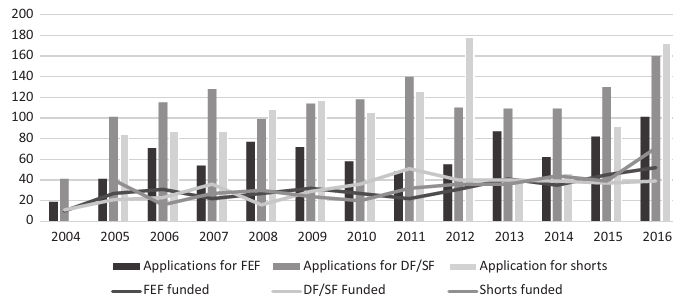
Figure 10.1 Number of applications and approved requests by category (FEF; DF/ SF; Shorts) (2004-2016).
Source: Elaboration by the authors on ministerial data.
The majority of requests for funding are made by filmmakers at the start of their careers (DF/SF); small-caliber projects follow (shorts), while the smallest number of requests is made for feature-length FEFs.
Of these 3,542 requests, 1,235 (34.86%) received public funding. 402 FEFs, 418 DF/SFs, and 415 shorts enjoyed the benefits of being recognized as “works of cultural interest.” Proportionately, the projects that received the most funding were those by established filmmakers: their requests were granted funding in 48.06% of cases. Shorts followed with a 33.44% success rate. Finally, debut and second features were the least successful, with a rate of 28.36%.8
The imbalance in favor of work by established filmmakers is further accentuated if we look at funding amounts. In the span of the 13 years considered here, 68.84% of funds for the support of cultural interest films (282 million euros) were allocated to projects by established auteurs; 28.02% to projects by new filmmakers (115 million euros); and 3.13% to shorts (13 million euros). The following chart shows the distribution of resources per year (Figure 10.2).9
On average, therefore, FEFs received a funding of around 701,000 euros; DF/SF about 274,000; while the average funding for shorts was 31,000 euros. In this context, women occupy a doubly marginal position.
First of all, the share of projects headed by women that apply for funding is significantly lower that than of projects headed by men: “women’s” projects add up to 544, with an extra 42 projects directed by teams composed of at least one man and one woman (represented in the graph as “mixed”). Together, these two categories form just above 16% of the total number of applications (Figure 10.3).
Second, the rate of “women’s” projects is at its peak in the category of shorts (21.59% of funding applications come from women or teams comprising at least one woman) and at its lowest in the category of films by established filmmakers (10.76%). Debut and second features directed by women that requested funding, in the 13 years considered here, add up to 15.53% (Figure 10.4).
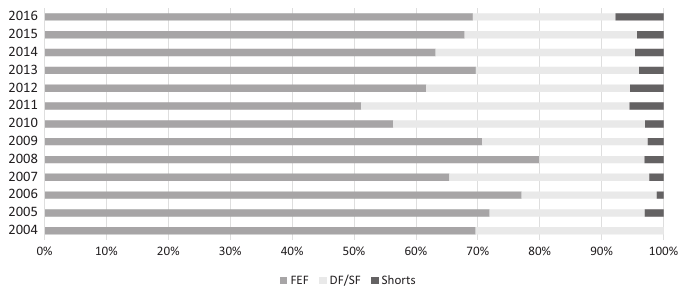
Figure 10.2 Share of funds according to format (films by established filmmakers; debut films/second films; shorts), per year.
Source: Elaboration by the authors on ministerial data.
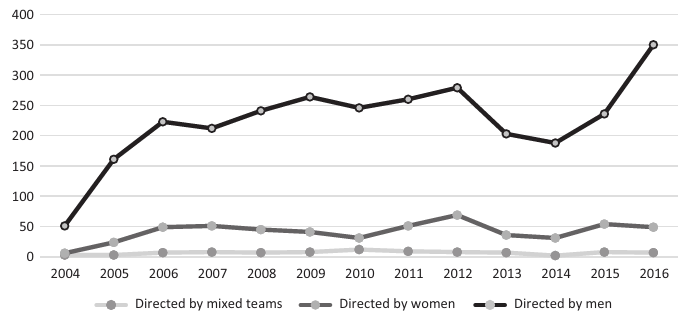
Figure 10.3 % rate of applications by women, men, and mixed teams, per year.
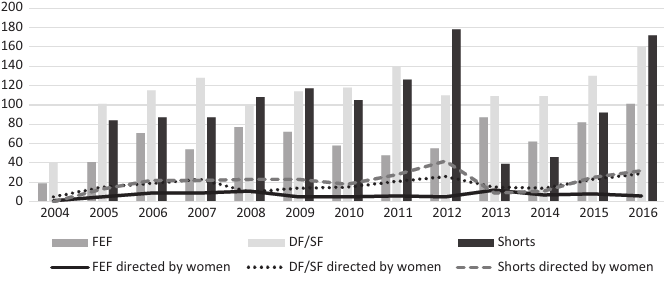
Figure 10.4 % rate of projects directed by women or teams comprising at least one woman, compared to the total number of applications (by women, men, and mixed teams), per year.
It becomes clear that women’s presence in the national creative scene is limited. When they are present, they are often positioned in funding categories where resources are more contained (shorts) or where chances of selection are lower (DF/SF).
This imbalance is not made any better by the selection criteria. The absence, in the provisions of the Urbani Law, of arrangements that would balance out gender inequality and that would therefore guarantee greater support for those who are usually excluded (such as women filmmakers, especially if at the start of their careers), effectively reaffirms the imbalance observed in our analysis of funding applications.
Projects directed by women (or teams with at least one woman) that received funding are 45 in the FEF category; 64 in DF/SFs; and 86 in shorts. On the whole, then, the gender discrepancy is blatant: only 11.19% of

Figure 10.5 Percentage rate of funded projects directed by women (or mixed teams) and by men (or mixed teams) over the total number of funding applications by women (or mixed teams) and men (or mixed teams), divided by category.
funded FEFs; 15.31% of DF/SFs; and 20.72% of shorts are directed by women. The imbalance is reduced if we compare the rate at which “women’s” projects are selected for funding from among the pool of requests by women to the equivalent rate for projects directed by men. In this case, the percentage of projects headed by women that receive funding remains lower than that of men in the category of shorts and DF/SFs but by a very small margin (32.09% of shorts directed by women accede to funding, as opposed to 33.40% of shorts directed by men; 27.95% of DF/SFs headed by women, as opposed to 28.58% headed by men) (Figure 10.5).
When it comes to established women filmmakers, instead, they are marginally more successful at obtaining funding that their male colleagues: 50.56% of their funding requests are approved, as opposed to 48.25% of requests by men. Nevertheless, when it comes to the size of the funding allocated, the balance is once again reversed. Projects by established women filmmakers receive, on average, smaller sums than those given to feature film projects directed by men: 655,000 euros, compared to 706,000 euros (Figure 10.6).
Our analysis of funding applications under the rubric of cultural interest films and the financial support they receive permits us to give an answer to our first two research questions: what is the presence of women on the national creative scene, and to what extent are they able to tune into the logics of the production system, starting with the criteria that regulate public funding?
The data we have illustrated thus far confirm what the literature indicates (Mascherini, 2009; Barca, 2018; EWA, 2018; Italian Research Council; Fanchi, forthcoming): women directors’ presence on the creative scene
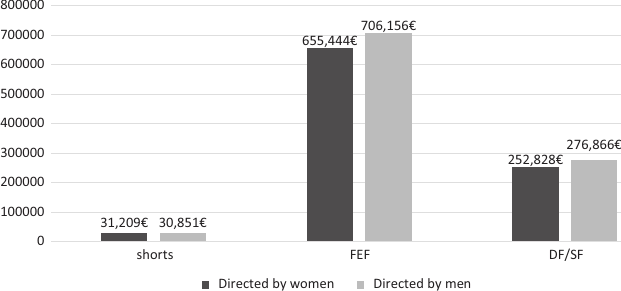
Figure 10.6 Average funding given to projects directed by women (or teams with at least one woman) and men (or teams with at least one man), by category.
is small to very small. When they are present, as we’ll see in later sections, they tend to occupy marginal positions within the system. They are not very present in big productions (FEFs), where they are at a disadvantage in terms of both the number of projects funded and the sums they receive. Their presence is felt more in the new generation of filmmakers (DF/SFs) and smaller formats (shorts), but their percentages remain significantly lower than those of their male colleagues.
The extent to which they are in a position to take advantage of state support and adjust to the logics of production appears lower, too. This issue would require further fleshing out, based on an in-depth analysis of the points system used to evaluate the funding applications. An analysis of the macro- and micro-entries in the various sections of the application forms would help reveal the strong and weak points of women’s productions.10 Even so, it remains unequivocally the case that women filmmakers, especially those breaking out into the creative scene, receive less funding than their male colleagues, both on the whole and in proportion to the number of requests made by them.
We might add that the quality of the production plan, and the fame and reputation of the professionals involved, are important criteria that allow projects to maximize yield during the funding application process. We will return to this point in the conclusion. On the one hand, such criteria serve as forms of guarantee for the state’s investment (reducing the risk of project failure). But on the other, they tend to exclude professionals who are starting their careers, ossifying the creative scene and providing a further obstacle to redressing its gender imbalance.
The overall trend in the 13 years considered confirms this interpretation. The data curve of applications and financed projects by women does not show significant changes. The small indication of growth in the number of applications in the categories of shorts and DF/SFs starting in 2014 seems more like a small irregularity, not unlike ones that have appeared in the past, than a sign of consistent improvement.
Despite the opportunities offered by digitization (lower production costs; greater possibilities for the circulation of audiovisual products; and, therefore, market growth and increasing demand for audiovisual contents), the number of female directors involved in the Italian film industry remains dramatically low.
Since women’s presence on the creative scene remains weak, are we to conclude that they are unable to make their mark on the digitized production system? To answer this question, we have to refocus the analysis on the level of individual professions and the relationship between professionals.

