A new presenteeism framework
Employees’ thoughts and decisions around whether to go to work or to stay at home while ill may be influenced by structural and contextual aspects of their job status and task demands, as well as self-evaluation of their health condition (Irvine, 2011). Therefore, as we will explain in more detail below, we propose a conceptual approach (Figure 4.1) where the axes of productivity and flexibility suggest the existence of four different typologies of employee environments. Employees in environments with high flexibility may have reduced productivity (HiFlexRedPro) or have a different attitude with lower levels of productivity loss due to presenteeism (HiFlexHiPro). Contexts of low flexibility may lead to profiles where employees go to work, but due to an absence of flexibility and poor working conditions reveal low production (LoFlexRedPro). Alternatively, employees may be pressured by supervisors and peers to increase their productivity despite the absence of a flexible work setting (LoFlexHiPro).
HiFlexHiPro
HiFlexHiPro is a label attributed to those employees who, despite going to work while ill, know how to benefit from the positive strengths of flexible work settings. Hence, we may ask whether all employees should go to work despite being ill. Concerning this question, there is no magic formula, since several factors such as illness severity, labour legislation, pressure from peers and supervisors, and self-motivation may contribute to the decision whether to stay at home or to go to work while ill. The literature shows that going to
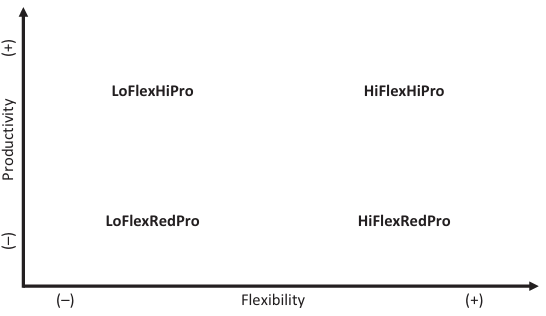
Figure 4.1 A conceptual model of presenteeism showing the impact of the dimensions of productivity and flexibility
work despite being ill can be an interesting strategy to recover from the health problem or possibly, even, to maintain wellbeing and good mental health (Sanderson & Cocker, 2013). In fact, a relevant faction of the presenteeism literature aims to provide suggestions to help managers and employees increase (or maintain) productivity despite illness. We know from the literature that employees with high job engagement (Ferreira et al., 2019), supervisor support, reduced task ambiguity (Zhou et al., 2016), low neuroticism, high conscientiousness, job security and low work-family conflict (Johns, 2011) reported fewer productivity losses despite going to work while ill. These findings emphasize that individual and contextual variables contribute towards reducing the negative impact of presenteeism at work. Therefore, in this chapter, we conceptualize that flexible work settings may provide good conditions for functional presenteeism (Karanika-Murray & Biron, 2019). Going to work may be seen as sustainable behaviour that allows employees to maintain their levels of productivity and, at the same time, recover from their health problems (Urtasun & Nunez, 2018). Employees who find flexible and positive working conditions may be more likely to fall into the HiFlexHiPro category in that they have good employee experiences (Whysall, Bowden & Hewitt, 2018) because flexibility allows them to deal with their illness problems and thus maintain high levels of productivity. This can be particularly relevant for workers dealing with chronic health conditions such as diabetes, arthritis or depression, as they are likely to have more time to be distracted from the health condition while at work socializing with colleagues, customers and supervisors (McGregor et al., 2017).
HiFlexRedPro
Some companies, such as Google, have developed a fun park where employees can have moments of amusement and have the flexibility to choose
Workplace flexibility and productivity 55 from several activities, such as playing video games, bowling, basketball or running slides at the expense of short-term productivity, with apparent therapeutic gains (Fortune, 2017). In real work settings that have similar features to those of the fun park, we can easily find employees who have the flexibility to execute several tasks, manage their daily schedule and still prefer to go to work and rest or simply procrastinate even while ill. The literature suggests the concept of therapeutic presenteeism to describe those workers who go to work to recover from health problems and see their job therapeutically (Karanika-Murray & Biron, 2019). These employees may find that the contexts of good camaraderie, a strong commitment to team work and organizational climates characterized by flexibility and positive organizational climate help mitigate or even hide the negative effects of their health problem (Knani, Biron & Fournier, 2018).
Employees with this profile tend to find that a supportive work environment where low productivity and less desirable workplace behaviours, such as procrastination, are well accepted for the sake of a common good that is the healthy recovery of a colleague. In the long term, however, this therapeutically driven presenteeism may change to dysfunctional presenteeism (Karanika-Murray & Biron, 2019) where long-term sickness presence may become detrimental to health and performance (Taloyan et al., 2012). In the long term, HiFlexRedPro profiles may experience a downward spiral of reduced performance and subsequent increased vulnerability associated with the incapacity to recover their resources despite the flexibility found in their work setting (Hobfoil, 1989). The perception of continuous reduced productivity may lead to perceptions of injustice from colleagues and supervisors which, in turn, may lead to reduced social support and decreased emotional support (Demerouti, Mostert & Bakker, 2010). Therefore, although HiFlexRedPro profiles in contexts of high flexibility and a positive organizational climate may initially find a sanctuary for their health recovery at the expenses of the company, the same sources of support may disappear if, in the long term, employees do not change their attitude and take advantage of the good environmental conditions provided by a flexible work setting to start increasing productivity.

