Social Cognition: Theory of Mind
If the mirror test really reflects self-recognition, then it could be argued that at least some animals are aware of their own mental states. Could they be also able to draw inferences about the mental states of other animals? The capacity to understand the mental states of others, called theory of mind, allows for social interactions that would otherwise be impossible. For example, if John wants the slice of pizza in the refrigerator but believes that Nancy is hungry for pizza, he may act as if there were no pizza in the house until Nancy leaves. Even scientists have difficulty controlling their tendency to attribute mental states to other animals—anthropomorphism (see double induction in Box 7.1). Here, however, the equation is reversed: Can nonhuman animals also attribute intentions, beliefs, and wishes to other organisms?
The seminal experiments (Premack & Woodruff, 1978) involved a series of choice situations with Sarah, a chimpanzee that had received linguistic training with tokens (described earlier in this chapter). Sarah watched a series of 20-s video clips depicting a person engaging in some action. For example, a man was unable to rinse a dirty floor while holding a hose or unsuccessfully tried to open a door. Subsequently, Sarah was given two static pictures, one depicting the solution to the problem (e.g., a hose attached to a faucet or a key) and another depicting an irrelevant stimulus. Sarah made 10 correct responses in 12 similar problems. The authors suggested that Sarah was able to choose the correct photograph because she could interpret the situation as a problem. Interestingly, when Sarah watched a

Figure 8.15 Behaviors directed at a mirror by a chimpanzee that suggest self-recognition.
Source: From Povinelli (1995); reproduced with permission from Elsevier; photos by Donna T. Bierschwale.
tape of somebody watching a tape similar to those she had watched before, and was asked to choose between pictures that portrayed that person making various choices, she failed to select the solution picture. In other words, while Sarah was able to attribute intentionality to a person engaged in an action when she was the observer, she failed to attribute intentionality to an observer who was watching a videotape as she had done on previous trials. This would be equivalent to a third person, say Mike, watching the scene between John and Nancy described before and being unable to figure out that John intends to get the slice of pizza for himself. Thus, there were limits to the cognitive capacities that Sarah was able to demonstrate.
An intriguing possibility illustrated by the behavior of John in the previous example is that of tactical deception—an animal intentionally misleading a conspecific away from a reward. Tactical deception is difficult to establish in nonhuman animals (Kirkpatrick, 2007; Toma-sello & Call, 1997). Typically, tactical deception is studied in the context of food procurement, and its function is to allow the animal to keep a piece of food that could be taken by a competitor. Situations involving food procurement are potentially open to instrumental conditioning, which, in this case, acts as a contextual variable in attempts to demonstrate tactical deception. In one experiment (Woodruf & Premack, 1979), four chimpanzees learned to point to one of two boxes that contained food to one of two trainers instructed to use the chimpanzee’s behavior to find the baited box. Upon finding the reward, the cooperative trainer always gave the food to the chimpanzee; when the cooperative trainer failed to find the baited box, the chimpanzee received no food. By contrast, the competitive trainer always kept the food for himself, but if he failed to find the bait, then the chimpanzee was allowed
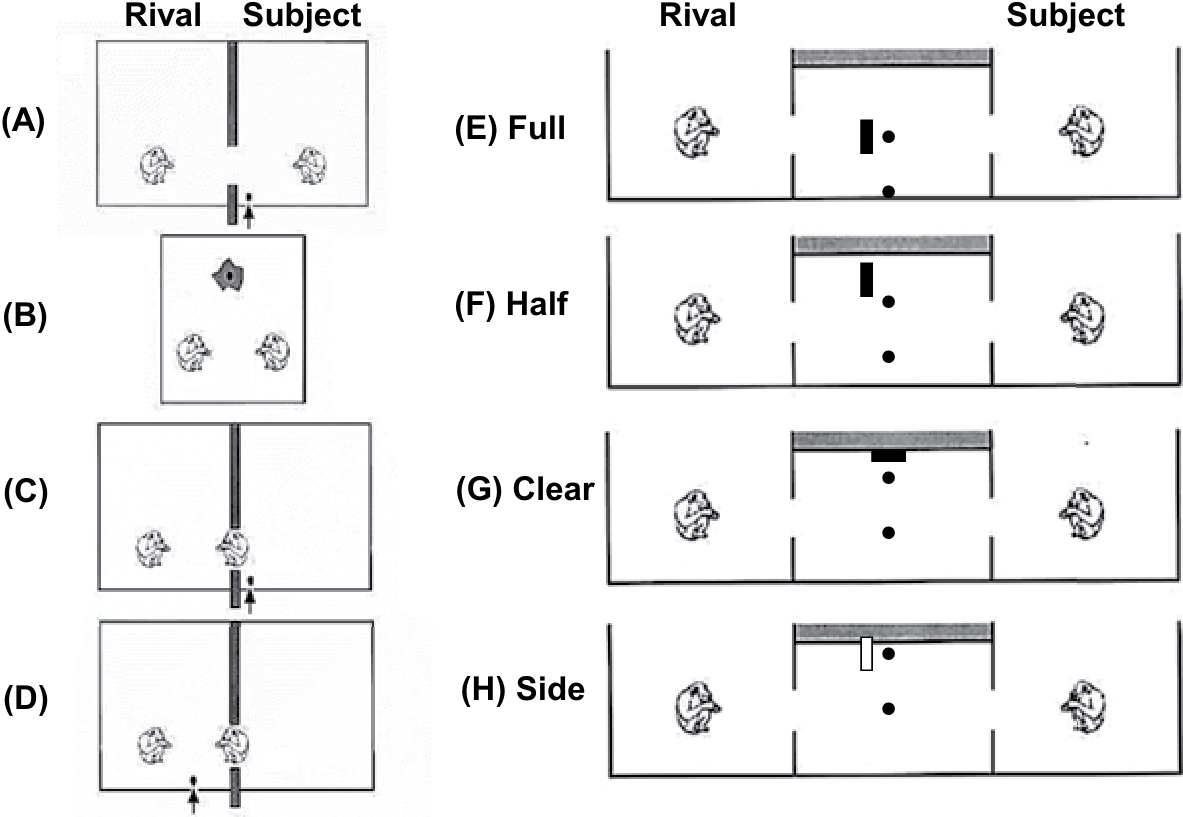
Figure 8.16 Testing the visual perspective taking in chimpanzees. Always with respect to the rival subject, in condition (E) the barrier fully occludes the food, in (F) it occludes only half of the view, in (G) the barrier is on the side, and in (H) the barrier is transparent.
Source: Karin-D’Arcy and Povinelli (2002); reproduced with permission from the International Journal of Comparative Psychology.
access to the food. Not surprisingly, all four chimpanzees learned to “conceal” information from the competitive trainer. But was this tactical deception or instrumental conditioning? Chimpanzees could have learned to point to the correct location with the cooperative trainer, but slowly learn to point to the wrong container or to avoid providing information with the competitive trainer. Both responses led to reinforcement.
It is difficult to demonstrate tactical deception, but would it be possible to show that chimpanzees understand what another chimpanzee is seeing? This capacity, called visual perspective taking, was tested in experiments involving hidden food (Hare, Call, Agnetta, & Tomasello, 2000). If a subordinate animal (S) is confronted with a dominant animal (D) in a situation in which there are two pieces of food, one visible to both and the other visible only to S, then S will take the hidden food in most of the trials. This behavior suggests that S understands what D can and cannot see, and it presupposes that taking the visible food could cause an aversive interaction that S is trying to avoid. However, other hypotheses are also possible. A replication and extension of these experiments provided no evidence of visual perspective taking (Karin-D’Arcy & Povinelli, 2002). Figure 8.16 presents the design replicating the original research on the left (A-D). Under these conditions, the subordinate subject retains the food more often in conditions (A) and (C), than in conditions (B) and (D). While consistent with visual perspective taking, these results are also consistent with other interpretations. For example, S could have simply taken the hidden food that was closest in (A) and (B). It is also possible that when confronted with a competitor, chimpanzees would prefer the piece that is closer to an object (a wall, as used in these experiments), rather than one that is out in the open. In such cases, preference for the hidden food reflects not visual perspective taking, but either proximity or preference for peripheral feeding. When tested under several barrier conditions and with rival and subject equidistant from the hidden food (see E-H in Figure 8.16), preference for the hidden food was not found. Subordinate chimpanzees were as likely to retain the hidden food independently of the barrier condition. Moreover, they took the food near the barrier just as frequently as the food located far from the barrier.

