Methods and measurement of epidemiological trends in the continent from 1980 to 2006
It should be noted that the prevalence and incidence of the disease as well as the mortality are constantly changing as a consequence of the impact of control programs, people migration, and changes in socioeconomic conditions of the population.
Data on the decrease of the frequency of new cases of infection by T. cruzi in the last decade as a result of vector control are presented below in the sections on the Sub-regional Initiatives for the Interruption of Transmission of Chagas disease.
The estimation of the decrease in the incidence rates of infection by T. cruzi in the period under study was made by comparing the age-specific prevalence rates of infection in a given age group in the period 1980—85 (at the time when the crosssectional studies were carried out in the different countries) and the age-specific prevalence rates in the same age group in the period 1997—2006, i.e., 20 years later (see Fig. 4.1 and Table 4.1).
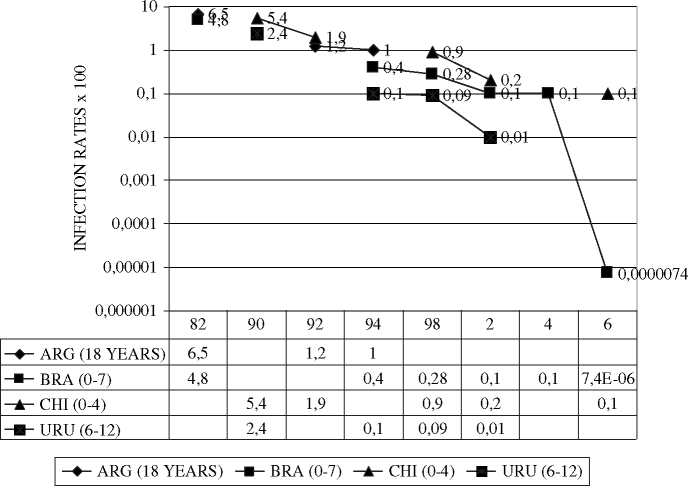
Figure 4.1 Interruption of transmission of Chagas disease, infection rates X 100 Southern Cone countries, 1982—2006.
Source: World Health Organization. Report of the Expert Committee on the control of Chagas disease. Technical Report Series 905, Geneva; 2002. p. 85; INCOSUR, 1993—2006.
Table 4.1 Prevalence of human T. cruzi infection in Latin America, 1975—85
|
Country |
Population at risk (thousands) |
Percentage of total population |
Number of infected persons (thousands) |
|
Argentina |
6900 |
23 |
2640 |
|
Brazil |
41,054 |
32 |
6180 |
|
Bolivia |
1800 |
32 |
1300 |
|
Chile |
11,600 |
63 |
1460 |
|
Paraguay |
1475 |
31 |
397 |
|
Uruguay |
975 |
33 |
37 |
|
Colombia |
3000 |
11 |
900 |
|
Ecuador |
3822 |
41 |
30 |
|
Peril |
6766 |
39 |
621 |
|
Venezuela |
12,500 |
72 |
1200 |
|
Costa Rica |
1112 |
45 |
130 |
|
El Salvador |
2146 |
45 |
900 |
|
Guatemala |
4022 |
54 |
1100 |
|
Nicaragua |
ND |
ND |
|
|
Honduras |
1824 |
47 |
300 |
|
Panama |
898 |
47 |
200 |
|
Mexico |
ND |
ND |
|
|
Total |
99,895 |
25 |
17,395 |
ND, no data.

