Shape-Memory Composites
We have seen that SMPs can be synthesized/designed to have the required properties for a specific application. However, trial and error, as well as a strong background (professional knowledge and experience), is needed. Form memory composites (SMCs), which contain at least one type of SMM, either SMA or SMP, as one of the components can be managed easily by design engineers, if the properties of SMA/ SMP are well understood. Via careful design, along with the introduction of additional mechanisms (e.g. elastic buckling), further phenomena and new features can be realized in SMCs (e.g. polymer self-healing).
Shape-Memory Hybrids
Shape-memory hybrid (SMH) is a more open and versatile solution for the average user, even with minimal scientific/engineering history. SMHs are made of conventional materials (properties are well known and/or can be easily found, but all without the SME as an individual). Thus, the SMM can be designed in a do-it-yourself (DIY) manner to achieve the required function(s) in a specific application.
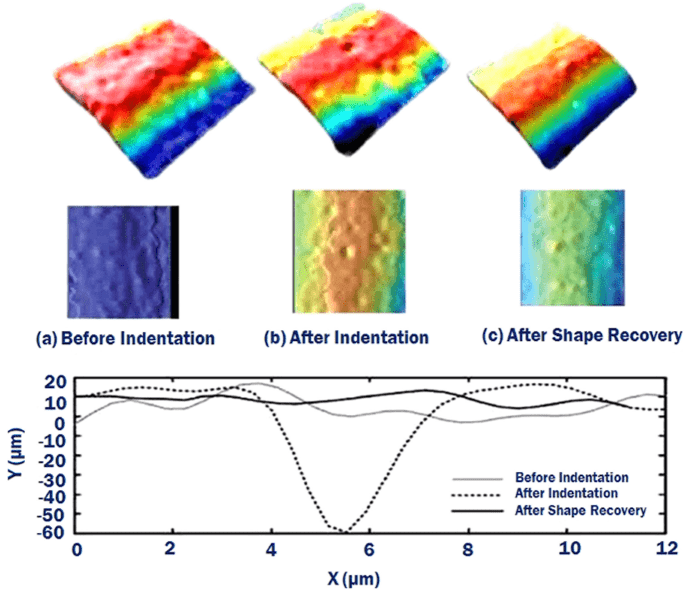
FIGURE 6.15 The SME demonstrated by indentation test (using a Berkovich diamond indenter) in a 170 nm thick thin film polyurethane SMP. Top: Three-dimensional and two- dimensional surface scanning images. Bottom: Cross-sectional view.
Similar to SMPs, SMHs are also based on a dual-domain system in which one is always elastic (elastic domain) while the other (transition domain) is able to change its stiffness remarkably if a correct stimulus is presented. However, the selection of transition domains for SMHs must be based on the principle that any possible chemical interaction between the elastic domain and the transition domain should be reduced if it cannot be entirely avoided. This is even better than an organic- inorganic mix. As such, we can accurately predict the thermo-mechanical response (or any other of our concerns) of the SMH based on the material properties of these two domains. The benefits of the SMHs are evident. For example, the elastic domain can be selected to meet the requirements for the stiffness and the sum of the shape recovery ratio of the SMH, while the appropriate stimulus form can be realized by selecting the correct material for the transition domain. In addition, the manufacturing/synthesis method is based on the well-known properties of domain materials, which is simple. It is manageable by almost anyone, even without a lot of experience.
We have developed a silicone-based SMH system for demonstration purposes. All features found in conventional SMAs and SMPs, namely dual-SME, triple-SME (as shown in Figure 6.16), two-way reversible SME (as shown in Figure 6.17), thermo- responsive (including by means of Joule heating by passing electrical current),

FIGURE 6.16 Triple-SME. Upon immersing into hot water, the SMH beam bends downward and then upward.

FIGURE 6.17 Two-way SME. Upon heating (top half, from left to right), the SMH beam pushes down the elastic beam (see inset for the illustration of set-up). Subsequently, upon cooling (bottom half, from right to left), the elastic beam pushes the SMH beam upward.
thermo/moisture-responsive, etc., have been reproduced. A narrow temperature recovery range within 5°C has been achieved. This principle has been further applied to the design of pressure-responsive SMH, thermo (on cooling or at extremely high temperatures)-responsive SMH with some success.
In addition, SMH has been shown to be rubber-like (not only in the high temperature range as superelastic SMAs, but also within the full application temperature range both below and above the transition/recovery temperature and, more importantly, with small hysteresis, as shown in Figure 6.18). Irrespective of the rubber-like feature, after cooling, the SMH retains more than 90% of the amount of pre-strain when extended to double its length at high temperatures. Subsequently, full-form recovery is observed immediately after heating in hot water. More interestingly, this SMH has a real crack healing function when it’s heated, but not just for shape recovery and crack closure. Unlike conventional polymer self-healing, which involves a curing agent for polymerization and can only be used once, after more than ten cracking/healing cycles, this SMH does not display any deterioration in terms of the strength recovered after healing.
For a more successful demonstration of the repeatable self-healing function, we manufactured a piece of cylindrical SMH with a piece of SMA spring embedded inside, as illustrated in Figure 6.19a. Remember that this SMA spring can be easily extended in a seemingly plastic way at room temperature. Upon heating, it returns to its original shape/length. We pulled the SMH until it broke into two pieces, as shown in Figure 6.19Ы. The SMA spring was also extended, resulting in a wide gap between the two sections of the SMH even after the pulling force was completely

FIGURE 6.18 Rubber-like SMH (in original and pre-bent shapes) under cyclic loading at room temperature (about 22°C) and at high loading speed.

FIGURE 6.19 Self-healing of SMH. (a) SMH with an embedded SMA spring inside (illustration); (bl-b2) Pulling SMH till fracture: (b3-b4) Joule heating SMA coil for self-healing; (c) Healed sample; (d) Healed sample in bending.
removed (Figure 6.19b2). Subsequently, an electrical current was passed through the SMA spring (Figure 6.l9b3). The SMA was heated for the recovery of the form so that the gap was closed (Figure 6.19b4). In the meantime, the SMH was also heated to achieve self-healing, with the aid of the compressive force produced by the SMA spring during yoke heating. After cooling back to room temperature, the SMH became one piece again (Figure 6.19c). There was no apparent crack even when it was severely bent, as shown in Figure 6.19d. This cracking-healing procedure can be repeated several times.

