An Extensive Overview of Wearable Technologies in the Healthcare Sector
Introduction
In recent times, the Internet of Health Things (IoHT) has become more popular in the healthcare sector, which generally includes a collection of the interlinked infrastructure of medicinal gadgets, software applications, and health systems and services. The utilization of the Internet of Things (IoT) in the medicinal field has abruptly raised several IoT use cases in the industry, personal healthcare, and healthcare payment applications. Wearable technology (WT) encloses the plethora of devices that are fixed with a transient connection. The secondary method contains smart mobiles, which are referred to as a core part of WT function. Although it is composed with the definition of smartphones as WT, the presence of the demise and rebirth of WT becomes more applicable in routine lifestyle [1]. This is due to the increase of cybercrime, a high cost of well-equipped applications. Also, mobile computation is highly influential, which is one of the significant innovations in WT such as processing rapid, robust, and simple bioassays at any place and time. WT is further divided into two classes: primary and secondary. The initial stage of primary deals with the independent operation in central connectors of alternate data, for instance, wrist-worn fitness trackers and smartphones, while the secondary class contributes to capturing particular events such as heart rate monitoring [2]. These classes are also included with modern textiles in which external features of the material can estimate stimuli from a user.
Some of the modern textiles leading to improving the value of the daily application of wearing digital tailored materials inside clothes or directly on skin retains the vernacular of scientific researchers. Regardless, fueled by miniaturization of electronic-based units, WT experiences the evolution of the primary condition to acquire conventional desktop computing. The WT has the capability of collecting and recording data and processing tedious computations, in healthcare applications, WT is realized as applicable devices to examine the patient status, remedy, as well as controlling of the disease. Regulatory bodies, as well as vendors providing medical applications, struggle for distinguishing apps as clinical tools that require normal regulatory acceptance, versus the well-trained user market. Fig. 3.1 shows the structure of wearables in healthcare applications.
The quality of a device and the application of diverse standards to analyze the accuracy with standard rate and interaction interoperability are interwoven by
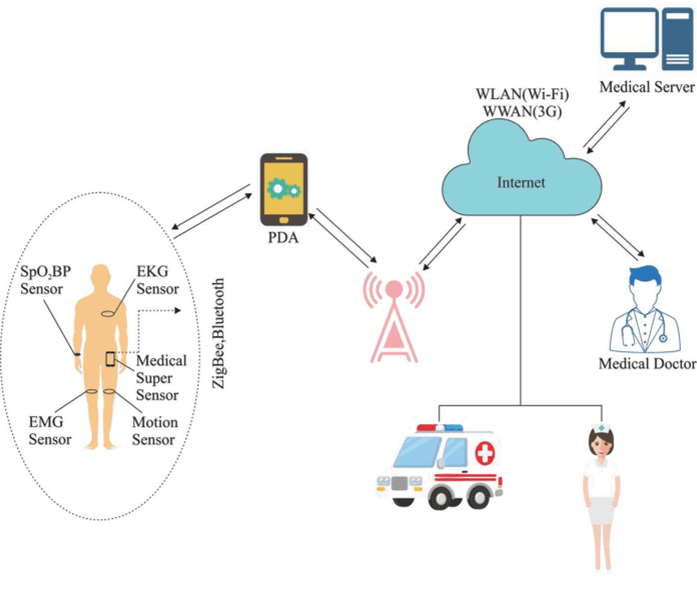
FIGURE 3.1 Architecture of wearables in healthcare.
projecting additional obstacles for medical consumption of WT. The purpose of this application is to review and highlight the important factors of WTs at minimum effective application for healthcare. Recently, it has been applied with a myriad of methodologies that have lower popularity in this domain.
WT has various electronic-centric sensors based on required values such as electrocardiogram (ECG) and blood glucose. These sensors produce an electrical signal while predicting physiological symptoms, which is captured several times for measurement demand. Consecutively, signals are recorded as difficult time series data by the data electronics. Off-the-shelf commercial tools apply proprietary software with integrated methods for downloading data, obtaining required information features, and producing essential results. Also, several WTs provides permission to use the actual data for developing bespoke methodologies through research gadgets such as MATLAB® for maximum insightful patient estimation. Consequently, it decides on the open-source developing choice in deploying techniques when compared with black box models.
The technologies were shaped based on computer-relied protocols for computing the sections of original electronic signals to obtain real-time information, the reliable outcome. It is considered to be more tedious from the permutations of data interpretation; however, pseudocode presentations give few insights for the task such as eye tracking [3]. WT is capable of frequently monitoring several iterations. Therefore, it has negative battery replacement as well as storage abilities and improved data capturing minimized WT installation duration. Although WT could apply maximum batteries, it makes WT ineffective by being too large to wear discretely. While applying WT, data acquisition is essential for ensuring data gathering strategies. For instance, minimum data and possible clues for analyzing patient details might be imputed; later, the searching process in big data in the case of clinically sensitive results is more tedious.
Generally, it is placed in low-power mode and speeds up the extra sensors if there is a feasible action that can be predicted. Big data is gathered in a free-living atmosphere that provides habitual nature such as seasonal movements and absence of direct medicinal observation. The major barrier that is present in applying big data inside a healthcare domain is selecting the best structure for memory, such as Structured Query Language (SQL) and analytical methods such as Apache Hive, which is not suitable [4].
Several WTs become a portion of IoT: connecting to electronic communication structures, serving fast data exchange as well as storage. The IoT devices generates a gigabytes (GB) of data for regular application. It is mainly based on the impact of hardware deployment on capturing the physiological values.
Following that, stable WT is optimally served as supervised patient estimation while instrumented testing in generic platforms with high sensitive electronic-based data. WT provides habitual information of serving self-care, a WT link with cloud computing (CC), adheres to GDPR, and guarantees ubiquitous sensing abilities in which embedded machine learning (ML) or artificial intelligence (AI) systems decipher from big data. Finally, WT data on a cloud is used by healthcare experts from a search engine, which makes the process simpler for users.
Feedback from these health services has to be employed in developing tasks. The cusp of the yottabyte (YB) period requires the size of big data that can be used as large proportions. The cloud is capable of resolving the constraints by offering a ubiquitous computerized financial scale; the energy of an effective system can be employed anywhere by different devices. However, CC is a developed optimizing technique, such as fogs and cloudlets for processing data present in network edges. Therefore, the study involved in this approach is named edge computing while realistic analysis is more important to increase the data efficiency [5].

