Pass through
The pass-through issue is an important one for climate change policies since the extent to which costs are passed through determines how effectively the policy works. Pass through is about the extent that a cost increase imposed by a policy is passed through by the airline to the passenger. In many cases, we cannot assume that a cost which is initially imposed on the airline gets fully passed through to the passenger. Competitive conditions can mean that only some of the cost is passed through — the airline may need to absorb some of the cost itself. Pass through is likely to be greater in the long run than in the short run, as airlines adjust their capacity on offer if it is not profitable. Some examples of incomplete pass through are as follows:
- • In oligopoly or monopoly, a tax will not be passed on to passengers in full in the short run, or possibly in the long run.
- • Where airports are subject to excess demand, and slots are used, an air passenger tax, such as those of the UK (Heathrow Airport), the Netherlands (Schiphol), and Germany (Düsseldorf Airport), will not be passed on -airlines will bear the full burden of the tax and there will be no impact of the tax on output or emissions.
- • When airlines are subject to an ETS for which some permits are allocated free of charge, they have the choice between setting fares at profitmaximising levels, or lower fares based on average costs. If the latter is the case, there is incomplete pass through.
The first case, that of monopoly or oligopoly, is considered when airlines are subject to an ETS. In Figure 4.7, the profit maximum is characterized by
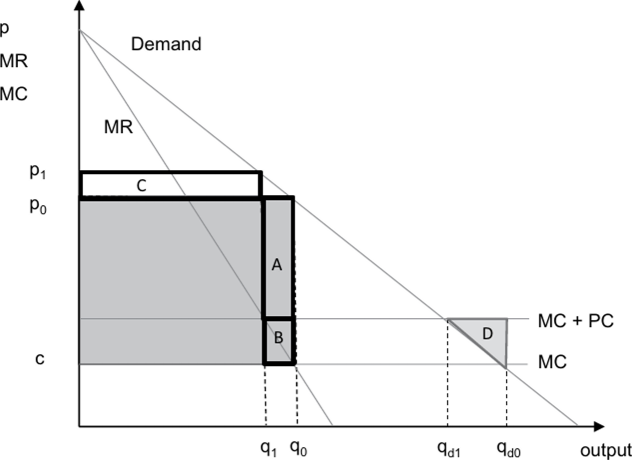
Figure 4.7 Cost pass through of opportunit)' costs of free allowances - monopoly case.
p0 and qn.With a linear relation between output and emissions, the introduction of an ETS leads to a parallel shift of the MC function, with p( and q, as the new profit-maximising situation. The profit contribution on the market for air transport services is reduced by (A+B-C). On the other hand, B is the additional revenue from selling q0-q, permits to other firms. Consequently, if C is larger than A, passing through opportunity' costs of free permits is a profit-maximising strategy. On the other hand, if A is larger than C, the airline would be better off not to pass through these opportunity costs. Many possibilities exist to change the assumptions of the model to make it more realistic. First, price differentiation is common in the air transport industry'. If the airline would apply' perfect price differentiation, every customer with a willingness to pay above “c” would pay' a fare equal to his maximum willingness to pay'. If free permits are introduced, total output would be reduced from qdll to q . For all remaining passengers, the price would remain the same; the airline’s profits would increase by' D. Second, CO, emissions (and therefore the demand for CO, permits) are not proportional to output.Therefore, they might be considered to be fixed costs (per flight) rather than variable costs per passenger.
The second case is where airlines are operating out of slot constrained airports, such as London Heathrow, Dusseldorf, and Amsterdam Schiphol.There is excess demand and airlines gain a slot rent from the constrained capacity, manifest in airfares being above costs (the slot rent). If the airline faces an increase in costs, be it due to an aviation tax or the workings of an ETS, it will face the whole of the cost increase itself- its slot rents will be reduced. In this case, there will be no reduction in the airlines output, and no reduction in emissions. Passengers will be unaffected, and there will be zero pass through.
A third case of partial pass through is that with free permits in an ETS. When aviation is included in an ETS, which has a proportion of free permits, will airlines raise prices by the amount that they need to pay for the non-free permits, or base prices on cost and recover only the value of all the permits which they need in order to make a flight, including free and non-free permits? At the margin, airlines can trade permits at their full value. A profit-maximising airline will factor its permits at their full value. Permits will be rather like airport slots — and airlines do not give their slots away just because they did not pay anything for them.
In spite of this, many discussions assume that the airlines will simply charge the passengers the amount they have to pay for the non-free permits and effectively give the free permits to the passengers. In short, they will set prices at below the profit-maximising level — they will behave as size maximisers. It is an empirical question as to how they will behave. This assumption lies behind the opposition of the non-European airlines to their inclusion in the EU ETS. Airlines from several countries, particularly the US and China, were very vocal about this, and instituting legal action and threating retaliation. In spite of this, the airlines might have profited substantially from their inclusion, especially if airlines act as profit maximisers.
The pass-through issue raises the issue of whether a policy actually works effectively to reduce emissions. Sometimes it will not. In order to have the full impact on demand and emissions, it is necessary that the passenger faces the cost of the impost. If pass through is incomplete or zero, the effect of the policy on emissions will be incomplete or in some cases zero.There is, however, an important difference between ticket taxes and an ETS. If a tax is imposed, the cost to the airline will rise, and all or some of this cost will be passed on to the passenger. If aviation is part of a multi-industry ETS, the introduction of the aviation ETS raises the allowable emissions from an amount X to X +Y, the emissions will rise from X to X + Y. The amount of emissions reduction from aviation may be smaller than Y — aviation will simply purchase permits from other industries. Thus, the European aviation ETS will have the effect of reducing emissions by the targeted amount, though much of the reductions in emissions may come from other industries. This has implications for the effect on non-carbon emissions, which will not be reduced by as much because of this effect (see Chapter 13, Section 3.3).

