Progress of intra-EU scheme
The scaled-down version of the original Aviation ETS is clearly far from ideal. Much is expected of an ICAO agreement to set up global market-based measures, or find a way to integrate the EU scheme into an acceptable global scheme. The interim solution introduces more distortions and also requires compliance by the airlines that are included. Quite a few non-EU carriers are still required to report and submit allowances under the reduced scheme, since they operate intra-EU flights. One such example, Saudi Arabian Airlines, has been fined €1.4 million (USS1.6 million) for breaching EU carbon emissions rules, making it the first big non-EU carrier to be fined for breaking EU regulations. The airline comes under the Belgian government for administrative purposes, and it is obliged to apply fines of €100 for each tonne of carbon dioxide equivalent that it emitted for which it has not surrendered allowances.
At least in the beginning of the scheme, the European authorities have been very relaxed about breaches in reporting. The German Emissions Trading Authority (DEHSt) published a list of 44 non-compliant operators it fined for not surrendering carbon allowances in 2012, which included Air Berlin.
Impact on airline costs
Most of the studies and estimates of the impact of ETS on airline costs applied to the broader-scope scheme that was suspended. However, Table 5.2 shows some that looked at more limited coverage. At the time, the final cost of acquiring the necessary allowances for the first year of the scheme was not known, and the initial free allowance was announced for the restricted scope for the Phase 3 period only in 2014. For most of the airlines that will have a shortfall, the cost of auction or market purchases of allowance will not be published. A key consideration is how far the value of free allowances is recovered from higher fares.
Table 5.2 shows the range of possible impacts of ETS allowance costs on air fares and profits. The earlier studies assumed that only departing flights from EU airports would be included. Even if 100% of the cost of allowances is passed on, the impact on an intra-EU flight is unlikely to exceed €5 per passenger at what are historically relatively high market prices of CO,. Long-haul passengers could pay up to €40 on these assumptions, but this attributes none of the costs to the cargo shippers (see later in this section).
Table 5.2 Summary of previous EU aviation ETS impact studies (assuming all allowances paid for)
|
Short-haul |
Medium-haul |
Long-haul |
|
|
European Commission (2006)L € per return ticket impact: Allowance price: €6 per tonne |
0.90 |
1.80 |
7.90 |
|
Allowance price: €30 per tonne |
4.60 |
9.00 |
39.60 |
|
CE Delft (2005)' € per return ticket impact:2 Allowance price: €10 per tonne |
0.20 |
0.40 |
1.00 |
|
Allowance price: €30 per tonne |
0.70 |
1.30 |
2.90 |
|
Ernst & Young-York Aviation (2007) € per return ticket impact: |
Low-cost |
||
|
Allowance price: €30 per tonne |
0.81 |
||
|
Average one-way fare € |
47.44 |
||
|
Percent increase in fare |
1.7% |
||
|
Change in demand (elasticity -1.5) UK Defra (2008) |
-2.6% |
||
|
Impact on airline profits Price elasticity 1.1-1.3 |
8-18% |
9-20% |
|
|
Price elasticity: 0.6-0.7 |
15-20% |
||
|
Frontier Economics for ELFAA (2006) |
|||
|
€ per return ticket impact: |
Low-cost |
Full service |
|
|
Allowance price: €27 per tonne |
2.72 |
5% of av. fare |
|
|
Allowance price: €40 per tonne |
4.00 |
8% of av. fare |
|
|
Change in demand (elasticity -1.5) Allowance price: €27 per tonne |
-7.5% |
-2.0% |
|
|
Allowance price: €40 per tonne |
-12.0% |
-3.0% |
|
|
Merrill Lynch (2008) € per return ticket impact: |
Low-cost |
Full service |
|
|
Allowance price: €30 per tonne |
1.54 |
3.52 |
|
|
on in higher fares. |
||
The European Commission (2006) commented that at an allowance price of €30, “these ticket price increases are modest. Their modesty is also demonstrated by the very limited impact they have on reducing forecasted demand”.
The allowance prices assumed are generally based on past market prices. However, studies have suggested that air transport is likely to be a purchaser of allowances given its growth rate and its marginal cost of abatement. This and a tighter scheme for ground-based emitters could have pushed up the market price of CO, to well above the €30—40 assumed earlier. Consultants Green Aviation (2009) forecasted prices in the range of €30—50 in the 2012—13 timeframe. Airlines can purchase CO, emissions derivatives well in advance of the first year in which allowance for their own emissions needs to be found.There will therefore be winners and losers in such trading activity, in the same way as fuel hedging. Auction prices for European Aviation Allowances (EUAAs) are unlikely to go above the market or futures prices for European Allowances (EUAs) at the time, since the former can be used only by other airlines.
As Figure 5.1 shows, there is quite a strong correlation between oil and carbon prices. Electricity generators have a large influence on the carbon market price, and when the price of oil is high they switch to “dirtier” coal, which needs to be covered by a greater number of allowances which are likely to have to be purchased in the market. This means that airlines could be faced by increased volatility of combined fuel and fuel emissions costs, some of which will be smoothed out by hedging. It should be noted that the CO, prices quoted here are for EUAs.The price is thus heavily dependent on the free allocation to other industries in the scheme. Higher recent prices (e.g. 24 euros in January 2019) will thus reflect the reduction in free allocation and the overall tightening of the ETS scheme. EUAs are used by ground-based emitters in the scheme but can be purchased in the market and submitted by airlines. Airlines are allocated EUAAs which can be submitted only by airlines and not by the other emitters.
The aforementioned studies generally concluded that the impact on LCCs would be lower per passenger, but higher in terms of percentage reduction in traffic. This conclusion is arrived at using similar elasticities and the higher share of ETS surcharge in relation to their average fare, which could be as low as €40-50.
None of the studies passed on the allowance cost for each flight to the cargo shippers, even though they account for a sizeable part of the payload on long-haul flights. The European Commissions analysis (based on CE Delft, 2005) took a B777—300 for their long-haul assessment and passed on the estimated
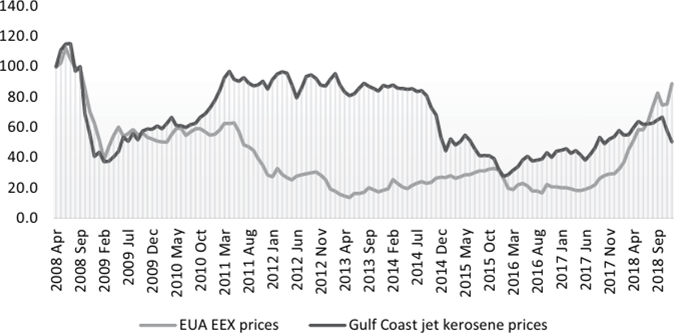
Figure 5.1 Jet kerosene (US Gulf) spot and carbon futures (EUA) market price (€/tonne CO,, and USS per gallon).
Source: Indexed: 100 = April 2008; data sources: US EIA and EEX exchange (own figure).
long-haul allocation of €9,422 per flight to the 238 passengers carried (340 seats at a passenger load factor of 70%), giving €39.60 per passenger at a CO, price of €30 (see Table 5.2).These should be doubled to allow for the fact that the scheme covered both arrivals and departures at EU airports (which would affect only flights between EU and non-EU airports). However, the long-range B777—300 can carry up to just over 25 tonnes of cargo in the lower deck compartment (depending on cargo density), or around 40% of total payload. If only 60% of ETS costs are allocated to passengers rather than the full 100%, the impact on the long-haul ticket price would be €47 rather than just under €79. This should be viewed against airline fuel surcharges which in June 2008 reached a peak of £2A?> {€215) per long-haul flights of more than nine hours on British Airways (2008b).
The Ernst & Young and York Aviation study (2007) was commissioned by airline trade associations covering all business models. It concluded that a large part of the ETS costs would have to be absorbed in reduced profits, with network airline operating margins reduced from 4% to 2.4% (for a CO, price of €30 per tonne), passing on around 35% of ETS costs to passengers. Low-cost carriers would face margins reduced from 15% to 11.1%, passing on 30% of costs.

