Material and Method for the Current Study
The English material has been culled from the British component of the International Corpus of English (ICE-GB), and is a subset of the material used for the study of adjunct adverbials in Hasselgard (2010). The Norwegian fiction texts come from the English-Norwegian Parallel Corpus (ENPC), while the Norwegian news texts are a collection of news articles sampled from various online newspapers in March 2011; see Table 1 and the list provided in the references section for details. The adverbial clauses were extracted and analysed manually. A subset was used for the case studies of information structure and experiential iconicism (Sects. 6 and 7). Table 1 also shows the frequency of adverbial clauses per 10,000 words, which gives an
Table 1 Corpus composition
|
Corpus |
Source |
Words |
N of adverbial clauses |
Adv clauses per 10,000 words |
|
English fiction |
ICE-GB |
10,000 |
146 |
146 |
|
English news |
ICE-GB |
10,000 |
118 |
118 |
|
Norwegian fiction |
ENPC |
24,800 |
229 |
92.3 |
|
Norwegian news |
Online newspapers |
11,000 |
156 |
141.8 |
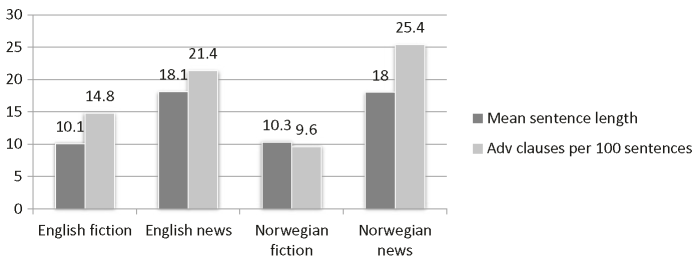
Fig. 1 Mean sentence length and frequency of adverbial clauses per 100 sentences across languages and registers
indication that in English such clauses are more frequent in fiction, whereas in Norwegian they are more frequent in news.
However, as occurrence per number of words is not an ideal measure for the frequency of adverbial clauses, the number of adverbial clauses per 100 orthographic sentences was also calculated. The number of sentences in the Norwegian material was calculated with WordSmith Tools (Scott 2014), while for the ICE-GB texts the number of ‘text units’ given for each corpus text was used. The mean sentence length is practically identical between English and Norwegian, but the registers differ in both languages, with sentences being almost twice as long in news as in fiction (see Fig. 1). This indicates that sentence complexity is greater in news, which correlates with a markedly higher frequency of adverbial clauses per 100 sentences in news than in fiction, as shown by Fig. 1. Frequencies per 100 sentences highlight similarities between the languages and differences between the registers, and thus give a different picture than the calculation per 10,000 words reported in Table 1: in terms of frequency per sentence Norwegian fiction has fewer adverbial clauses than English fiction, while Norwegian news has more than English news. It should be noted, however, that the opportunity of occurrence for adverbials is not the sentence, but the clause; thus frequency per sentence is not an ideal measure either. The quantitative findings of this study will therefore mainly be given in terms of raw frequencies or proportional distribution of adverbial clauses across positions within each subcorpus.

