Results
Figure 1 below shows the frequency per 1,000 words of the stance categories following Halliday’s (1994) model: subjective explicit (SE), subjective implicit (SI), objective explicit (OE) and objective implicit (OI), as explained in the section on Theoretical Background above. The frequency per 1,000 words is calculated with regard to the number of words in the whole corpus of each speech. The result of the X2 test is p < 0.005, which indicates that the overall differences with regard to stance categories in each political speech are statistically significant.
Taking into consideration each stance category, the greatest difference is revealed in the category Subjective Implicit stance, in which items are much more frequent in Obama’s speech than in Bush’s. Additionally, a difference is observed in the preference of each politician in the objective stance category: while Bush’s speech shows a preference for objective implicit stance, Obama’s speech shows a preference for objective explicit stance.
Figure 2 below shows the various types of modality in the two political speeches: epistemic and deontic modality. The frequency per 1,000 words is calculated within the overall category of modal verbs in each corpus. The result of the x2 statistical test is p < 0.005, which indicates that the differences in each political speech are statistically significant.
Results in Fig. 2 reveal that Obama’s speech shows an overall higher frequency of markers of modality, in particular of epistemic modality, followed by deontic modality. Deontic modality shows a low frequency in Bush’s speech.
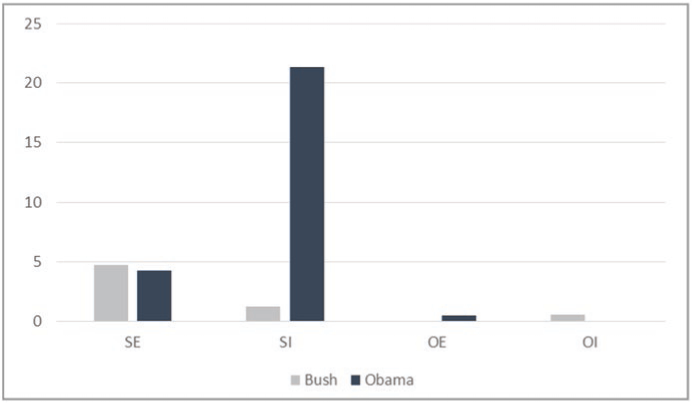
Fig. 1 Types of stance in Bush’s and Obama’s speeches (SE subjective, explicit, SI subjective, implicit, OE objective, explicit, OI objective, implicit)
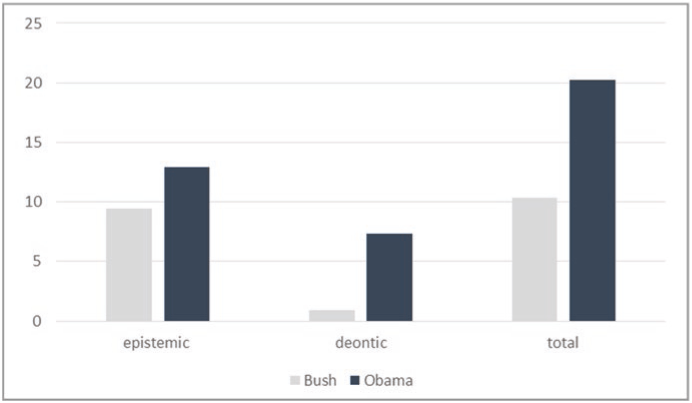
Fig. 2 Modality types in Bush’s and Obama’s speeches
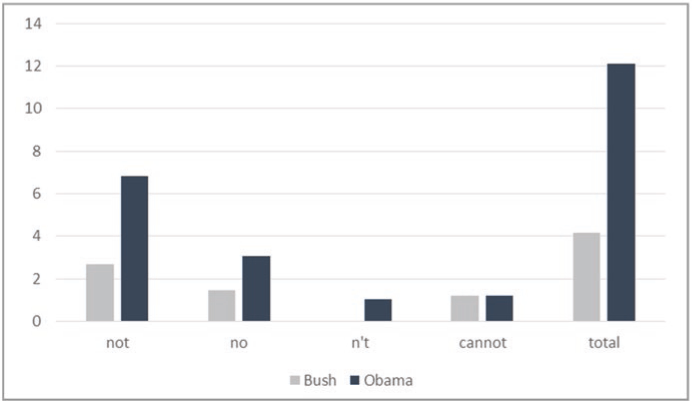
Fig. 3 Negation and distribution of negation types in Bush’s and Obama’s speeches
Figure 3 above shows the frequency per 1,000 words of overall negation types and the distribution of types of negation. Statistical significance is determined on the total number of negative types in terms of frequency per 1,000 words in each corpus.
Results in Fig. 3. show that the difference in the frequency of use negation in the two speeches is extremely significant, with p < 0.001

Fig. 4 Distribution of personal pronouns in Bush’s and Obama’s speeches

Fig. 5 First person pronouns in Bush’s and Obama’s speeches
Figure 4 shows the frequency per 1,000 words of personal pronouns in the two political speeches with regard to the total number of pronouns in each speech. The statistical test shows differences are extremely significant, with p < 0.0001. Results show Obama’s preference for first person pronouns and Bush’s preference for second and third person pronouns.
Figure 5 shows the frequency and distribution of first person pronouns in Bush’s and Obama’s speeches. Frequency per 1,000 words is calculated within the total number of first person pronouns. The statistical test shows that results are extremely
Table 2 Keyword significance in Bush’s speech vs. Obama’s
Keywords in Bush’s vs. Obama’s Arab world speeches
|
Keyword |
N. |
% |
N.REF. |
% |
REF. |
LOGG |
|
Your |
44 |
1.37 |
4 |
0.07 |
+ |
65.30 |
|
You |
47 |
1.46 |
11 |
0.19 |
+ |
48.89 |
|
East |
20 |
0.62 |
2 |
0.04 |
+ |
28.96 |
|
Free |
15 |
0.47 |
1 |
0.02 |
+ |
23.84 |
|
Middle |
19 |
0.59 |
3 |
0.05 |
+ |
23.71 |
|
Their |
37 |
1.15 |
19 |
0.34 |
+ |
20.42 |
|
Freedom |
18 |
0.56 |
5 |
0.09 |
+ |
16.93 |
|
President |
8 |
0.25 |
0 |
0.00 |
+ |
16.22 |
|
Liberty |
7 |
0.22 |
0 |
0.00 |
+ |
14.20 |
|
Neighbors |
6 |
0.19 |
0 |
0.00 |
+ |
12.17 |
|
Reconciliation |
6 |
0.19 |
0 |
0.00 |
+ |
12.17 |
|
Societies |
6 |
0.19 |
0 |
0.00 |
+ |
12.17 |
|
Stability |
6 |
0.19 |
0 |
0.00 |
+ |
12.17 |
|
Terrorists |
5 |
0.16 |
0 |
0.00 |
+ |
10.14 |
|
Democracy |
12 |
0.37 |
4 |
0.07 |
+ |
9.95 |

Fig. 6 Second person pronouns in Bush’s and Obama’s speeches
significant, with p < 0.0001. While Obama uses the first person pronouns I and we much more frequently than Bush, Bush shows a preference for the second person pronoun you.
Figure 6 shows the frequency of second person pronouns per 1,000 words within the total number of second person pronouns. The statistical test shows that
Table 3 Keyword significance in Obama’s speech vs. Bush’s
|
Keywords in Obama’s vs. Bush’s Arab world speeches |
||||||
|
Keyword |
N. |
% |
N.REF. |
% |
REF. |
LOGG |
|
Be |
57 |
1.01 |
4 |
0.12 |
+ |
29.95 |
|
I |
55 |
0.97 |
7 |
0.22 |
+ |
20.05 |
|
Must |
32 |
0.57 |
2 |
0.06 |
+ |
17.68 |
|
But |
35 |
0.62 |
3 |
0.09 |
+ |
16.64 |
|
Countries |
16 |
0.28 |
0 |
0.00 |
+ |
14.42 |
|
Communities |
14 |
0.25 |
0 |
0.00 |
+ |
12.62 |
|
Why |
14 |
0.25 |
0 |
0.00 |
+ |
12.62 |
|
Our |
64 |
1.13 |
15 |
0.47 |
+ |
11.30 |
differences are extremely significant, with p < 0.0001. Bush’s speech has a much higher frequency of use of second person pronouns.
As a complement to the quantitative results provided so far, keyword significance of lexical words, personal pronouns and modal verbs in each speech is provided in Table 2 and Table 3 above.
Results in Table 2 show the keyword significance of lexical items, personal pronouns and modal verbs in Bush’s speech. Results show that the second person pronouns you and your are highly significant in terms of keyness, occupying the first two places in the list. No other markers of stance discussed in the present study occur as significant in terms of keyness. The lexical items, however, reveal preferences in Bush’s discourse which stand out against lexical choices in Obama’s speech. For example, the terms free, freedom and liberty are highly frequent in Bush’s discourse, in line with the title of his address. The term terrorist, though not used frequently is a significant keyword, since this term is absent in Obama’s speech.
Table 3 shows keyness significance of selected lexical items, pronouns and modal verbs in Obama’s speech. Results reveal the keyword significance of the stance markers I, first person pronoun, our, plural first person possessive pronoun, but, concessive, and must, deontic modal verb.

