Example 1: Japanese women’s language
Segment 1: Speech from the geisha house
As to the question of how such private speech used in the geisha house came to permeate the upper-class family and became the common speech of respectable mothers and daughters: there are a number of former geisha among the wives of now powerful people who became influential as meritorious retainers at the time of the Meiji Restoration. Many other women with whom such women (former geisha wives) interact and closely socialize also have the same previous occupational [geisha] background. ... They use such speech as ii(n)-dayo [“It is okay”] or yoku-(t) teyo [“That’s fine”], even to their children. Then, those children acquire such speech and start using it outside their home. That’s how speech such as atai [“I”] and yoku-(t)tcyo [“That’s fine”] became common usage today. I think this observation would probably not prove wrong. In support of my theory, it was around the time when the offspring of “the ex-geisha-now-upper-class wives” started going to school that such speech became prevalent.
(Takeuchi, 1907, pp. 24—25)
In this excerpt, Kyuichi Takeuchi, a famous Japanese sculptor, connects categories of persons and categories of speech. In the narrated event, Takeuchi describes “former geisha” and “respectable mothers and daughters.” He discusses how geisha “permeate the upper-class family” both physically and linguistically. Physically, geisha took up positions in upper-class homes as “the wives of now powerful people.” Linguistically, the “private speech” of geisha became the “common speech” of upper-class women and girls.
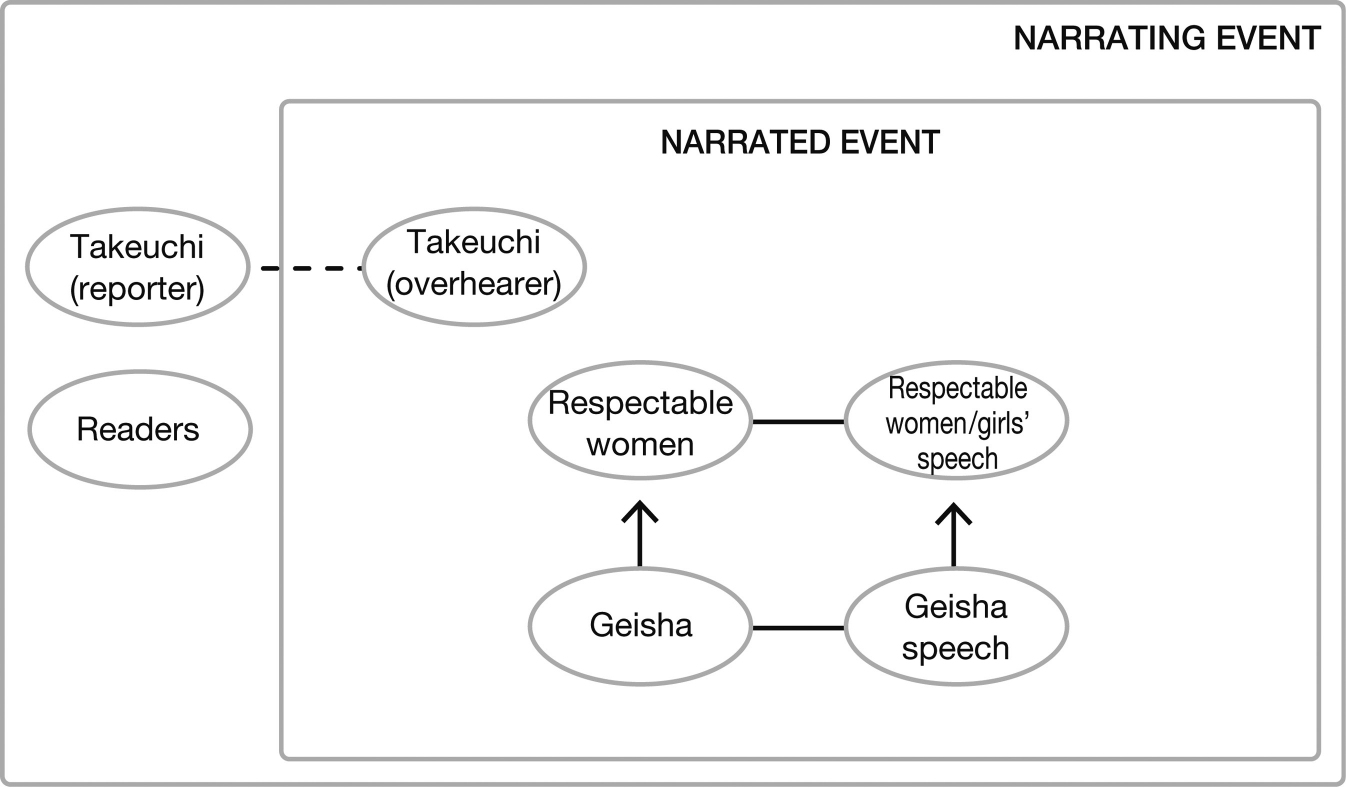
FIGURE 4.1 Geisha speech.
Figure 4.1 represents the narrating and narrated events in this excerpt. The narrating event involves Takeuchi writing to people who will read his work. In archival work, narrating events are somewhat different from the narrating events described for ethnographic work in the last chapter. The narrating event involves, on the one hand, the act of writing, with Takeuchi writing to an imagined audience of possible readers and aiming for certain effects on that audience. On the other hand, the narrating event includes many events of reading in which people interpret Takeuchi’s writing in various contexts—often privately while reading, but sometimes in conversation with other readers. Narrating events in archival studies are more obviously cross-event phenomena, because they involve linked events of production and reception.
In the figure, we present Takeuchi as an overhearer of women and girls in the narrated event as well as a reporter in the narrating event, because he presumably knows about the narrated events he describes through personal experience. Takeuchi’s narrated event describes “geisha” and “respectable women and girls.” He claims that these two social categories have distinct styles of speech. We represent this with lines that connect person categories to speech categories. Takeuchi describes a social change: geisha come to populate upper-class society, becoming respectable women themselves, and, over time, this changes how respectable women and girls speak. The lines with arrows represent this historical change and the supposed influence that geisha had on respectable women and girls.
Note the reported speech that Takeuchi uses to characterize geisha—sentence-final particles -teyo and -dayo, and the first-person pronoun atai. To a speaker of Japanese at the time, these forms indexed a recognizable style of speaking, one linked both to “the geisha house” and to “today’s” respectable mothers and daughters. He can take it for granted that his intended readers will be able to infer the kinds of people and types of speech events he is describing. He goes on to explain his “theory”: women and girls came characteristically to speak this way because geisha married powerful men during the Meiji Restoration (1866—1869) and brought their ways of speaking with them. As these former geisha become mothers, they transmitted “private” geisha speech to their daughters. When these daughters used it at school, elements of geisha speech became part of a new way of speaking—“common” schoolgirl speech. At this point, we will merely note two other potentially salient indexicals in the excerpt. Takeuchi’s use of the evaluative indexical “respectable” may presuppose that geisha speech is not respectable, and his use of the term “private” to describe geisha’s activities may presuppose their potentially disreputable activities with men.
Table 4.1 represents our brief analysis of this single speech event. The narrated event provides an account of geisha speech becoming common among upper-class women and girls. We have noted two evaluative indexicals that might establish geisha as disreputable, although we would need more evidence to draw this conclusion authoritatively. We also described Takeuchi’s quotation of the linguistic features linked to geisha (e.g., -teyo, -dayo). No configuration of indexicals has emerged yet to presuppose definite voicing, positioning, or social action. Such a configuration of indexicals could have emerged across this one text if Takeuchi had written a more extensive account that established some
TABLE 4.1 Initial analysis of Takeuchi’s text

|
1907 Narrated event: Geisha influence how “respectable” women and girls speak |
|
“respectable,” “private,” “common,” “today” Reported speech: -teyo, -dayo, atai |
|
|
Not yet fully formed |
|
|
Linking recognizable speech styles to geisha and upper-class women/girls Describing geisha as not respectable, engaged in disreputable activities Perhaps describing linguistic features linked to geisha as not respectable |
|
|
Not determined yet |
definitive social action. With archival data, it is often the case that configurations of mutually presupposing indexicals only emerge across temporally distant events as broader social processes take hold. An analyst must explore whether descriptions like this one also appeared, before or after this publication, and how readers interpreted those texts. Takeuchi may be positioning himself and others in ways that have implications for important social processes in Japanese history. But this one event by itself does not suffice to draw any conclusions about the social action or these broader processes.

