Storylines recurring across events
This section describes how the six stock storyline elements are used in Lazy Sunday and Friday!. Figure 5.4 displays screenshots from the two music videos for each of the story elements. In Lazy Sunday, which features Saturday Night Live actors Andy Samberg and Chris Parnell, Samberg wakes up in what Rymes calls a “youthy” bedroom (one with indexes of youthfulness) and arranges to meet his friend Parnell. They go to a bakery and a convenience store to get food. They ride in a taxi and then walk down the street. They arrive at their destination, a matinee screening of the film The Chronicles of Narnia. In Friday!, at-that-time unknown teenager Rebecca Black wakes up in a youthy bedroom and talks about getting food (saying, “gotta get my bowl, gotta have cereal”). She gets together with friends and rides in their cars. Finally, she walks toward a party at some unspecified location.
Figures 5.5 and 5.6 represent the narrated and narrating events in Lazy Sunday and Friday!. The narrated events contain the six storyline elements described earlier. The narrating events include Samberg and Parnell in Lazy Sunday and Black in Friday!, telling their stories to the viewing audiences. As in the cases presented by Inoue, Moore, and Chun previously, the narrating events project an interaction with the audience, presupposing certain things about the speakers and the audience. In subsequent narrating events, individual viewers watch the video and interpret it. Some viewers have produced recycled or mashed-up versions of these videos in response, posting these on social media sites across which new pathways emerge, but we do not have space to follow these pathways here.
Beyond the six storyline elements, Rymes also describes how the producers used several recognizable story enhancements in both Lazy Sunday and Friday!. Figure 5.7 provides screenshots to illustrate each of these. In addition to the car ride that occurs as a storyline element, both videos use strobe-like video effects and also display words on the screen in distinctive fonts. Two further enhancements involve the use of “hip-hop grammar” and “tough guy attitude.” Both videos make use of these features associated with hip-hop and African American speech. For example, the speakers use copula deletion in Lazy Sunday (e.g., “tru dat”) and Friday! (e.g., “we so excited”). Tough guy attitude is displayed nonverbally throughout Lazy Sunday as Samberg and Parnell sneer and swagger in ways associated with urban thuggishness. A similar attitude is displayed briefly in Friday!, when one of the producers of the song, Patrice Wilson, drives a car and raps about fast and furious driving (e.g., “fast lanes, switching lanes, with a car up on my side”).
Lazy Sunday and Friday! draw on a remarkably similar set of stock elements and story enhancements, even though they were created six years apart by people from very different social locations—established actors and a nationally recognized television show, on the one hand, and an unknown teenager and her

FIGURE 5.4 Storylines in Lazy Sunday and Friday!

FIGURE 5.5 Lazy Sunday storyline.

FIGURE 5.6 Friday! storyline.
parents who paid a small production company to produce a video, on the other. Each video moves through these elements in order to create a similar storyline. But the videos achieve very different effects because of the way they combine the elements and other enhancements.
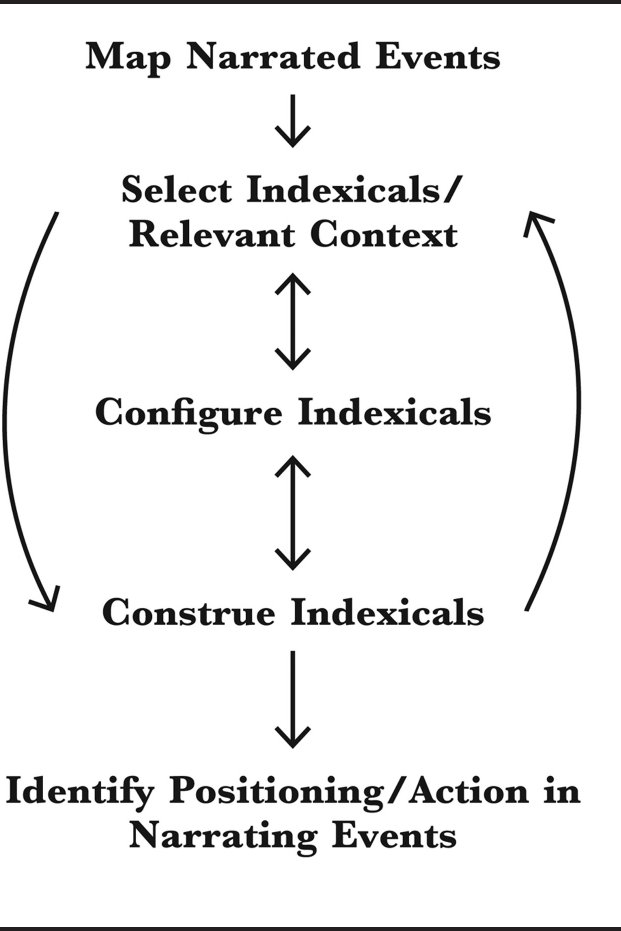
Table 5.12 analyzes Lazy Sunday as a discrete event. The narrated event involves Andy Samberg and Chris Parnell telling the viewing audience about a

FIGURE 5.7 Story enhancements in Lazy Sunday and Friday!
day in their lives. Several indexicals, such as “tru dat,” profanity, and “gangster” hand gestures, suggest stereotypical elements of hip-hop masculinity. But several other indexicals, such as discussing map technology, seeing a fantasy film, and eating candy and cupcakes, presuppose stereotypical elements of white nerd identity. Juxtaposing these contrasting emblems of identity produces an ironic metacommentary on both white youthy thoughtlessness and urban toughness, making each seem somewhat silly. By combining these contrasting stereotypes in a self-aware manner, Samberg and Parnell position themselves not as simply reproducing or inhabiting these stereotypes but as commenting cleverly on them.
TABLE 5.12 Within-event analysis of Lazy Sunday
|
Narrated event: Samberg and Parnell tell a story about their day |
|
“tru dat,” “gangster” hand gestures, rapping co-occurring with discussions of map technology and viewing a fantasy film |
|
|
Configurations emerge that presuppose stereotypical black masculinity juxtaposed with unmasculine alternatives |
|
|
Simultaneous performance of dominant black masculinity and nerdy incompetence, creating “ironic blackness” |
|
|
Samberg and Parnell are positioned as clever and self-aware Reinforce and subvert racialized ideologies through ironic commentary |
Friday!, in contrast, becomes a very different kind of event even though it incorporates many of the same elements. Table 5.13 presents a within-event analysis of this video. The narrated event here is nearly identical to that in Lazy Sunday: Rebecca Black tells a story about her day—in this case, Friday, not Sunday. Indexicals, like waking up in a youthy bedroom, meeting friends, and riding in cars, suggest youthful behaviors. Other indexicals, such as “we so excited” and a black man rapping in a car, presuppose “hip-hop” culture. However, unlike in Lazy Sunday, these two potentially contrasting models of identity are not juxtaposed. Instead, they simply appear as stock elements and enhancements from the music video genre that Rymes describes. Friday! merely replicates these elements instead of cleverly recontextualizing them as Lazy Sunday does. Friday! does not combine storyline elements playfully, nor does it juxtapose styles in order to create an ironic effect. The narrative follows the now-familiar storyline without telling a unique story or positioning Rebecca Black in an ironic or otherwise complex way. She is simply a girl wanting to have fun on Friday.
Although Rymes does not analyze them in the same detail as Chun, many commentaries about each of these videos have been posted both on and off the YouTube website. Both Lazy Sunday and Friday! were posted to YouTube and received millions of views in only a few months. YouTube comment threads are available for Friday!, which was reposted to YouTube in September 2011. In June 2014, it had 670,000 comments, and in May 2020 it was up to 850,000—as well as 1.1 million “likes” and 3.2 million “dislikes.” Although Lazy Sunday moved to the Hulu website, where no comments could be posted, before reappearing recently on YouTube, where it has not attracted extensive comments, there are numerous commentaries elsewhere—in blog posts, news media, critical reviews, and so on. These commentaries form pathways extending forward in time from the videos themselves. In general, commenters and critics have ridiculed Friday! for replicating stock elements earnestly with no ironic distance and no awareness of the irony in the original video being copied. Lazy Sunday has more often been praised for recontextualizing stock elements with irony and self-awareness—for example, receiving 24,000 “likes” and only 345 “dislikes” in its more recent posting on YouTube. As with the irony we saw in Wu's video, the positioning and social action in Lazy Sunday echo with more possible voices and stances, juxtaposing social types and creating a more complex and ambiguous type of social action. Despite these differences, the two music videos participate in a common pathway, one marked by the shared storyline elements and embellishments. Across these and other events, Rymes shows how a music video genre emerges and becomes recognizable.

