Phase 2: "Women's language" from the early 1900s to the 1930s
The three events form part of a pathway across which “schoolgirl speech” was codified as a recognizable way of speaking and associated with the social types of “respectable” women and girls, who were supposedly becoming corrupted by disreputable, “low-class” people. Inoue (2006) describes other events along this pathway from the same time period. As we mentioned earlier, she also shows how this pathway changed direction in some respects as it continued into the 20th century. In this section, we sketch the next step in her account, offering a few examples from the next phase.
By the early 1900s, Japanese schoolgirls were understood to speak a common language called “schoolgirl speech” or “teyo-dawa speech.” Linguistic forms such as —teyo and —dawa had become established as what Agha (2007) calls “enreg-istered emblems” of this form of speaking. That is, the use of these forms could index the speaker as a member of the social group described by Ozaki, Takeuchi, and Yanagihara—women and girls who had been corrupted by strange, outrageous, and vulgar speech that came from lower-class, disreputable origins and had lamentably spread to more respectable females. But in the early 1900s, many Japanese began to evaluate this way of speaking differently. Within a decade or two, “schoolgirl speech” came to be understood as “women’s language” (onna no kotoba). It was no longer a vulgar language associated with schoolgirls but a way of speaking linked to the middle-class urban woman.
In this section, we analyze a few discourse segments from archival data that Inoue presents in her account of the shift from “schoolgirl speech” to “women’s language” that occurred between the 1900s and the 1930s. These data come from two women’s magazines: Jogaku sekai (Women’s Learning World, 1901—1925), and Pujin sekai (Lady's World, 1906—1933). Figure 4.3 is an advertisement for Pearl Paste Hair Oil in Jogaku sekai that appeared in 1912. The advertisement takes the form of a testimonial. Segment 4 contains the transcript. All bolded portions in the next three excerpts indicate Japanese sentence-final particles written in Romanized script.
Segment 4: Pearl Paste Hair Oil
I used to have very frizzy hair, and was really troubled-desu-no. I have tried all kinds of remedies and oils and did my best, but could not possibly do my hair in a chignon [mage]. So I wondered what to do. Then my husband told me that Pearl Paste Hair Oil has a reputation for being good for hair, and that I should try it. So I gave it a try. Good Heavens, before I knew it, I was able to do my hair chignon beautifully like this-no. Besides having a really nice fragrance, Pearl Paste Hair Oil makes your hair miraculously beautiful-desu-noyo.
This excerpt projects an interaction between a woman and the reader, with the woman talking to the reader about her hair. Deictics such as “I” and “this,” as in the phrase “I was able to do my hair chignon beautifully like this,” anchor the woman’s speech in an imagined present conversation with the reader and tie it to the nearby image of the woman whose hair is arranged in a chignon. The text refers to two types of hair: “frizzy hair” and a “chignon.” The woman has had both hair types. Indexicals characterize frizzy hair as undesirable (“troubled”) and a chignon as desirable (“beautiful”). The woman’s transition from undesirable frizzy hair to a desirable chignon involved failed attempts (“tried all kinds of remedies and oils,” “did my best”), until her husband offers a solution.

FIGURE 4.3 Advertisement for Paru Nerikoyu (Pearl Paste Perfumed Hair Oil), by Hirao Sanpei Shoten (Hirao Sanpei Company),Jogaku sekai, 1912, 12(15), unpaginated. ©Hanbunkan Shinsha Publishers, Ltd. Reprinted with permission from University of California Press.
This solution—Pearl Paste Hair Oil—not only facilitates a “miraculously beautiful’’ chignon but also has a good “reputation’’ and a “really nice fragrance.” The text contains three linguistic elements that have been linked to schoolgirl speech: —desu-no, —no, and — desu-noyo. Ozaki, Takeuchi, and Yanagihara construed schoolgirl speech as vulgar and low-class. But here, elements of schoolgirl speech are used by a woman who seems to be voiced more positively. She wants to fix her “frizzy hair,” she is a good consumer who “gave it a try,” and she appeals appropriately to authority (“my husband told me”; the product “has a good reputation”).
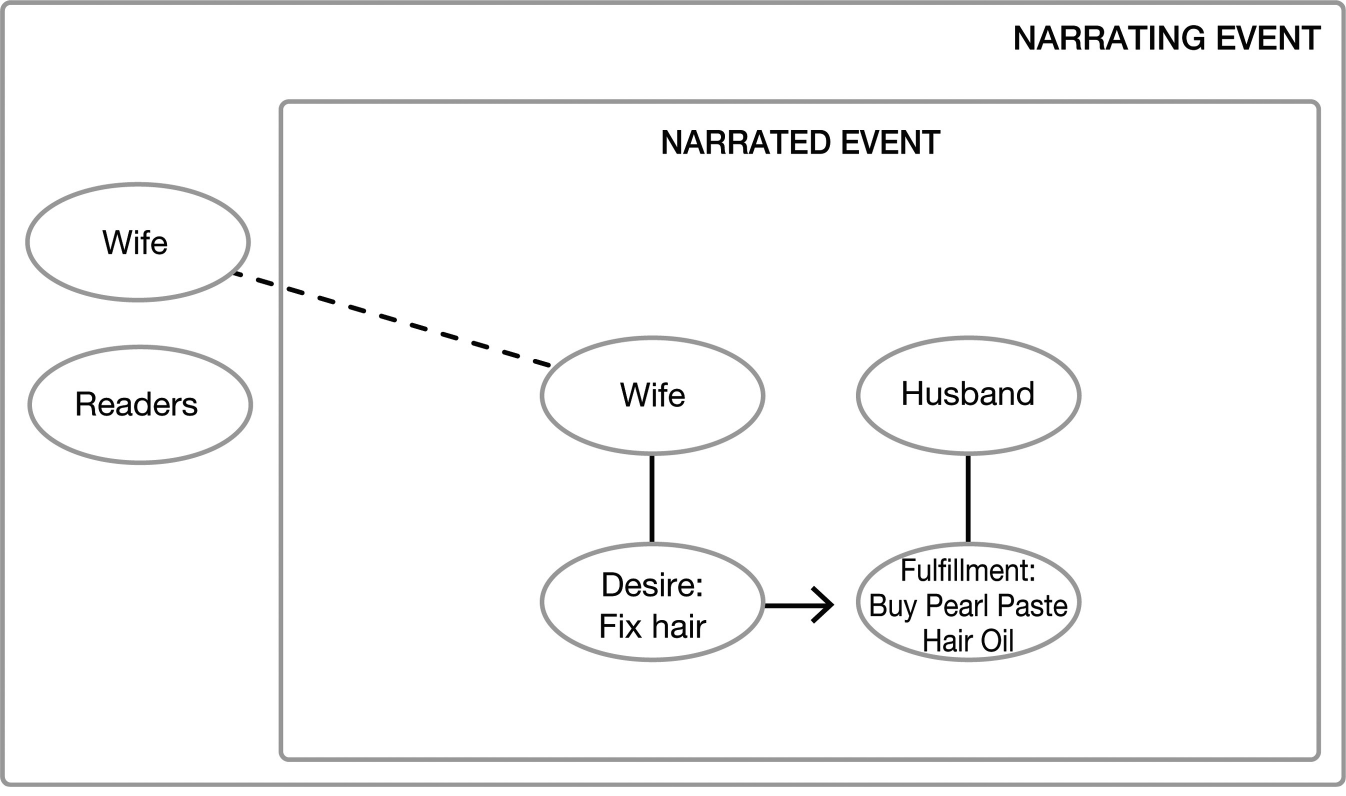
FIGURE 4.4 Advertisement.
Figure 4.4 represents the narrating and narrated events in this excerpt. In the narrating event, a woman speaks and gives advice to the reader. In the narrated event, she tells a story about her frustrations with her hair, her attempts to fix it, and the fulfillment of her desire through a product that was suggested by her husband. We represent the movement from desire to fulfillment with an arrow. Table 4.3 represents our brief discourse analysis of this one event. The narrated event is the woman’s story about a desire being fulfilled. Several indexicals, like “troubled,” “frizzy hair,” “beautiful,” and “chignon,” voice the characters: the woman is a good wife and consumer struggling to improve herself, her husband is helpful, and the product is beneficial. The schoolgirl speech forms (-desu-no, -no, -desu-noyo) associate the woman with the recognized way of speaking that has been called “schoolgirl speech” up until this historical moment. Given how Ozaki, Takeuchi, Yanagihara, and others characterized this way of speaking, it seems puzzling to have it associated with a diligent wife and consumer like the character in this advertisement. But we cannot draw any firm conclusions from this one event.
In order to interpret how this way of speaking positions women differently from 1910 onward, we need to examine more events in the pathway. Figure 4.5 features a nioga (modern girl) in the periodical Fnjin sekai in 1931. She is presented as an avid consumer who expresses distinct desires and style in women’s language. Segment 5 contains the transcript.
Segment 5: Items for a moga (modern girl)
This is a new-style dress that I just bought yesterday-nano. I really like the collar, cuffs, and I particularly like the right shoulder part-noyo. The

|
1912 Narrated event: A desire is fulfilled |
|
Troubled frizzy hair, beautiful chignon Schoolgirl speech: -desu-no, -no, -desu-noyo |
|
|
Not yet fully formed |
|
|
Linking schoolgirl speech to upstanding middle-class women Perhaps describing women as desiring subjects and consumers |
|
|
Not determined yet |
brooch has moved up here-wa. This is my favorite watch-nano. It has a small, oval-shaped gold frame and a pitch-black band! These shoes are simple, but are made of cream-colored kid leather, and I like their light and smart style-nano. How wonderful it would be to walk in the early summer on the street in such a style-kashira.

FIGURE 4.5 Untitled image of a nwga, Fujin sekai, 1931, 26(5), unpaginated. ©JitsugyO no Nihon Sha, Ltd. Reprinted with permission from University of California Press.
Inoue argues that this advertisement forms part of a pathway that also includes the one just described. Both advertisements involve a woman directly addressing the reader about fulfilling her desires through consumer goods. Both women use features of schoolgirl speech as they tell their stories, including -nano, -noyo, -wa, and -kashira. Both project an interaction with the reader, creating immediacy with deictics like “I,” “this,” and “here.” Instead of a married woman whose husband offers a solution that fulfills her desire, this advertisement features an unmarried woman, a nioga (modern girl), who does not include anyone but herself in describing the fulfillment of her desires. Though she may not appeal to male authority, she does appeal to the consumer good as a kind of authority that is able to fulfill her desire. The women in both advertisements are presented as experiencing fulfillment through consumption.
Consider one last example. Figure 4.6 is an advertisement for Victoria Menstrual Garment that appeared in Fujin sekai in 1925. It features a conversation between two sisters. Segment 6 contains the transcript.
Segment 6: Victoria Menstrual Garment
Sonoko: Sister,you kindly invited me to the karuta game, but I ... I
can’t make it tomorrow-noyo.
Older Sister: Oh, how come?
Sonoko: But ... but, I have been in the moon disease all day-nano.
Older Sister: Period? ... Sono-chan, don’t you know about a menstrual garment called Victoria? If you wear it, you will not have to worry at all for hours-wa.
Sonoko: Ah, my friends are actually all wsiMgVictoria-desu-wa.Why
didn’t I think about that! Sister, I will go home right away and will definitely visit you tomorrow-teyo.
Older Sister: Oh my, you suddenly look all cheered up-none.
This example differs from the previous two in representing a conversation between two fictional characters, not projecting a conversation between the main character and the reader. The reader is instead recruited as an overhearer to this third conversation. The use of “all” in “my friends are actually all using Victoria” might invite the reader into the story as a potential member of this group of Victoria users. As in the previous examples, the women in this advertisement use several emblems of schoolgirl speech: -noyo, -nano, -wa, -teyo, and -none. The women are also voiced as desiring subjects—wanting to go to the game, not wanting to worry about her period—and as consumers. As in the first ad, these desiring and consuming female subjects appeal to authority—not the explicit authority of men, like the husband in the first example, but that of other young women (“sister” and “my friends”) as well as the commodity itself.
Table 4.4 represents our analysis of these three events from 1912, 1925, and 1931. Various similarities provide evidence that the events are part of the same

FIGURE 4.6 Advertisement for Bikutoria Gekkeitai (Victoria Menstrual Garment), by Yamato Gomu Seisakusho (Yamato Rubber Manufacturing Company), Fujin sekai, 1925, 20(1): 333. ©Jitsugyb no Nihon Sha, Ltd. Reprinted with permission from University of California Press.
pathway. The narrated events from the three advertisements in women’s magazines are parallel. Women fix their frizzy hair, feel “wonderful” while walking down the street, and enjoy life despite menstruation, thanks to consumer goods like Pearl Paste Hair Oil, contemporary clothing, and Victoria Menstrual Garment. All three events project conversations by “real” women, anchored in the here and now through deictics, either directly addressing the reader or inviting the reader to be an overhearer. Women in all three events also use linguistic

|
Linked Events: 1912, 1925, 1931 Narrated events: Desires are fulfilled through consumer goods |
|
Troubled frizzy hair, beautiful chignon, “I like,” “want” to go to game I, my, me, you, this, here Schoolgirl speech: -desu-no, -no, -desu-noyo |
|
|
Tight linkage established between the linguistic forms associated with women’s speech and the respectable, desiring, consuming subject |
|
|
Mainstream, respectable women speak women’s language Women who speak this way are desiring and consuming subjects |
|
|
Women’s language helps constitute a new vision of women as desiring consumers |
forms that have been associated with “schoolgirl speech” (e.g., -teyo, -none, -nano, -noyo, -tva, -kashira, -desn-no, -no, -desu-noyo).
But the type of woman being associated with this way of speaking has changed from the one characterized by Ozaki, Takeuchi, and Yanagihara. Women who speak this way in events from the 1910s, 1920s, and 1930s are no longer respectable females at risk of being corrupted by speech that came from geishas. They are instead respectable middle-class women who appropriately have their desires fulfilled by consumer goods. Across the pathway of events, a configuration of indexicals emerges that associates these forms of speech with this new social type. Within any one event, we could not conclude that the earlier meaning of “schoolgirl speech” had changed. But, across events, the new presuppositions of these ways of speaking solidify, establishing a more rigid pathway across which a set ofjapanese women came to be identified differently. The same set of linguistic forms became evaluated differently as they presupposed a new social type of the respectable urban middle-class woman who both desires and consumes. By tracing these three (and other similar) speech events in this second phase of the pathway across which the meaning of “Japanese women’s language” emerges, Inoue is able to identify a new social voice and show how advertisements recruit women into speaking and acting in this way. Inoue argues that in this second phase, the changing meaning of women’s language helped constitute gendered capitalist subjects as women defined their social positions through relationships with commodities.
By the second decade of the 20th century, then, “schoolgirl speech’’ came to be understood as “women’s language”—no longer a vulgar language with low-class origins but a style of speaking associated with respectable, desiring, and consuming middle-class urban women. Inoue argues that, in the first phase, men’s denigration of “schoolgirl speech” expressed male anxiety about modernity in the late 1800s, while, in the second phase, “women’s language” became an expression of the modern, consumer self who has learned to desire commodities. She supports these conclusions with careful cross-event discourse analyses that trace how the linguistic forms associated with “Japanese women’s language” signaled certain social types and evaluations between 1880 and 1910 and then different ones between 1910 and 1940. By doing discourse analysis beyond the speech event on her archival data, she is able to trace these pathways and substantiate her claims about the larger social processes that speech helped constitute in Japan a century ago.

