Monitoring and enforcement
The success of any chosen instrument or a set of chosen instruments would be dependent upon effective monitoring and enforcement. The polluters will start complying if the fear of being caught and penalised is present. The SPCB is the nodal agency responsible for monitoring of compliance. The NEP attributes weak enforcement of environmental compliance to inadequate technical capacities, monitoring infrastructure and trained staff in the enforcement institutions. In addition, it has been observed that there is an insufficient involvement of the potentially impacted local communities in monitoring of compliance and an absence of institutionalised PPP in enhancement of the monitoring infrastructure. It has recommended developing feasible models of PPP and strengthening the testing infrastructure and network for monitoring ambient environmental quality for environmental compliance. Curmally (2002) has observed that the monitoring by the SPCBs is poor, and the lack of comprehensive data/informa-tion on polluting activities of the industries only adds to the problem. Attention has been focused on the installation of abatement equipment rather than ensuring that it operates continuously. The operating costs of pollution control equipment are high and, therefore, industries are often reluctant to run such equipment efficiently. Poor monitoring allows firms to get away with improperly operating these plants.
Monitoring is costly and the problem becomes worse in developing countries as the agencies are often inadequately funded and have less access to technology and trained manpower (Eskeland & Jimenez, 1992). The situation becomes aggravated when a large number of SSIs are involved. The shortage of manpower adds to the problem. In 2014, in the GPCB, one technical person was required to monitor 150 units (there were 33056 registered polluting units and 220 technical personnel in the GPCB)5. This, coupled with the poor monitoring infrastructure, adds to the problem.
Monitoring alone is not sufficient and strong enforcement mechanisms are needed to make any instrument effective. The non-compliant firms need to be punished so as to force them to comply. The errant behaviour will change only if the threat to penalise the non-compliance is seen to be credible. In India, the remedies to deal with non-compliance as provided under the current legislation are as follows. The SPCBs are empowered to file a legal case against a polluting firm and non-compliance is dealt with by way of imposing fines or imprisonment. Any person from civil society can also file a legal case against the polluter. In this instance, a notice regarding the offence is given to the SPCB at least 60 days in advance and, additionally, the intention to file such a complaint is made clear. In the event that a firm is found to be non-compliant, the fines and penalties are so low that they do not act as a deterrent. The penalty structure does not consider the degree of non-compliance and the pattern of non-compliance (onetime defaulter or habitual defaulter). The probability that habitual defaulters will receive a higher penalty is not present in the existing environmental legislation. This, coupled with the slow judicial process, has made this provision ineffective in dealing with non-compliance. The legislation also empowers the SPCB to issue directions to polluters and these directions include the power to direct (a) the closure, prohibition or regulation of any industry, operation or process; and (b) the stoppage or regulation of supply of electricity, water or any other service and closing of the industry. This provision is used extensively by the SPCBs to take action against the defaulters (Bansal & Solanki, 2015). However, this action does not lead to any major improvement in environmental quality as the closure orders are revoked on the assurance given by the polluter that it will take the necessary steps to treat pollution. Given the constraints faced by the regulatory agency, continuous monitoring of an offender does not take place.
Theoretically, the ideal choice for pollution control is when marginal abatement cost (MAC) is equal to marginal social damage (MSD). However, the firms make a decision about MAC based on the marginal expected penalty (MEP). The firms would like to save on the abatement costs in case the enforcement mechanisms are weak and MEP is low. Any policy instrument which reduces MAC or increases MEP would lead to lesser pollution (Kathuria, 2014). In the Indian context, it can be seen that units do not comply with the prescribed standards, irrespective of MAC being high or low, because enforcement is so weak.
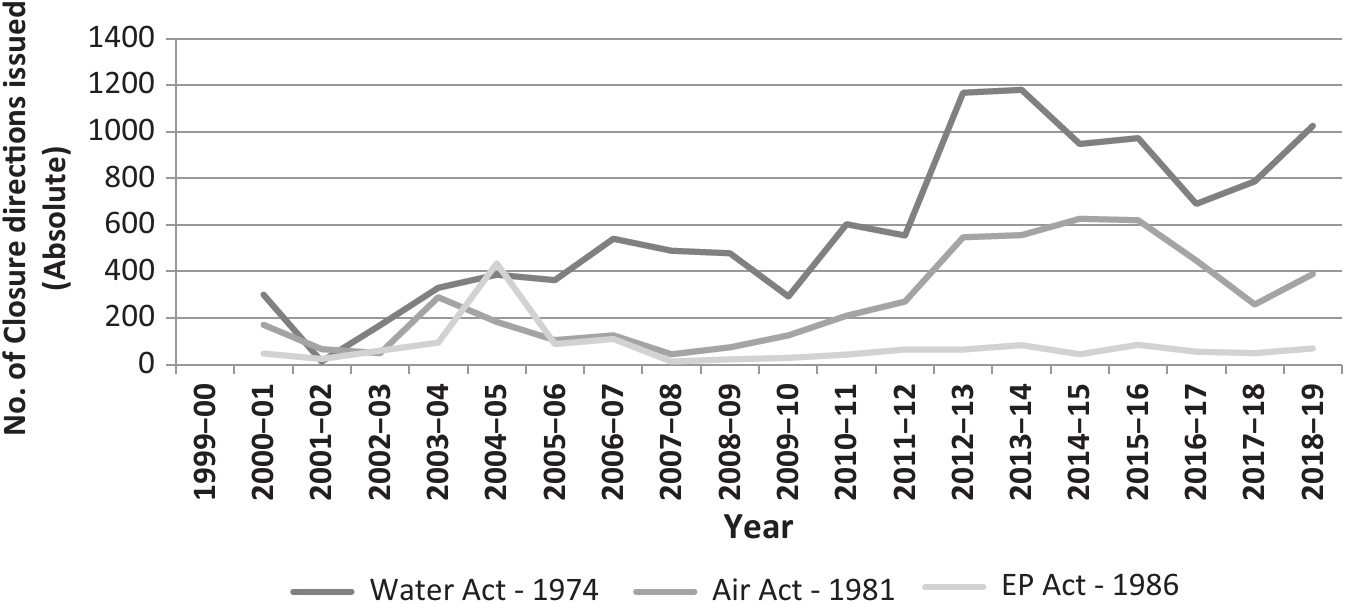
FIGURE 5.1 Closure directions issued by GPCB. Source: GPCB Annual Reports.
The level of compliance with the environmental laws can be judged by the closure directions issued to the industries in Gujarat as shown in Figure 5.1. Every year the number of closure orders issued for non-compliance under the Water Act and the Air Act has been very large.
The high number of closure orders issued every year is a clear indication of the fact that industries are not complying with the environmental laws. Vyas & Reddy (1998) have stated that in spite of promulgating various acts and instituting the MOEF, the record of their implementation has been dismal. Kathuria & Haripriya (2000) have also expressed similar concerns that despite having a number of legislations and institutions to protect the environment, the success in abating and controlling pollution has been limited.

