CETP Sachin Infra Environment Ltd. (SIEL)
GIDC Sachin has two CETPs: CETP SIEL and CETP GECL, with capacities of 50 MLD and 0.5 MLD respectively. The treated effluents from the CETP are discharged into the GIDC pipeline which meets the Unn creek. The effectiveness of the CETP in treating industrial effluents is discussed in the following paragraphs.
BOD at the inlet and outlet of CETP SIEL
CETP SIEL is designed for treating homogeneous effluents from the textile industries. The BOD values at the inlet and the outlet of the CETP have been analysed and the percentage reduction of the BOD by the CETP has been calculated. These details are presented in Figures 10.6, 10.7 and 10.8. The inlet value for the BOD for this CETP is not prescribed in the consent order issued by the GPCB. The average inlet value of the BOD for the period of April 2011 to December 2017 is observed to be 314 mg/1, which is comparable to the inlet values of the other CETPs treating effluents from textile units.
For the treated effluents, the average value is 91.5 mg/1 against a permissible value of 30 mg/1. The average reduction in the BOD by the CETP is 66 per cent against an expected reduction of 85 per cent, with an average exceedance factor of 3.1. In 2017, there are many months when the CETP has been able to reduce the pollution load by 85 per cent which means that if the CETP is run properly, it can perform as per design. There are two occasions when a negative reduction in the BOD is seen, as has been the case for many CETPs

FIGURE 10.6 BOD at the inlet: CETP SIEL. Source: Unpublished data from GPCB.

FIGURE 10.7 BOD at the outlet: CETP SIEL. Source: Unpublished data from GPCB.

FIGURE 10.8 Percentage reduction in BOD: CETP SIEL. Source: Unpublished data from GPCB.
in Ahmedabad. The results for CETP SIEL are in a similar range as those for CETP Pandesara.
COD at the inlet and outlet of CETP SIEL
For the COD, the average inlet value is 1145 mg/l and the average outlet value is 395 mg/l. The percentage reduction in the COD values is only 61 per cent. When negative reduction in the BOD is observed then, for the same corresponding months, the COD reduction is seen to be negative too. However, in 2017, there are many months when the value of the COD for the treated effluents is less than the permissible standard of 250 mg/l (Figures 10.9 and 10.10).
FIGURE 10.9 COD at the inlet: CETP SIEL. Source: Unpublished data from GPCB.
FIGURE 10.10 COD at the Outlet: CETP SIEL. Source: Unpublished data from GPCB.
On the whole, the CETP is not able to meet the standards for treated effluents with respect to either the BOD or the COD (except for a few months recently) despite the fact that the concentration of effluents is observed to be much lesser in Surat as compared to that in Ahmedabad.
CETP Globe Enviro Care Ltd. (GECL)
This CETP treats effluents from chemical units in GIDC Sachin and has a designed capacity of 0.5 MLD, the smallest capacity amongst all the CETPs in Surat. The utilised capacity of the CETP is smaller still, at only 0.2 MLD. The CETP treats heterogeneous effluents from chemical units engaged in the manufacture of chemical and chemical products, dye and dye-intermediates and pharmaceuticals. The effluents are transported to the CETP via tankers and the treated effluents from this CETP is discharged into the GIDC pipeline which meets the Unn creek. The performance of the CETP in treating the pollution load is discussed in the following paragraphs.
BOD at the inlet and outlet of CETP CECL
The BOD values at the inlet and outlet of this CETP have been analysed and the percentage reduction of the BOD by the CETP has been calculated, the details of which have been presented in Figures 10.11, 10.12, and 10.13.
The value for the BOD for the inlet effluents to the CETP, as prescribed by the regulatory authority in the consent order, is 1500 mg/1, which is the highest amongst all the CETPs in Surat, even higher than that of the CETPs in Ahmedabad. The average inlet value of the BOD for the study period is observed to be 460 mg/1, which is well within the permissible range. For all the readings for the six-year study period, the values of the BOD for the inlet effluents have been found to be within the permissible limits.
In the treated effluents, the standard prescribed by the regulatory authority for the BOD is 30 mg/1. However, for the study period, at the outlet of this CETP, the average value of the BOD is observed to be 79 mg/1, which is 2.6 times higher than the permissible value of 30 mg/1. The average reduction in the BOD is observed to be 78 per cent for the study period. The CETP is thus not able to comply with the prescribed standards if the average values for the study period are considered. However, for the year 2017, the average BOD value for treated effluents from the CETP is 32 mg/1 which almost meets the prescribed standards.
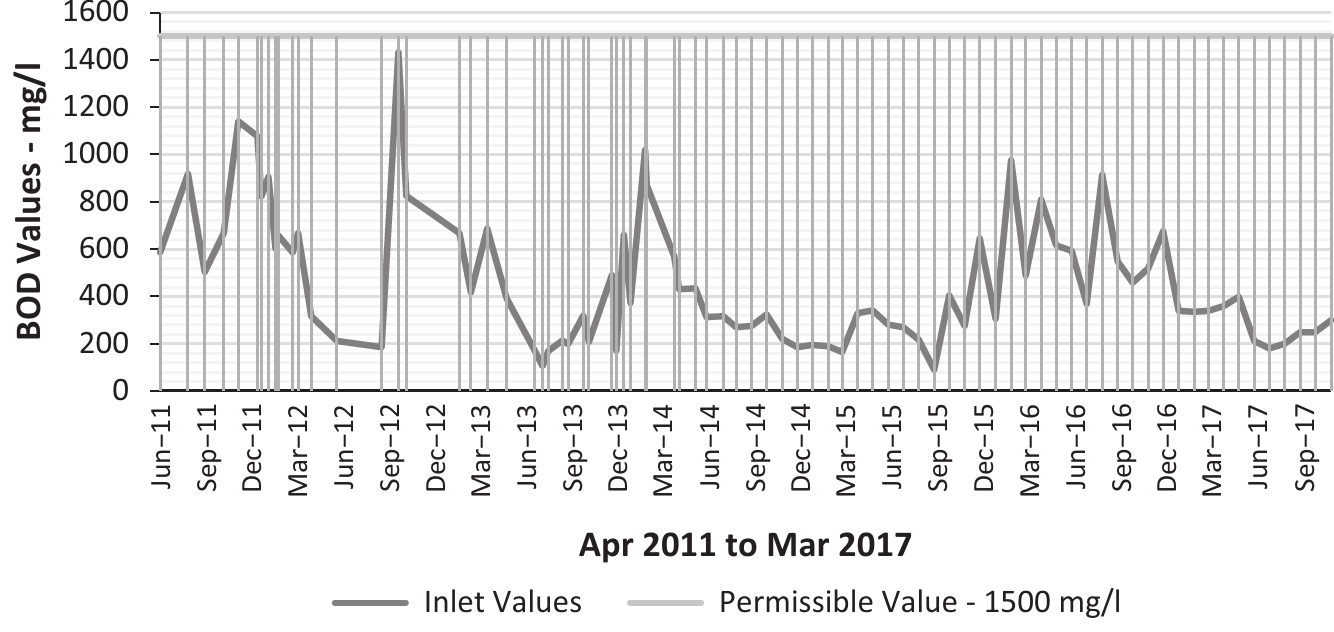
FIGURE 10.11
BOD at the inlet: CETP GECL. Source: Unpublished data from GPCB.
FIGURE 10.12 BOD at the outlet: CETP GECL. Source: Unpublished data from GPCB.
FIGURE 10.13 Percentage reduction in BOD: CETP GECL. Source: Unpublished data from GPCB.
The average BOD reduction is 88 per cent which is again the expected reduction as per the design.
COD at inlet and outlet of CETP CECL
The average inlet value for the CETP GECL is 1699 mg/l (Figure 10.14) for the period from April 2011 to December 2017, and that of treated effluents is 351 mg/l (Figure 10.15). The reduction in the COD for the study period is observed to be 75 per cent which is comparable to the BOD reduction. The results are no different than those for the BOD. Even for the COD, the performance of the
FIGURE 10.14 COD at the inlet: CETP GECL. Source: Unpublished data from GPCB.
FIGURE 10.15 COD at the outlet: CETP GEC. Source: Unpublished data from GPCB.
CETP is much better in 2017 and the average value in the treated effluent is 231 mg/l, well within the prescribed standards.
Given the BOD levels in the treated effluents and the exceedance factor, it can be stated that this CETP is performing much better than the other CETPs in Ahmedabad and Surat. Even though the CETP treats effluents from chemical industries, a negative reduction in the BOD has not been observed for this CETP—unlike the CETPs treating heterogeneous effluents in Ahmedabad.

