What Is a Model?
We have already formulated two definitions of the model. First, the model is a means of carrying out any activity of the subject. Second, the model is a form of the existence of knowledge. It is possible to somewhat complement each of these definitions by indicating that the model is also a system, with all the system-wide properties described in Chapter 2. A distinctive feature of models from other systems is (in addition to what the two definitions say) in their ability to display the simulated original and replace it in a certain respect, that is, contain and present required information about the original. Let us express this idea in the form of one more general definition: the model is a systemic representation of the original.
All three definitions are very general in a philosophical sense. Further, we will need to specify the types of models and their characteristic properties. As we already know, the description of the model can be refined using analysis and synthesis.
Analytical Approach to the Concept of a Model
The analytical approach is aimed at finding out what the system under consideration consists of. We will do the first decomposition, noting that there are two types of materials from which models are created: means of thinking and material means — objects and substances. Accordingly, the models are divided into abstract and real (Figure 3.5).
We will continue the analysis and carry out the decomposition of the branch “abstract” models. What and how are they built? The answer to this question would mean that we would explain how thought processes occur. But thinking is so

FIGURE 3.5 Two types of abstract models.
complex, so little known phenomenon that at the next step of decomposition we have mostly unexplained fragments (Figure 3.6): most of the manifestations of thinking, noted in our scheme (and not exhaustive of its manifestations), defy explanations that meet the scientific standards of completeness.
More specifically, we can talk about abstract models, which are the endproduct of thinking, prepared for transfer to other subjects. These are models embodied by means of language: they are amenable to registration (texts, audio recordings) and can be studied as objects alienated from direct thinking, but its products contain information about it.
The role of language in society is impossible to overestimate: it is not only a means of communication but also a carrier of culture, a means of organization and governance, and the main component of subject’s models of the world. Linguistics is one of the most complex natural sciences (which for some reason is attributed to the humanities).
We will pay attention to those features of the language that will be required to substantiate and use the technology of applied systems analysis.
The main feature for us is that language is a universal modeling tool: you can talk about anything. Of the many properties of language that provide this property to it, let us pay attention to the vagueness of the meaning of words.

Let us consider an example of a verbal model of a certain situation. “A tall handsome young man entered the room, carrying a heavy burden”. You easily can imagine the real situation. But “tall” — what is his height? “Young” — how old is he? Not to mention what “beautiful” is. “Heavy” — what weight? Virtually, no word of a colloquial language has an exact meaning.
An analogy can be made: the “meaning” of a particular situation is a point, the “meaning” of a word is a cloud. Describing a specific situation, we seem to cover the point with clouds, realizing that the truth is somewhere in the middle of this cluster.
In most cases, especially in everyday life, such an approximate, vague description is enough for successful activity. In some types of activity, such vagueness is consciously used as an important positive factor: poetry, humor, politics, diplomacy, fraud, etc.
However, in cases where it is necessary to produce a specific product and to achieve a specific result, this specificity begins to interfere with the vagueness of the everyday language. In such a scenario, those who are engaged in a specific activity get rid of interfering uncertainty by introducing more precise terms into the language. Every group, with its common goal, develops its own, specific language, providing the necessary precision for this activity. The Masai pastoral tribe in Africa has hundreds of terms to describe cows; among the northern peoples, many terms define the condition of the snow; physicists, doctors, lawyers, and criminals speak their special languages; young people talk in slang that is not understandable by adults; London “lower classes” talk on “Cockney”.
The general conclusion is that any group activity requires the development of a special, more accurate spoken language; let’s call it professional.
Professional languages are more accurate than colloquial because of the greater certainty of their terms. It is important to realize that uncertainty can be removed only at the expense of new, additional information.
Thus, the accuracy of the meaning of language models is increased due to the acquisition and inclusion in the language of more and more new information about the subject of interest.
Is there a limit to this refinement process? There is, and this is the language of mathematics where terms are as precise and unambiguous as possible. True, it is impossible to completely eliminate uncertainty; otherwise, it would be impossible to talk about the infinity of the world with finite phrases. There are several (and not only auxiliary, but also basic) concepts in mathematics that have a vague meaning: “approximately equal”, “significantly more (less)”, “infinitely small (large)”, “indefinite”, etc. Yet, the mathematical language is extreme and is the most accurate on the right end of the spectrum of languages (Figure 3.7).
Now we can appreciate the words of Kant, repeated and interpreted by many philosophers, that the more a field of knowledge can claim to be a science, the more it uses mathematical models.
The fact that some kind of science is insufficiently mathematized (history, biology, medicine, psychology, political science, etc.) means that its object is so complex and so little studied that it is still far from mathematical accuracy. But there is a prospect.
For completeness, we note another feature of languages. The culture of an individual (the world of his models) is formed from the interaction of his innate models
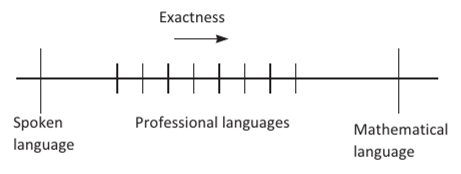
FIGURE 3.7 Spectrum of languages for specific types of activities.
and the culture of his social environment, including (and perhaps first of all) the languages that make up this culture. This is where the inherent property, the compatibility of internal and external cultures, is manifested. At times, they cannot be fully coordinated: genetics have proven that sometimes the inability to learn to speak and write correctly is inherent in the subject’s genes; a person who does not have an absolute hearing, despite all his efforts, cannot fully understand the language of music; people with predominant “right-hemispheric” thinking experience a kind of allergy to mathematics; people who matured into emigration experience a feeling of nostalgia; etc. However, there are so many languages that everyone finds an opportunity to shape their culture in a way that in some respects they can ensure their feasible successful interaction with the environment.
The following two points are also important:
- 1. there is a range of languages of varying degrees of certainty and, therefore, it corresponds to a range of models of varying degrees of accuracy;
- 2. one of the main features of the applied systems analysis is an attempt to develop the description of the problem situation, presented by the client, in the direction of more and more accurate description of the problem situation from its original “soft” description toward the “hard” one.
Often the mathematical description is not necessary: the problem can be solved without precisely defining the conditions. However, the tendency to include more and more information in the model until it is sufficient to solve the problem is important; the fact of movement toward clarification is important.
We now move on to the next act of decomposition, trying to get to the elementary abstract models. Obviously, words are among the elementary language models. What is the original for a word which is its model?
Classification is the Simplest Abstract Model of the Diversity of Reality
Perhaps the main purpose of language is to present finite description of the infinitely diverse world. There are no absolutely identical objects in the world. Even if, for example, electrons are identical in their electrical and mechanical properties (although there is reason to say that this is not quite so: the law of their distribution, derived from the assumption of their identity, is not exactly fulfilled in the experiment), they differ at least by coordinates. Moreover, modern physics prefers to model electrons not as particles but as waves.
How to describe an infinitely diverse world with finite phrases? There is only one way, to do it coarsely, approximately, and in a simplified manner.
The first simplification step is based on the fact that all objects are different, but some differ from each other “weakly”, “slightly”, or “insignificantly”, while others “strongly” or “substantially” (pay attention to the evaluating meaning of these terms). The idea now is to unite all the different but similar objects into one group, leaving others that are considerably different out of it.
The second simplification step is to refuse to take into account the differences within the group, neglect the small differences, and consider the members of the group as the same. This group is called the class.
The objects that remain outside the class are also diverse, and although they are “very” different from those that are included in the class, according to other features, they turn out to be “similar” or “different”. This makes it possible to identify new classes that are similar inside them and different from other classes.
Consequently, an infinitely diverse world is described by a finite set of classes differing from each other.
To express differences between classes, they are assigned different names (nouns, symbols, signs, numbers, etc.). These names are the words of a certain language. Trees (all trees), animals (all animals), people, buildings, insects, rivers, etc. are examples of class names. Not only objects can be classified but also properties (colors, sounds, forces, dimensions, etc.) and processes (to walk, run, pull, eat, drink, etc.). Thus, the words of the language are the names of some classes.
Classification is the simplest abstract model of the diversity of reality.
Recognition and identification of an object in this case involve finding out which class it belongs to (and what name it should bear).
When building models, the subject has room for informal, creative actions.
First, it is necessary to choose a characteristic, a parameter, and a measure of the difference between objects. The multiplicity of characteristics is one of the reasons for the multiplicity of classifications. A special (and nontrivial) question is the classification not by one but by several characteristics.
Second, the number of classes to be distinguished and the definition of the boundaries between them depend on the specification of the evaluative concepts of “weak” and “strong” differences.
It is important to remember that any classification is only a model of the diversity of reality, that reality is more complex, and that there is always an object that cannot be unambiguously attributed to a particular class.

