Fractals
The modern concept of fractals, a very specific feature of the structure of natural systems, gradually formed as a result of the efforts of many natural scientists and philosophers to understand the principles of self-organization (origin, growth, and development) of natural systems.
The fact that fractals are inherent in nature was discovered and understood gradually, in parts, from different viewpoints on reality. One aspect of fractals — the selfsimilarity of natural structures, or wide-scale invariance — was noticed in ancient times by Eastern thinkers. Buddhist monks from ancient times learned the world, thinking alone about themselves (“contemplating his own navel”). British missionaries in colonial times discovered in the culture of the African Zulu tribe the concept of umuntu — a person who is aware of his continuity with the community, experiencing suffering if others suffer. The Zulus have a reserved wisdom: umuntu ngumuntu ngabantu (“everyone is part of everyone”). Many of the thinkers of all time have come to realize this property of natural systems. Three hundred years ago, Leibniz wrote: “Any part of matter can be represented as a garden full of plants, or a pond full of fish. But every branch of the plant, every member of the animal, every drop of its juices is again the same garden or the same pond.” And the outstanding psychologist of the last century Carl Jung saw the similarity between the structures of the universe and the human psyche: “Our psyche is arranged like the universe; what happens in the macrocosm, occurs in the smallest, most subjective corners of the psyche.”
Both in science and art there were displays of the phenomenon of cascade (hierarchical) structure of reality. Paintings by Leonardo da Vinci “Avalanche” (Figure 8.21) and by Katsushik Hokusai “Big wave” (Figure 8.20) illustrate the phenomenon of self-similarity: all the smaller parts of the whole are organized at all levels in the same way. Folk art also reflects this: remember the nested design of toy “Russian dolls”; songs like “I, you, he, she, together — the whole country”; the British in the
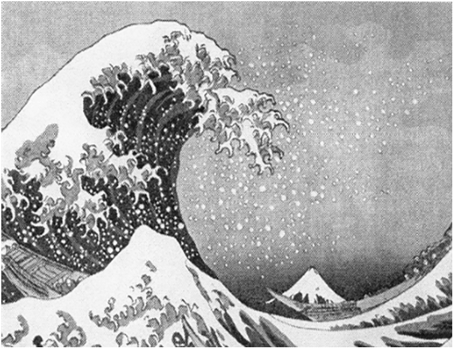
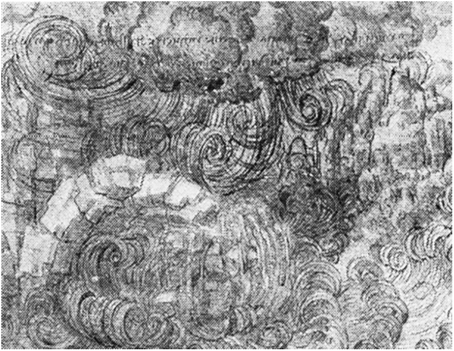
FIGURE 8.21 Another artistic illustration of reality structure.
course of the saying such as “I am who I am because of everyone”, the Australians — “I am, you are, we are Australia”.
This aspect of the self-similarity of the structure of natural systems can be called a hierarchical system (bearing in mind that the system is sometimes non-hierarchical). Features of hierarchy (see Section 8.4) generate stability, efficiency, and mutability (discreteness of development branches) observed in natural systems, which largely explains the mechanisms of self-organization and evolution in nature, and at the same time the reasons for the frequent preference for hierarchical organization of management in technical and social systems.
But the real breakthrough in understanding this feature of systems, which ended with the formation (and naming!) the concept offractality occurred in the development of a mathematical model of geometric configurations. To this day, the outlines of many flat and three-dimensional shapes are usually described using continuous smooth lines and surfaces in terms of Euclid geometry. Drawings of all artificially created by us technical objects (tools, devices, buildings, structures) look this way. But these objects are artificial systems. Natural systems, however, have a different geometry. As Benoit Mandelbrot writes in his pioneering book The Fractal Geometry of Nature (Freeman, San-Francisco, 1977) [11,12]:
“Clouds are not spheres, mountains are not cones, the outlines of the shore are not circles, and the bark is not smooth, and lightning does not spread in a straight line. Nature shows us not just a high degree, but a completely different level of complexity. The number of different scales of lengths in structures is always infinite. The existence of these structures challenges us in the form of the difficult task of studying those forms that Euclid discarded as formless — the task of studying the morphology of the amorphous.”
Long before Mandelbrot, in several sections of mathematics (in geometry, set theory, logic) abstract objects were already built, so strikingly different from the usual regular objects that they were called “monsters”, “paradoxes”. Examples of geometric objects of this type are the Peano curve (Figure 8.22):

FIGURE 8.22 Four generations of the Peano curve.
and Serpinsky’s triangles (Figure 8.23); in the set theory, such an object is the Cantor dust (Figure 8.24); in logic — the paradox of Zeno (“Achilles and the turtle”) and the paradox of the liar (“I lie”).
Some of the salient features of such objects can be clearly seen in the construction process of the Koch curve introduced by the Swedish mathematician Helge von Koch in 1904. We begin with a straight segment of unit length (n = 0). Divide it into three equal (1/3) parts, discard the middle part and replace it with a polyline of two links in length 1/3 so that the middle part is the base of an equilateral triangle. The result was a broken line of four parts with a total length of 4/3 (“first generation”, n = 1).

FIGURE 8.23 Four generations of Serpinsky’s triangles.

The next generation will succeed if this operation is repeated with each segment of the previous generation. For example, the length of the Koch curve of the second generation is already 16/9, the third—64/27, etc. (Figure 8.25).
With an infinite product of generations will process the Koch curve. It has such properties that derive it from the number of objects of classical geometry: (1) this curve has no length: the length of the curve of each next generation is greater than the length of the previous one, and with the growth of the number of generations tends to infinity; (2) to this limit continuous curve it is impossible to build a tangent: each point is an inflection point. But the length and smoothness are the fundamental properties of objects to be studied in the geometries of Euclid, Lobachevsky, and Riemann.
Benoit Mandelbrot, driven by the desire to simulate the real properties of natural configurations, saw the opportunity to do so with the help of “monsters” that caused such a stir in mathematical circles (Bourbaki even called them “pathological phenomenon in mathematics”). He created a new geometry, calling it fractal geometry. Fractals, objects of new geometry, allowed to build formal models of “formless” natural chaos. Mandelbrot so justified the introduction of a new term: “I created the term fractal from the Latin adjecti efractus. The corresponding Latin verb frangere means to break, interrupt, i.e. to create irregular fragments. It therefore has (suitable for us!) a meaning additional to the term ‘fragmented’: fractus is also ‘irregular’. (...) The combination of a fractal set’ will be defined strictly, but a combination of ‘natural fractal’ will be given freely — for the definition of natural examples that are useful to represent using fractal sets”.
The last phrase speaks of a clear understanding that the mathematical fractal is an abstract model of real natural chaos, more useful than the model of regular geometry: fractals are fundamentally different from the traditional geometric forms such as point, line, and smooth surface.
The construction of fractal geometry led to a tremendous breakthrough in the knowledge of nature finally completing the transition to the paradigm of

discreteness of all things. It was found a striking similarity of mathematical geometric fractals with natural (continuous!) geometric configurations (e.g., the trajectory of lightning, the curves of the river, the outlines of clouds, mountain ranges, coastlines of islands and continents), which sometimes seem unpredictable chaotic, random, and sometimes very complex, but amazingly harmonious (the shape of snowflakes, the sound of music, the external forms of every living creature, a variety of plant and animal species, the shape of space objects, such as planetary systems and galaxies).
This fact led to the understanding that all natural phenomena in their original essence have a discrete nature. Particular aspects of this universal feature of nature were discovered earlier: by explaining the nature of matter, physicists have built a quantum model of the microcosm; chemists have detected a discontinuity in the world of chemical elements (periodic table); biologists — “mutafacient” forms of life (discreteness of species and the impossibility of their crossing); sociologists have found that the society consists not only of individual subjects, but also of individual cells (family, ethnic group, nation, group, organization, community).
However, it has now become clear that not only spatial but also any qualitative continuous (in some respect) natural phenomena are inherently discrete. For example, the continuous trajectories of dynamical systems are implemented in the form of a discrete set of attractors; continuous growth of the system occurring through accumulation of resource from the environment is implemented in the form of separation of discrete parts of the system (branches of plants, the deposits in mineral deposits, settlements in the inhabited territory, the private capital in the market economy, etc.).
This internal, initial discreteness of even continuous manifestations of nature is represented in their mathematical modeling by a hierarchical and self-similar structure of fractals: generations of continuous fractal sets are constructed discretely, iteratively, by the same relations for all generations. A good example is the set of Julia and Mandelbrot points (x, y) on the plane. Both sets are built recursively by the transition from the k-th point to the (k+ l)-th point using the functions F and G:
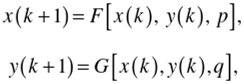
where p and q are some parameters of the constructed set. The functions F and G may be different but necessarily nonlinear.
If on the plane consisting of all pairs (x, y), we consider the limit position of the initial point z. at к tending to infinity at fixed p and q, then we obtain sets of Julia. In particular, if on the complex plane, at z = x+iy, recurrent iterations z, and the nonlinear function F(z„ c) = z.xz+c,—then appear attractors (!). When c = 0 there are three attractors: (1) Izl < 1, the attractor is the point (0,0); (2) Izl = 1, the attractor is a circle of radius 1; and (3) Izl > 1, the attractor is infinity. The fourth attractor, other than zero, occurs when c*0.
If we trace the trajectory of the point when the parameters p and q change, then various images of an extremely complex multicomponent configuration, called Mandelbrot sets, appear on the plane. For example, in Figure 8.26, the configurations
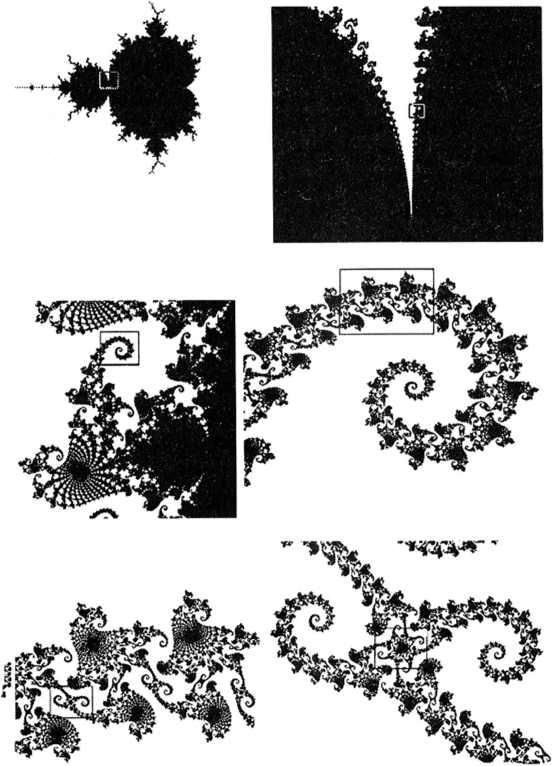
FIGURE 8.26 The Mandelbrot set in different scales.
of the more and more small sizes of the same set are given. Each next image (from a to e) is a rectangle circled and enlarged fragment of the previous one.
Fundamental difference between fractal geometry and classical geometry also manifested itself in attempts to describe fractals in terms of Euclidean geometry. It was impossible to obtain fractal configurations by analytical technique of integral and differential calculus based on continuity and smoothness; fractal images can be constructed only algorithmically, using discrete iterative procedures on a computer. The description of some properties of a geometric object through the concept of its dimension also encountered the inapplicability of this classical concept to fractal objects.
The dimension of a geometric object is the number of coordinates that can be used to determine the position of each point of the object. Dimension of a straight line — one; dimension of a smooth flat figure — two; volume — three. To describe the position of the points of fractal (irregular, tortuous, rugged) objects is not enough coordinates of the smooth set in which they are placed. A fractal point is no longer a point, but not yet a line; a fractal line or figure on a plane is no longer flat, but not yet volumetric (Figure 8.26). To describe this property of fractals, the definition of dimension (Bezikovich-Hausdorff) coinciding with the integer dimension of smooth sets and characterizing the degree of difference between a fractal set and a smooth one is proposed. This concept of dimension is based on the idea of covering the considered set with elements h(8) = Sd.
Suppose we have a set of points in certain Euclidean space. Let’s cover this set densely in turn with straight line segments (d = 1), squares (d = 2), cubes (d= 3). The measure of Md of a set is defined as Md = 'LS‘I. The measure is a general concept for length (d = 1), area (d = 2), volume (d = 3), and is computable also for noninteger d. At <5 -> 0, the measure Mtl is zero, or infinite if the dimension of the measured set and the c/-dimcnsion of the measure do not coincide. For example, when covering a flat figure with straight lines Md is infinite, when covering it with cubes, the measure tends to zero (the volume of the plane is zero), and when d = 2, the measure of the flat figure tends to the final value (the area of the figure).
If you cover the Koch curve with segments (d = 1), its measure (length) tends to infinity; when covered with squares (d = 2), its measure (area) tends to zero. There is a value of 1 < d< 2 at which the measure changes its value from zero to infinity; it is an estimate (1,2628...) of the dimension of this fractal: this is what is meant when it is said that “the Koch curve is no longer a line on the plane, but not yet a volume figure”. It is not easy to determine the fractional dimension value of a particular fractal. Estimates of the length of the coastline give different dimensions for the coasts of Australia, Germany, the west coast of Britain, Portugal [last].
This speaks not about the “strangeness and complexity” of nature but about the limitations of our knowledge about it and the imperfection of our models of reality. Projecting ideas of fractality not only onto description of the geometric qualities of reality revealed that the fractal character is inherent in many other (and may be in all?) aspects of the organization of nature: the attractors in the dynamics of systems archetypes in the static structures of systems, uniformity in the probability measure of distribution of sample values of the observed quantities, diversion of living species, self-similarity of branching plants, historical analogies, etc.
Mandelbrot realized his intention to reveal fractality not only of quantitative manifestations of nature but also of phenomena evaluated qualitatively, in weak measuring scales, by introducing a strictly mathematical concept of “fractal set” and a qualitative concept of “natural fractal”. The corresponding distinction of dynamic processes is made in the form of constructing a qualitative analog of the numerical concept of “phase space”: the coordinates fixed in weak scales form a “phase space”.
The study of natural phenomena revealed the universality of the properties of fractals, but at the same time showed that the mathematical fractal is an abstract, approximate model of the organization of nature: real systems are not fractal, but only fractal-like. First of all, this is manifested in the fact that the number of levels in real hierarchical systems is not infinite, as in mathematical fractals, but is limited: the hierarchy of self-similarity begins to develop from the lower level of qualitatively specific systems and ends with the appearance of lower-level systems of the next qualitatively new, higher level of development. For example, the hierarchy of the physical microcosm ends with the appearance of chemical molecules, the biological hierarchy begins with the appearance of a living cell, the hierarchy of social systems begins with the elemental communities of individuals (family, pack, primitive community). In addition, the likeness of future generations in reality is not their identity.
Awareness of the phenomenon of fractality was a major breakthrough in the knowledge of how nature is “arranged”.

