Elements of Systems Statics
When systematically considering a particular problem situation, one has to appropriately combine information regarding these properties with data on its other qualities. When using this information for practical purposes, it is important to keep in mind that all properties of the system are not independent, and are interrelated. Working with the system, you must constantly keep in mind that it is integral, and that all its properties are not manifested separately, but jointly and simultaneously: all the properties of the system themselves also form a system. Let us discuss the static properties of systems taking into account this aspect.
Integrity (Combined with Openness, Functionality, Expediency, and Emergence)
The idea of the integrity of the system reflects the fact that the real world is heterogeneous, and that one heterogeneity can be distinguished from another as a separate whole — by some features, characteristics, and properties that are inherent in this heterogeneity but not in others. We perceive something as a whole, if it is the owner, the carrier of some specific property.
The property that distinguishes one object from others is thought of by us as an attribute of an object that belongs to it. The ball is round, the weight is heavy, the grass is green, the girl is beautiful, etc. However, on closer examination, the concept of property turns out to be the product of an amazing feature of language modeling — the ability to simply, effectively, and economically describe a complex situation, replacing the multi-place relation with a single-placed one.
Any property of an object becomes known to us only by observing its interaction with other objects; it is a description of the peculiarities of its ties and relations with them. For example, when we say that “glass is transparent”, it means that “if a light source is placed on one side of the glass and a device sensitive to light on the other, the device will register the passage of light energy through the glass”, and you can even measure (using a special technology!) the degree of “transparency” of the glass. Consider another example, we say that “this object is green”. This phrase briefly expresses the fact that “when this object is illuminated with white light, the light analyzer, sensitive to colors, will find that this object reflects only the green component of the entire spectrum of white light frequencies”.
Such an understanding of “property” refers to all properties of all objects: any property of an object manifests itself only in its interaction with other objects. The explanation of what a described object is, is reduced to listing its properties of interest to us, that is, some of its connections with other objects. Which of the properties you need to describe depends on the purpose of the consideration of the object. The presence of system interactions with the environment is expressed by the concept of openness of the system. At the same time, Kant drew attention to the fact that the external properties of an object, which become known to us by observing and understanding its interactions with its environment (cognition “things for us”), are a manifestation of some internal features of the object that are inherent in it, regardless of the state of the environment and the presence of an observer. Kant calls such features “a thing in itself”.
Transparency of glass is manifested (glass becomes “a thing for us”) not only when it is illuminated with light, but also in darkness, a glass (as “a thing in itself”) has the property that makes it transparent when illuminated. This “something” is knowable only in some part of it, in the course of a certain specific experiment, and in the absolute sense remains unknowable. For example, we do not know what people are capable of and to what extent until we test them in action. The modern development of pedagogy sets the main goal of education (upbringing and training) of a person to detect innate (internal, potential, purely individual) abilities and talents of a person, as well as to create conditions for their full disclosure in the external environment. The revealing of a previously unknown property of an object is called discovery.
On the other hand, the integrity of the system can also be viewed as the internal appearance of emergence. Violation of integrity (e.g., the removal of any, even the smallest, part of it) changes the entire system (see Section 2.3, Part I). Ecologist A. Leopold [1] puts it figuratively: “If the soil mechanisms work well as a single whole, then every part is good, and it doesn’t matter how detailed we are in understanding them. For millions of years, biota managed to build something that we really like, but in which we understand almost nothing, so getting rid of parts that we think are useless to us — is a monstrous stupidity”. Although he referred to soil, this is true for any natural system (e.g., at one time there was a practice in the United States to cut an appendix from all newborns to prevent appendicitis in the future; of course, the practice had to be stopped, although the role of the appendix in the body remained unclear). With artificial systems, the situation is the same: by altering them, we assume the role that natural selection plays in nature.
Openness (Combined with Feasibility and Functionality)
The openness of the system is displayed by its “black box” model. The main difficulty in modeling reality stems from the fact that everything in the world is interconnected and interdependent, and each time it is necessary to include in its black box model, from the entire infinite interweaving of connections of our system with the rest of the world, only a very limited finite number of connections, information about which is necessary and sufficient (essential) to solve our particular problem. Therefore, of the various connections, we include only “strong”, “important” inputs and outputs in the model. At the same time, because of the subjectivity and the relativity of the concept of essentiality (in relation to the achievement of a goal), difficulties arise in the form of the possibility of making four types of errors (discussed in Section 2.1, Part I).
Analytical description of the system’s relations with the environment begins with consideration of significant pairwise interactions between the system and each of the elements of the environment. At the same time, it is necessary to take into account that relationships that differ among themselves qualitatively in nature and quantitatively in the strength of one entity’s influence on another, and, naturally, we strive to take into account first of all the most “essential” (for our purposes) in our understanding.
The strongest of them, cause-and-effect, are called the laws of nature. The causal connection between events is so strong that it is necessary and sufficient: if the first has happened, the second will necessarily occur, and vice versa, that is, if the second has happened, then the first has necessarily preceded it.
The presence of third parties is not required in the interaction for a causal relationship (Figure 7.1). However, this implies that such a “law of nature” is a certain abstraction from reality with its universal interconnectedness. This approximation manifests itself both in practice and in theory. For example, independence of the acceleration of free fall from the mass of the body follows from the law of gravity; but stone and fluff fall differently because of their interactions w'ith another entity, air. In theory, it manifests itself in the form of paradoxes. For example, according to Coulomb’s law, the force of interaction of two charges tends to infinity as they approach each other; according to Newton’s law, the strength of mutual gravitation of the two masses increases indefinitely with decreasing distance between them (in both laws, the force of interaction is inversely proportional to the square of the distance).
Thus, the causal relationship between the two entities is an approximate description of reality when other interactions are neglected. For example, when designing a crane, only the weights of its parts and cargo (i.e., the forces of their interactions with the earth) are taken into account, neglecting the (very small, but existing) forces of their mutual attraction to each other.
However, in many situations, the difference in significance of different influences on the system is not so great that it is permissible to neglect some of them; when describing the interaction between only two entities, the interference of the others in this interaction should be taken into account. This intervention may have a different character, which leads to three more types of presentation of the final interaction as a pair, weaker than cause-and-effect. 1
The connection of two entities may be necessary, but not sufficient. An example is the connection between an acorn and an oak: for an oak to appear, an acorn is necessary, though not enough — soil, moisture, heat, light, air, and much more are needed, without which the oak will not grow.
A term for this type of connection between the two entities has not yet
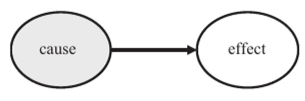
FIGURE 7.1 Causal relationship abstracts from universal interconnectedness.
been established. In the group of causal conditions, the principal cause (the essence of the acorn) is called the “main cause’’ or “system-forming factor”, the remaining (also necessary) conditions are called “accompanying causes” or “limiting factors”. R. Ackoff proposed to call the central pair of entities so connected (the main cause-and-effect) as “producer-product” (see Figure 7.2).
Producer is a “system-forming” factor, and without it, the remaining (“limiting”) factors are useless; however, without the limiting factors, the producer cannot affect the product. Consideration of system dynamics, that is, its history after the origin, led to the expansion of the concept of this type of communication. In addition to the root cause, without which the consequence cannot occur in principle, many other factors are necessary for the functioning of the system. Importantly, their presence is required in strictly defined proportions between themselves and in strictly defined limits for each one. For the growth of oak, soil is necessary, but not of any composition; it needs moisture, but in a certain proportion; it needs heat, but in a limited range of temperatures; etc. If any factor goes beyond the permissible limits, it will cause the failure of the entire system (like a drought or a flood ruining the harvest). Hence, it becomes a factor limiting the effect. Often, the actual management of the system is reduced to returning to the normal limits of limiting factors that succeed each other (due to changes in time and the environment, and the system itself) throughout the life of the system.
Thus, this type of relationship is characterized as the relationship of the effect to the causal combination of system-forming (fundamental) and limiting factors.
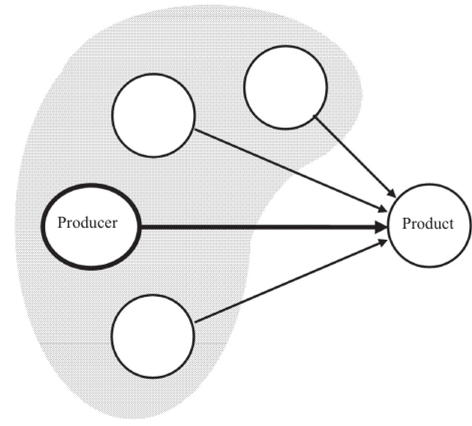
FIGURE 7.2 Among the factors defining the result, there are the main one and the accompanying others.
- 2. The connection of two entities may be sufficient, but not necessary. This is the case when the same effect can arise from any of the various causes (like being wounded in a battle from different attacking objects; or intoxication from different drinks; or getting the required amount from a number of investors). Such a connection is sometimes called directed or potentially possible (see Figure 7.3). Each of the several factors leads to the same result.
- 3. The connection of two entities can be significant, but not necessary and not sufficient. Unlike the first three, direct interactions between two entities, they can be linked indirectly through chains of other interconnected entities. There may be several such chains, and the effects on one chain may be positive, while on others it may be negative (see Figure 7.4). The final result for different objects in the same circumstances may be different, and when it is considered as a whole, the set of objects is interpreted as probable, possible, random.
An example of the indirect link between two entities is the relationship between smoking and a smoker’s heart condition. Smoking affects the heart through effects on several various parts of the body: it tightens the arteries (which is bad for the heart), stabilizes body weight (which is good), reduces anxiety (which is good), damages the lungs (which is bad for the heart), etc.
Such an indirect connection may have different strengths, and in some cases becomes significant. At the same time, by virtue of final ambiguity and randomness, indirect connections allow one to predict events, but they do not have explanatory power. According to Ackoff and Emery [2], “Even a very strong link between alcoholism and socio-economic conditions does not explain the causes of the disease and does not help prevent or cure it. Statistics of road accidents and the state of intoxication of drivers does not help to eliminate accidents on the roads”. Relations of this type are called indirect “stochastic”, “probabilistic”, “statistical”, or “associative”.
Distinguishing between different types of relationships is important primarily because different relationships require a different approach to modeling and/or
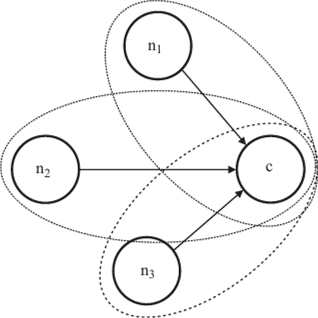
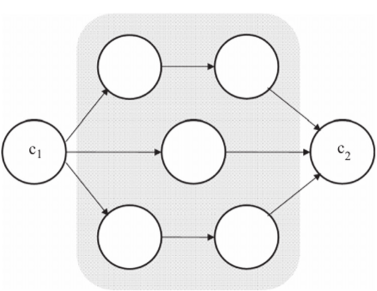
FIGURE 7.4 Indirect connections between two entities.
controlling the object. This becomes especially clear when one connection is mistaken for another, for example, “after — means due to”, or an error of the fourth kind when building the black box model, or when a strong stochastic connection is taken as cause-and-effect (“in a healthy body — a healthy spirit”, “smoking causes lung cancer”, etc.).

