SN02-BASED NANOSTRUCTURES AND APPLICATIONS
Tin oxide is a wide bandgap semiconductor, with a direct gap of 3.6 eV at 300 K, usually presenting a rutile crystalline structure and high chemical stability. This material exhibits high electrical и-type conductivity due to the presence of native oxygen vacancies, as well as good
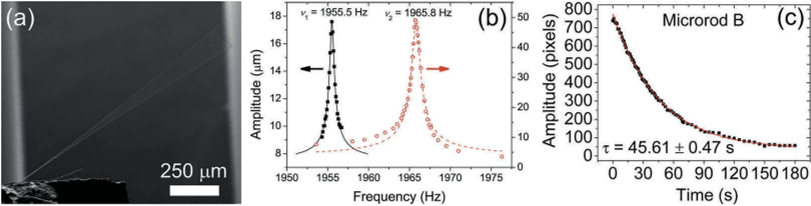
FIGURE 5.8 (a) Scanning electron micrographs of an oscillating 1п203 rod. (b) Oscillation amplitude curve showing amplitude peaks at the two resonance frequencies, (c) Oscillation decay curve with the estimated decay lifetime, corresponding to a quality factor of 4 x 10⁵.
Reprinted from Bartolomc et al. (2014) ((a) and (b)), and from Bartolomc et al. (2015) (c) with permission from Л1Р Publishing.
transparency in the visible range. The combination of these properties includes tin oxide in the TCOs family, and together with its low cost and thermal stability, enables the functionalization of Sn02 in different devices. In the last decades, Sn02 has been extensively used in optoelectronic applications (Drevillon, Kumar, & Cabarrocas, 1989; Lee et al., 2004; Li, Zhou, Yu, Liu, & Zou, 2012), solar cells, LEDs, flat screens, Li-ion batteries (LIBs), catalysis, gas sensors, and smart windows, among others. Most of these applications require a control of the morphology and miniaturization of the materials, yielding in the micro- and nanoscale, where the surface to volume ratio increases considerably. Changes in size and morphology, as well as appropriate doping, can produce significant improvements in the optoelectronic properties of Sn02 associated with the mobility of carriers, a large aspect ratio and effects of quantum confinement (Huang et al., 2009; Kar, & Patra, 2009; Kumar, Govind, & Nagarajan 2011; Zhao et al., 2008). In addition to Sn02 nanoparticles (Aragon et al., 2016; Caetano, Meneau, Santilli, Pulcinelli, Magnani. & Briois, 2014; Del Prado et al., 2018; Suematsu et al., 2014), nanobelts (Wang, 2003), nanowires (Choi, Hwang, Park, & Lee, 2008; Wang, Lee, & Zeng, 2005), nanodiscs (Wang et al., 2005), or in the microscale morphologies as microrods (Choi, Akash, Sun, Wu, & Kim, 2013), microtubes (Del Prado et al., 2017; Garcia-Tecedor et al., 2016; Garcia-Tecedor, et al., 2016; Maestre et al., 2005), or some more complex morphologies (Zhang et al., 2014) have been reported for Sn02. Moreover, Sn02 has also been used as a part of ternary compounds (e.g., ITO; FTO) and recently as a part of composite materials in combination with conductive polymers and carbonaceous materials.
Hence, different approaches have been followed during the past years to spread and improve the applicability of Sn02 based on different micro- and nanostructures. In this section, some of the most relevant applications in the field of energy storage, solar cells, sensing, and optoelectronic devices are described.
Application of Sn02 in Batteries
Currently, LIBs are considered as one of the most efficient resources for energy storage in portable devices (Goriparti et al., 2014; Marorn, Amalraj, Leifer, Jacob, & Aurbach, 2011; Girishkumar, McCloskey, Luntz, Swanson. & Wilcke, 2010; Scrosati, & Garche, 2010; Kim et al. 2012; Goodenough. & Park, 2013; Etacheri, Marom, Elazari, Salitra. & Aurbach, 2011). However, in the last few' years an increase in energy density has been required to achieve other applications that demand greater energy, such as electric vehicles (Etacheri et al., 2011;
Gallagher et al., 2014). There are still certain challenges for this technology to be the predominant one in high-performance devices, such as portable electronics or automatic electrical applications in the industry (Lavoie, Danet, & Lombard. 2017). An improvement in the performance of the batteries can be obtained by various factors, such as, for example, using materials with higher capacity than the commercial carbon-based electrodes, and optimizing the mechanical stability of anodes or cathodes (Goriparti et al., 2014; Nitta, & Yushin, 2014; Song, Kim, Kang, & Kim, 2017). Therefore, one of the main strategies that are being developed is the implementation of materials within the nanometric scale in the constituent electrodes of the LIBs, in order to avoid the disintegration of the electrode materials after a certain number of charging and discharging cycles, while improving the diffusion of Li through the battery. The use of nanomaterials has been proposed to solve the mechanical stresses due to the volumetric expansion and contraction that the electrodes suffer during the delithiation/lithiation processes, providing simultaneous advantages as the high relation surface to volume together with the presence of sites asset for the storage of Li, which facilitates reversibility in the insertion of Li+ ions as well as the ionic diffusion of Li and electrons.
Sn02 nanomaterials have been recently considered in LIB applications based on the high-moderate theoretical capacity (~782 mAh g_1) and the low intercalation potential of Li-ions that Sn02 exhibits. Nevertheless, its cyclability and final performance are substantially reduced, mainly to the volumetric expansion that the lattice suffers during the lithia- tion and de-lithiation processes. An alternative solution to this issue has been proposed employing low-dimensional Sn02 as a part of a compound material that buffers these distortions, enhancing in this way the lifetime of the LIBs (Idota, Kubota, Matsufuji, Maekawa. & Miyasaka. 1997; Chen, & Lou, 2012; Nitta, & Yushin. 2014; Goriparti et al., 2014). Nanocomposites containing allotropic phases of carbon such as fullerenes and carbon nanotubes are reported to improve lithium storage properties compared to bare Sn02 materials (Chen, & Xiong, 2013). Although graphene and GO composites had been getting into the spotlight due to their good properties for energy storage (Del Prado et al., 2019), it still remains an ongoing issue to implement them as part of commercial LIBs (Deng, Fang, & Chen, 2016). Several approaches are being evaluated in order to improve the capacity and cyclability of the Sn02- graphene-based anodes in LIBs. As an example, Zhang et al. (2019) recently reported how the addition of ferrocene can improve the Li storage capability and enhance the reversible capacity of the Sn02-based anodes, by suppressing Sn/Sn02 agglomeration and hence retaining the nanoscale Sn/Li20 interface. In their work a reversible capacity of up to 1084.5 mAh g_l after 150 cycles was reported, as shown in Figure 5.9.

FIGURE 5.9 Scheme of the ferrocene SnCWgraphene composite and cyclic performance as anode in a LIB. Reprinted with permission from Zhang et al. (2019). Copyright (2019) American Chemical Society.
The fact that GO, presenting a large amount of functional groups, owns a large surface to volume ratio makes it a promising material that can act as an absorbent, with improved performance in combination with nanoparticles due to the surface tension and electrostatically attraction that appears between both kind of materials (Huang, Boey, & Zhang, 2010). These features have motivated the investigation of GO-nanoparticles compounds and their implementation in different applications, specifically combining them with Sn02 or Ti02 nanoparticles focused on more effective energy storage (Chen, & Qin, 2014; Li, Lv, Lu, & Li, 2010; Lian et ah, 2011).

