INTER PLANETARY FILE SYSTEM
The internet-planetary file system (IPFS) is a distributed file system. This protocol uses a peer-to-peer network communication for storing and sharing information in a distributed file system [10]. The IPFS suggests their clients to get as well as to host content. As hostile a centrally arranged server, it is built around a decentralized network of client operators. Any client in the system can serve a document by its content address, and different peer in the network can discover and demand that content from any hub that makes them utilize a distributed hash table. To serve information on the Web, this protocol is used. At the present scene of the world, the Web works off location-based addressing where we go to a URL like something.com which has an IP address of A.B.C.D, and then we get served our articles. These URLs are indicated to specific servers around the globe. Instead, what IPFS does is it helps data dependent on what it is as opposed to where it is (location). With their routing algorithms, we can pick where we get our content from, and we can set our privacy and security of what peers/hubs we trust to get our records which is fascinating [11].
- • By using hash addressing, the content will be immutable. Doesn’t vanish like presently HTTP convention.
- • It collects the contents from multiple hubs, instead of from one server, to save bandwidth.
- • Access to the offline content or in low availability third-world or rural
areas.
- • Censorship safe.
- • Needs to the decentralization anthropology (Figure 6.1).

FIGURE 6.1 IPFS workflow.
To further use innovation, FileCoin was proposed as a method for making a decentralized storage system by utilizing the unused storage lying around and boosting clients to be a part of the sharing economy through FileCoins (FIL) by utilizing the IPFS convention. Like other decentralized storage solutions, FileCoin opens up a different economy and perspective around incentives and interest through networking. Individual are rewarded for serving and facilitating content on their space hard drives in remuneration for FIL. It likewise can work with other block- chain networks as a decentralized off-chain storage solution which would be fascinating to see.
SIA-SIACOIN
Siais adecentralized cloud storage platform that uses a blockchain to facilitate payments. On Sia, you can rent storage, get paid to host files, mine Siacoin, or contribute to the project. Existing cloud storage providers are centralized. Siacoin was developed in September 2013 by DavidVorick and Luke Champine when they were pursuing their undergraduate degree as a computer science student at Rensselaer Polytechnic Institute in Troy, New York. Siacoin is a decentralized file storage system [12]. By these people rent out their unused disk drive space to earn some Siacoin. It uses blockchain technology for file storage. It is using a special kind of blockchain smart contract that provides a way for hosts to get paid for proving that they have stored a file and made it available for end-users over a while. All other payment technologies more optimize the Siacoin network for file storage.
Siacoin Design Features
Siacoin is written in Go programming language, which is developed by Google. It runs almost in every 64-bit systems. It has a graphical user interface for all end- users, and it also has a command-line version for use in headless environments. Both the interfaces use the same code and the same features and capabilities. It breaks all the files in small blocks.
It is the cryptocurrency, which is used to sell or buy file storage on Siacoin platform. It uses proof-of-work (PoW) algorithm. This Siacoin is created with the proof-of-work mining to stop attacks and to secure the network. It plans to utilize proof-of-burn algorithm for providing more security [13].
Features of Sia
- • Decentralized: While Nebulous Labs build up the product, the system is decentralized, implying that no focal authority administers exchanges, record contracts the board or coin issuance.
- • Security using Encryption: Files put away in Sia are scrambled utilizing the two cryptographic calculations, and just the tenant claims the unscrambling keys.
- • Un-usefulness: Files are put away over numerous hosts utilizing Reed- Solomon excess calculation, guaranteeing that regardless of whether various hosts go disconnected, the leaseholder will, in any case, approach his records.
- • Accessible: Being an aggressive commercial center, typical stockpiling costs are much lower than regular distributed storage suppliers, notwithstanding thinking about the redundancy [3].
Future and Improvements
Siafunds are an incredible model, which is worked in Siacoin stage. Ten thou- sandSiafunds exist; 1,175 Siafunds were sold in May 2014 for an expected $500,000 to help subsidize the improvement of the Siacoin stage. The staying 8,835 Siafunds are claimed by Nebulous, the parent organization of Sia. Thus, 3.9% of all effective stockpiling contract payouts go to the holders of the Siafunds [4] (Figure 6.2).
From the graph shown in Figure 6.2, it is seen that right now, SC has a market estimation of $0.002406 or 0.00000062 BTC (UTC 08:30). It is present market top is as of now getting exchanged at 95,335,714 USD with 24h vol. Worth of $711,249. Rather than its current value, the cost of SC, about one month back, from a similar outline, was seen as at 0.002371 USD. In this way, during this one
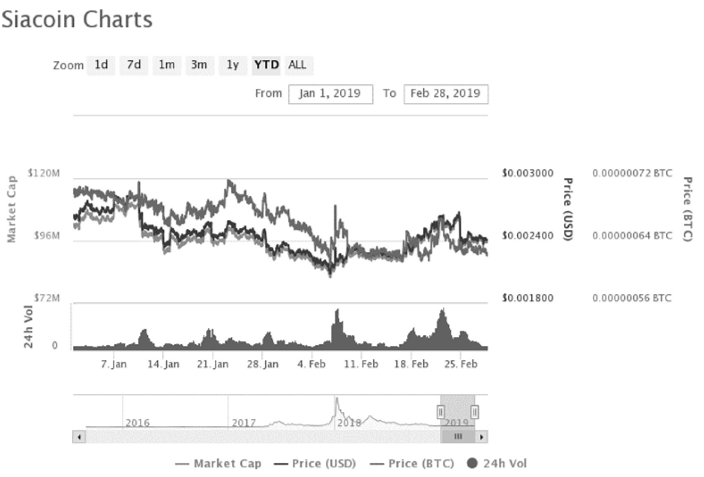
month, the cost of SC has climbed by l .47%. A slight bullish pattern is being seen in this one month with value point 0.002278 USD as an excellent help level [5].

