THE LOCATION OF THE MOSAICS AT GONUR
The vast majority of these mosaic compositions were destroyed long ago, due to multiple lootings of the tombs in the Royal Necropolis. As a result, we are left today with thousands of individual pieces with geometric and figurative decoration (see Shaposhnikova 2.012: figs. 6, 7) (Figure 11.10).
Apart from the finds in elite tombs of the Large Necropolis associated with containers for bronze mirrors mentioned above, a few compositions still in quite good condition have been brought to light in the hypogea. Those of the “fighting griffins,” the “griffin in a cartouche,” or the “dragons swallowing a goat” are obviously part of a large composition from tomb 3210 (Sarianidi 2005: figs. 67, 83, 85-86; 2006: fig. 11; 2008: figs. 147-159; 2009: figs. 117,120-126). A “portrait” comes from the chamber grave 3245 (Sarianidi 2005: fig. 105; 2009: fig. 136; Kovaleva 2016: figs. 23, 24). The “fight between flying dragons and snakes” together with a geometric decoration come from the front facade of the “house-like” tomb. A plaquette with a geometric polychrome pattern hanging from the neck of a camel lying in the “courtyard” was found in tomb 3880 (Sarianidi and Dubova 2010: figs. 22, 24-25, 27, 29, 30; 2013: figs. 27-28; 30, 32, 36-38).

Figure 11.io Four inlays in the shape of a dragon’s head from hypogeum 3210. © Margiana Archaeological Expedition.
Several jewelry boxes were preserved. They have different shapes and are decorated with geometric ornaments (tomb 3200) (Dubova 2004: figs. 27, 29; Sarianidi 2006: fig. 4; Kovaleva 2016: figs. 18-22) and presumably also floral ones (tomb 3235) (Sarianidi 2009: fig. 114). Similarly, three large (o.8/1.0 x o.6/0.8 x 0.6/0.8 m) “ostensories” have reached us: One, in tomb 3220 was decorated with “hearts” (or pipal leaves) (Sarianidi 2006: fig. 18; Sarianidi and Dubova 2013: fig. 10a); another, in tomb 3230, had a “carpet pattern” (Kovaleva 2012; Veresotskaja 2012, 2016a; Sarianidi and Dubova 2013: figs. 13, 14); the last and best-preserved one, from tomb 3880, is decorated with several rows of alternating crosses of different shapes (Sarianidi and Dubova 2010: figs. 17, 18; 2013: fig. 10c).
THE MOTIFS AND THEIR COMPARISONS
Today, most of the mosaics are stored and exhibited at the Museum of Fine Art of Turkmenistan (Ashgabat). The ostensory from tomb 3880 and some smaller compositions from burials 3870 and 3915 are stored in the Mary Regional History
Museum. N. Kovaleva and G. Veresotskaja are in charge of the restoration and study of these artifacts in the Museum of Fine Art. While analyzing the individual inlays from tomb 3210, G. Veresotskaja used the signs on their back. She was able to recover the lost shapes and sizes of the larger fragments and to complete in part the best-preserved composition of the “two griffins.” Her study of the technological characteristics and of the way the inlays were assembled has revealed that the blocks with the wing feathers were made from two different kinds of material, one certainly mineral (probably limestone) and the other made of a less dense and light material, the analysis of which are in process. These feather blocks, made of various materials, are placed in a checker pattern, with spaces colored in red or black. These technological characteristics will allow a more accurate restoration of the complex composition scheme decorating this royal tomb. They also show the deep knowledge of those who made these mosaics. On the basis of the various techniques that have been identified, Veresotskaja has significantly improved the reconstruction of the griffins from tomb 3210. The first restorations dealt with two independent representations, the “eagles in a heraldic position” (see Sarianidi 2008: fig. 129) and the “fighting griffins” (Veresotskaja 2016b: fig. 23), which turned out to be two registers of the same composition (Figure 11.11).
The mosaics are still under study. Nevertheless, one cannot ignore the amazing variety of the color range in these pictures although only red, black, and white paints were used. This effect was achieved using different techniques in the position of the tesserae and in the choice of the filling between them. The compositions closely resemble some of the painted scenes of the so-called “Zimri-Lim’s investiture” in the Amorite palace at Mari in Syria (Musée du Louvre, inventory no. AO19826).1 This is particularly the case of the “griffin in a cartouche,” exquisitely made by the Gonur craftsmen (Figure 11.12). In both the Gonur and Mari versions, the animal is placed in a frame surrounded by a dark border. The other representations in the investiture scene are framed in the same way. At Gonur, the black color was used in the final stage of the making of the mosaic, to outline or to draw the borders. The fantastic beast from Gonur Depe tomb 3210 has the torso of a lion, the head of a dragon, and spread wings. It is standing firm on its powerful legs. The head of the Syrian winged lion did not survive, but it may have worn horns. On the Gonur representation, the beast’s head is crowned with black curved horns. It also has a black, slightly curved forward and narrow beard similar to that usually depicted on Egyptian priests’ and pharaohs’ faces. Other griffins wearing the same beards are depicted on another composition found in the same tomb at Gonur. The griffin’s body is generally reminiscent of that of a lion’s torso, but there are still noticeable differences: there is no mane, a distinctive feature of a male lion, and the lower part of the belly is colored in bright red. The back of the neck of the griffin is similar to that of a buffalo or a zebu since it is depicted with a hump rising immediately behind the head. Several blocks are made of stone tesserae: the head with its wide-open jaws, the legs with their underlined muscles, and the wings made of tiny elements in order to underline their volume. The Syrian beast’s wings are also multicolored. But its torso is much less powerful, especially in the bottom part. In both pictures, the tails of the animals are raised up and tense. The Mari griffin’s tail is rolled around a multicolored disk. Interestingly, in the Mari picture, the lion-griffin cartouche stands over that of a humpback buffalo or zebu with its front leg standing over mountains. These comparisons vividly illustrate


Figure ii.ii Comparison between the mosaics “griffin in a cartouche” from hypogeum 3210 at Gonur Depe (bottom © Margiana Archaeological Expedition) and a fragment of the “Zimri-Lim’s investiture” painted scenes in the Amorite palace at Mari in Syria (top).
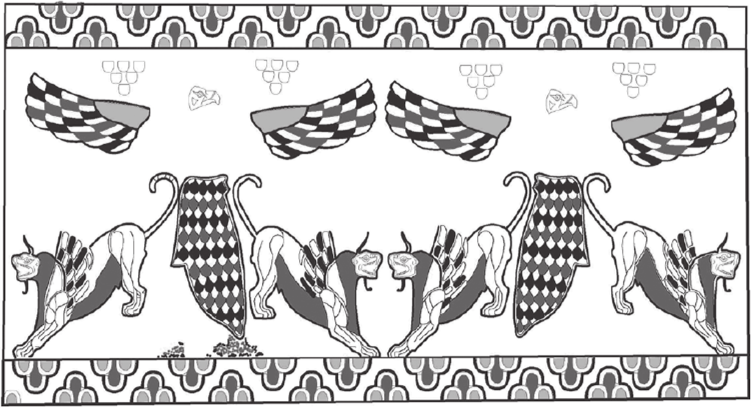
Figure ii.12 G. Veresotskaja’s reconstruction of one mosaic scene from hypogeum 3210. © Margiana Archaeological Expedition.
the close cultural ties between the country of Margush and the Near East at dates close one to the other (see endnote 2).
Other comparisons can be advanced between the birds’ figures (especially the heads) found at Gonur in hypogeum 3230 and the “small vulture” represented on a fragment of a gold vessel in the Fullol hoard of northeastern Afghanistan (Tosi and Wardak 1972: fig. 13).
As has already been mentioned, the Gonur mosaics are different from anything known before, as they combine two techniques - painting and inlays. Another remark is worthy of interest. Among the Gonur Depe finds, only one fragment represents a human face (burial 3245) (Figure 11.13), while complete human figures are typical in the third-millennium Mari mosaic compositions or on the famous standard of Ur, and they are also numerous in the early 2nd-millennium painted investiture scene mentioned above. However, many of the “tesserae” detached from the compositions in the Gonur tombs seem to represent elements of cloths (tombs 3210, 3230, 3235). There are also several pieces of large eyes (burial 3210; see, e.g., Shaposhnikova 2012: 173,174). Apparently, human beings (or composite figures?) were represented in some of the lost compositions, and must have all been painted.
It is remarkable that only a few individual inlays have been discovered in the Gonur palace itself or in the other buildings considered by Sarianidi as a temple. Obviously, there, these inlays are not in situ. All the surviving figurative mosaic compositions come from the elite burials. However, even in the wealthiest burial chambers, only small mirror cases, game boards, and ostensories with mosaic decoration have been found. We can only assume their meaning.
A wooden box decorated inside with flowers inlays (Figure 11.14) was found in the shaft tomb 3870 built next to the rich tomb 3220 in the “Royal Necropolis” at Gonur. This looks more like the 3rd-millennium finds of Mari and Ur since there are

Figure ii.13 Mosaic inlay in the shape of a human portrait from tomb 3245 in the Gonur Depe "Royal Necropolis.” Photo by K. Samurskij. © Margiana Archaeological Expedition.

Figure 11.14 Wooden box with mosaic inlays made of stone and ivory during cleaning in situ in chamber tomb 3870 at Gonur Depe. © Margiana Archaeological Expedition.
(almost) no painted elements. Four identical flowers are represented on the long sides of the box and two on the short sides.’ All the flowers are identical and have four oval petals, the inner parts of which are decorated with drop-shaped ivory inlays; their external outline and central part are made of a white-colored mineral.4 The rest of the sides are also decorated with inlays. The decoration consists of alternating stone and bone rectangular blocks from top to bottom, making six identical compositions where two right triangles made of a white mineral frame an isosceles triangle made of ivory standing on its summit. The edges of the whole composition, as its elements, are outlined in black. Some of the bone inlays making the frame of the flowers present traces of red paint.
To conclude this description, we would like to underline that the extraordinary mosaics discovered at Gonur, in tombs dated between 2300 and 2100 BC (Zajtseva et al. 2008) (or rather between 2150 and 1950, see the Appendix), demonstrate once more the high level of arts and crafts developed in the ancient Murghab oasis. We have just started the scientific analysis of the motifs and of the methods used to make these unique compositions that once decorated the walls of the elite burials and the ostensories. Remarkable results have already been achieved. Still, we are just at the beginning of our understanding of the symbolic or narrative meaning of the motifs. Hopefully, this will help us get an insight into the vision of the world and beliefs of these people. We hope that the uniqueness of the Gonur mosaics and the artistic mastery of their creators will also attract other researchers and specialists of the myths and legends of the ancient East, in order to reveal further the mysteries of this civilization, which remained hidden in the sands of the Kara Kum Desert for millennia.

